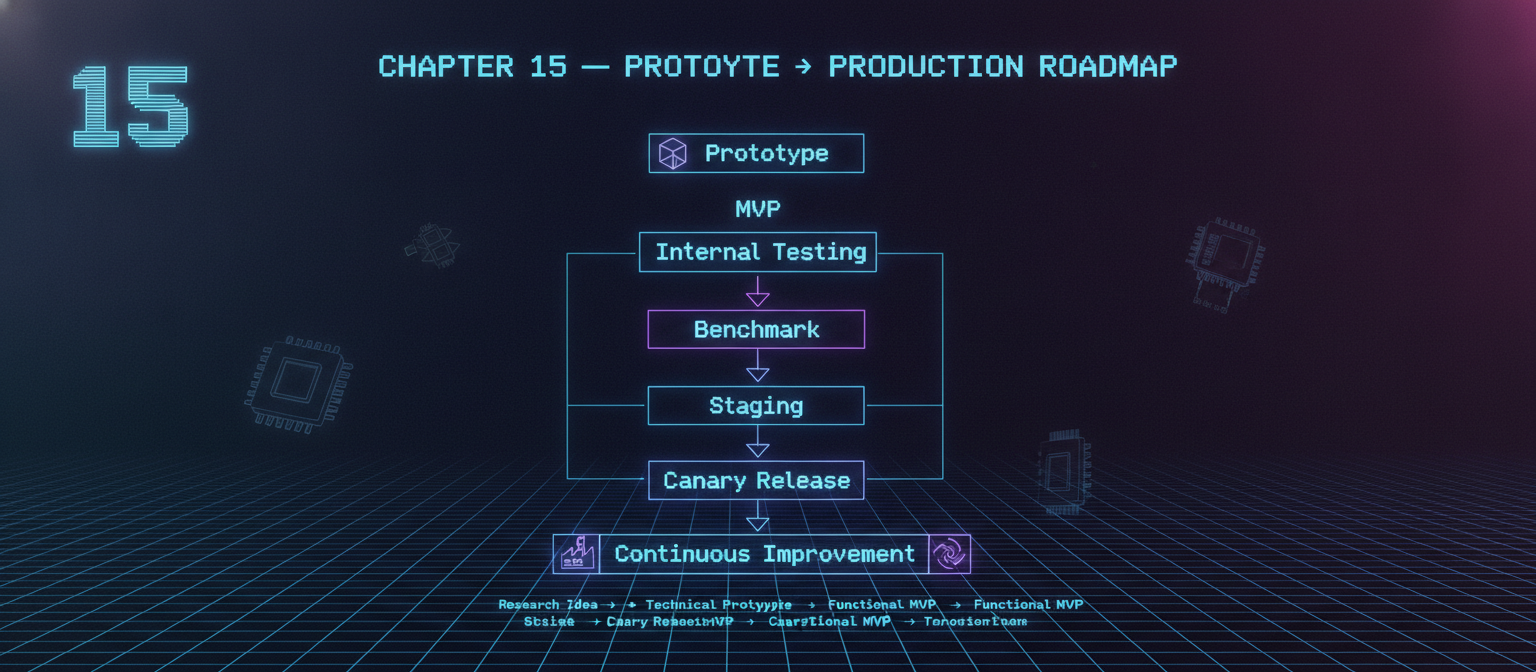
Prototype
↓
MVP
↓
Internal Testing
↓
Benchmark
↓
Staging
↓
Canary Release
↓
Production
↓
Continuous Improvement
15.1 Introduction
The ACAI architecture should not be built as a massive system from the beginning.
A more realistic approach is to develop it through controlled stages:
Each stage has a different objective. The purpose is to prevent unnecessary infrastructure and complexity before the core research hypothesis has been tested.
15.2 Stage 0 — Define the Research Problem
Before writing code, define exactly what ACAI is expected to improve.
For example:
Can a modular architecture combining planning, retrieval, adaptive memory, model routing, and verification improve selected complex tasks compared with a single-model baseline?
This question is much more useful than simply saying:
"Build a smarter AI."
The research question should be measurable.
15.3 Stage 1 — Technical Prototype
The first prototype should be intentionally small.
At this stage, the goal is simply to prove that the components can communicate correctly.
15.4 Prototype Requirements
The first working version should support:
-
User requests
-
Basic planning
-
Retrieval
-
Model generation
-
Basic verification
-
Logging
-
Error handling
It does not need:
-
Multiple data centers
-
Large GPU clusters
-
Hundreds of agents
-
Complex distributed infrastructure
-
Automatic self-modification
Those can come later if experiments justify them.
15.5 Stage 2 — Functional MVP
After the basic prototype works, create an MVP.
The MVP should have:
At this point, a small group of testers should be able to use the system.
15.6 Stage 3 — Evaluation Platform
Before adding more advanced capabilities, build the benchmark system.
This stage is extremely important.
Without it, developers may continue adding features without knowing whether the system is actually improving.
15.7 Stage 4 — Component Experiments
Now evaluate individual components.
Experiment A
Experiment B
Experiment C
Experiment D
Experiment E
Experiment F
This creates evidence about which components provide measurable benefits.
15.8 Stage 5 — Multi-Model Routing
Only after the basic architecture works should multi-model routing be introduced.
The router can select models according to:
-
Task type
-
Context length
-
Quality requirement
-
Latency requirement
-
Cost constraints
-
Availability
15.9 Stage 6 — Advanced Memory
Memory can then become more sophisticated.
The system should test whether these memory mechanisms actually improve performance.
If they do not, unnecessary memory complexity should be avoided.
15.10 Stage 7 — Tool Integration
Additional tools can be introduced gradually.
Possible categories:
Each tool should have:
15.11 Stage 8 — Production Hardening
Once the research system demonstrates useful performance, production engineering begins.
Add:
-
Authentication
-
Authorization
-
Rate limiting
-
Monitoring
-
Backups
-
Recovery procedures
-
Security testing
-
Load testing
-
Error tracking
-
Deployment automation
The architecture then changes from:
to:
15.12 Stage 9 — Staging Environment
Before real users receive the new version:
Staging should resemble production closely enough to reveal deployment-specific problems.
15.13 Stage 10 — Canary Deployment
A new release should initially serve a small percentage of traffic.
If the new version performs correctly:
If serious problems appear, traffic can be returned to the stable version.
15.14 Rollback Strategy
Every production deployment should have a rollback path.
Rollback should be tested rather than merely documented.
15.15 Stage 11 — Continuous Improvement
After production deployment, development does not stop.
Every recurring production failure can become a future evaluation case.
15.16 Research-to-Engineering Loop
The complete development cycle becomes:
This is much stronger than continuously adding features without measurement.
15.17 Suggested Team Structure
A small research project does not necessarily require a huge organization.
Potential responsibilities include:
AI/ML Engineer
Model integration, evaluation, prompting, routing.
Backend Engineer
APIs, orchestration, databases, queues.
Frontend Engineer
User interface and interaction.
Infrastructure Engineer
Deployment, monitoring, scaling.
Security Engineer
Security architecture and testing.
Research Lead
Experimental design, benchmarks, analysis, documentation.
In a small team, one person may perform multiple roles.
15.18 Development Repository
A practical project structure might look like:
The exact structure can vary with the programming language and deployment strategy.
15.19 Versioning Strategy
The project should version:
For example:
This allows researchers to reproduce earlier experiments.
15.20 Release Criteria
A new release should meet predefined criteria.
Example:
The exact thresholds should be defined before the release.
15.21 Production Readiness Checklist
Application
AI
Infrastructure
Security
15.22 What Should Not Be Automated Initially?
Some functions should remain manually controlled during early research.
For example:
Instead:
This gives researchers control while the architecture is still being validated.
15.23 Long-Term Scaling
If experiments demonstrate strong value, ACAI can eventually scale into a larger infrastructure.
However, this level of infrastructure should only be built when actual requirements justify it.
15.24 Realistic Timeline Structure
Instead of promising a fixed number of months, the project can use milestones.
Milestone 1
Basic model + API working.
Milestone 2
Planner and retrieval working.
Milestone 3
Memory and verification working.
Milestone 4
Benchmark framework working.
Milestone 5
Baseline comparison completed.
Milestone 6
Ablation study completed.
Milestone 7
Security and reliability testing completed.
Milestone 8
Production candidate deployed in staging.
Milestone 9
Controlled real-user testing.
Milestone 10
Production deployment.
The project advances when each milestone meets its acceptance criteria.
15.25 Go / No-Go Decision
At each major stage, the project should make an evidence-based decision.
This prevents sunk-cost thinking.
15.26 Final Production Architecture
After successful validation, the architecture may look like:
15.27 The Most Important Implementation Rule
The entire roadmap can be summarized as:
This is the most realistic path for turning the ACAI concept into an actual research system.
15.28 Chapter Summary
Chapter 15 established a complete path from research concept to production deployment.
The proposed lifecycle is:
The key idea is evidence-driven development.
ACAI should become more complex only when experiments demonstrate that the added complexity provides sufficient benefit.
That makes the roadmap practical for a small research team while leaving a clear path toward a much larger production system if the experimental results justify it.
End of Chapter 15


Comments
Post a Comment