Final Chapter — Conclusion, References & Research Appendix


Final Chapter

Conclusion

Adaptive Cognitive AI (ACAI) proposes a practical architecture for building more capable AI applications around existing foundation models.

The central idea is simple:

The future of AI does not necessarily depend only on making a single model larger; system-level intelligence can also be improved through better planning, memory, retrieval, orchestration, verification, and evaluation.

The architecture combines:

User Interface
      ↓
Intent Analysis
      ↓
Planning
      ↓
Adaptive Memory
      ↓
Knowledge Retrieval
      ↓
Context Optimization
      ↓
Model Routing
      ↓
Cognitive Reasoning
      ↓
Multi-Agent Coordination
      ↓
Verification
      ↓
Confidence Estimation
      ↓
Response Optimization
      ↓
Monitoring
      ↓
Continuous Improvement

The most important scientific principle of this proposal is that none of these architectural ideas should be treated as proven simply because they appear theoretically useful.

The actual contribution must be demonstrated through implementation, controlled experiments, reproducible benchmarks, failure analysis, and comparison against strong baselines.

A realistic first prototype does not require a massive AI laboratory. A small implementation can begin with one foundation model, a planner, retrieval, basic memory, verification, and an evaluation dataset. Additional components can then be introduced one at a time.

If experiments demonstrate measurable improvements in selected tasks, the architecture can be expanded. If a component fails to provide sufficient benefit relative to its cost and complexity, it should be redesigned or removed.

That experimental discipline is what can transform ACAI from an architectural idea into a legitimate engineering and research project.


Final System

                         ┌──────────────┐
                         │     USER     │
                         └──────┬───────┘
                                │
                                ▼
                       ┌─────────────────┐
                       │  API / SESSION  │
                       └───────┬─────────┘
                               │
                               ▼
                       ┌─────────────────┐
                       │ INTENT ANALYZER │
                       └───────┬─────────┘
                               │
                               ▼
                       ┌─────────────────┐
                       │  TASK PLANNER   │
                       └───────┬─────────┘
                               │
                 ┌─────────────┼─────────────┐
                 ▼             ▼             ▼
            ┌────────┐   ┌──────────┐   ┌─────────┐
            │ MEMORY │   │RETRIEVAL │   │  TOOLS  │
            └────┬───┘   └────┬─────┘   └────┬────┘
                 └─────────────┼──────────────┘
                               ▼
                       ┌─────────────────┐
                       │ CONTEXT ENGINE  │
                       └───────┬─────────┘
                               │
                               ▼
                       ┌─────────────────┐
                       │  MODEL ROUTER   │
                       └───────┬─────────┘
                               │
                 ┌─────────────┼─────────────┐
                 ▼             ▼             ▼
              Model A       Model B       Model C
                 └─────────────┼─────────────┘
                               ▼
                       ┌─────────────────┐
                       │   COORDINATOR   │
                       └───────┬─────────┘
                               │
                               ▼
                       ┌─────────────────┐
                       │  VERIFICATION   │
                       └───────┬─────────┘
                               │
                               ▼
                       ┌─────────────────┐
                       │   CONFIDENCE    │
                       └───────┬─────────┘
                               │
                               ▼
                       ┌─────────────────┐
                       │    RESPONSE     │
                       └───────┬─────────┘
                               │
                               ▼
                              USER

Final Statement

Post cover

17.1 Conclusion

This document has presented ACAI as a proposed architecture for building more capable, modular, testable, and controllable AI systems.

The central idea is not that one model must perform every operation itself.

Instead, the architecture separates important functions:

                         USER
                           │
                           ▼
                    Intent Analysis
                           │
                           ▼
                        Planner
                           │
              ┌────────────┼────────────┐
              ▼            ▼            ▼
           Memory       Retrieval      Tools
              │            │            │
              └────────────┼────────────┘
                           ▼
                      Model Router
                           │
                           ▼
                    Selected Model
                           │
                           ▼
                      Verification
                           │
                           ▼
                       Response
                           │
                           ▼
                    Evaluation/Logs

The objective is to create a system in which each major capability can be independently developed, tested, replaced, and measured.


17.2 The Core Principle

The entire project can be summarized in one principle:

Do not assume that architectural complexity produces intelligence; measure whether each architectural component produces useful improvement.

This principle protects the project from a common failure mode in AI engineering: continuously adding models, agents, tools, memory systems, and prompts without establishing whether they actually improve the intended task.


17.3 From Single Model to AI System

Traditional AI applications often resemble:

Prompt
  ↓
Model
  ↓
Answer

ACAI proposes a broader system:

Request
   ↓
Understand
   ↓
Plan
   ↓
Retrieve
   ↓
Remember
   ↓
Select Model
   ↓
Use Tools
   ↓
Generate
   ↓
Verify
   ↓
Respond
   ↓
Evaluate

This does not mean that every request must pass through every stage.

A practical implementation should dynamically bypass unnecessary components.

For example:

Simple Question
      ↓
Model
      ↓
Answer

while:

Complex Research Task
      ↓
Planning
      ↓
Retrieval
      ↓
Multiple Model Calls
      ↓
Verification
      ↓
Answer

This adaptive behavior can reduce unnecessary cost and latency.


17.4 The Complete Experimental Loop

The proposed system should continuously follow:

                 ┌───────────────┐
                 │ Research Idea │
                 └───────┬───────┘
                         ▼
                    Hypothesis
                         │
                         ▼
                      Prototype
                         │
                         ▼
                     Benchmark
                         │
                         ▼
                     Experiment
                         │
                         ▼
                       Results
                         │
                ┌────────┴────────┐
                ▼                 ▼
             Improve          Remove
                │                 │
                └────────┬────────┘
                         ▼
                    New Version
                         │
                         └──────────→ Benchmark

This loop is more important than any individual component.


17.5 What the System Should Demonstrate

A successful implementation should eventually answer measurable questions such as:

Does planning help?

Baseline
   vs
Baseline + Planner

Does retrieval help?

Baseline
   vs
Baseline + Retrieval

Does memory help?

Without Memory
      vs
With Memory

Does verification help?

Generation
    vs
Generation + Verification

Does routing improve efficiency?

Single Model
      vs
Adaptive Model Routing

Does the complete architecture outperform the baseline?

Baseline
    vs
Full ACAI

These comparisons should form the scientific core of the project.


17.6 What Counts as Success?

Success should not be defined as:

"The AI feels smarter."

Instead, success should be defined using measurable criteria.

For example:

Task Success
Accuracy
Retrieval Quality
Planning Quality
Error Rate
Latency
Cost
Reliability
User Satisfaction

A particular deployment may prioritize some metrics over others.


17.7 A Multi-Dimensional Objective

The project can therefore think of system quality as:

                    SYSTEM QUALITY
                         │
       ┌─────────────────┼─────────────────┐
       ▼                 ▼                 ▼
    Quality           Efficiency        Reliability
       │                 │                 │
    Accuracy          Latency           Availability
    Completeness      Cost              Recovery
    Relevance         Resources         Failure Rate

The optimal architecture is not necessarily the one with the highest accuracy at any cost.

A more useful system may provide a strong balance between quality, cost, latency, and reliability.


17.8 Practical Implementation Philosophy

The implementation should follow:

Start Small
    ↓
Make It Work
    ↓
Make It Measurable
    ↓
Make It Reliable
    ↓
Make It Secure
    ↓
Scale It

Not:

Build Everything
    ↓
Hope It Works

17.9 Research Reproducibility

A credible research implementation should preserve:

Code Version
Model Version
Dataset Version
Prompt Version
Configuration
Hardware
Evaluation Script
Results

A future researcher should be able to understand how a reported result was produced.


17.10 Research Ethics

The project should avoid presenting hypothetical results as real results.

For example, this is inappropriate before experimentation:

"ACAI increases accuracy by 35%."

Unless an experiment actually produced that result, the statement should not be made.

A scientifically responsible statement is:

"The proposed architecture will be evaluated to determine whether it improves accuracy relative to the selected baseline."

This distinction is essential.


17.11 Important Limitations

The architecture has significant limitations.

It may introduce:

  • Additional latency
  • Higher infrastructure cost
  • More failure points
  • More complicated debugging
  • More security boundaries
  • Memory errors
  • Retrieval errors
  • Routing errors
  • Verification errors

Therefore, ACAI should not automatically replace simpler architectures.

The appropriate architecture depends on the workload.


17.12 When a Simpler System Is Better

For a simple task:

Question
 ↓
Model
 ↓
Answer

may be superior because it is:

  • Faster
  • Cheaper
  • Easier to maintain
  • Easier to debug

ACAI becomes more interesting when the task requires several interacting capabilities.

For example:

Large Research Task
      ↓
Multiple Sources
      ↓
Long Context
      ↓
Planning
      ↓
Verification
      ↓
Complex Output

17.13 The Real Research Question

The deepest question behind the project is therefore:

Under what conditions does a modular AI architecture outperform a simpler single-model architecture enough to justify its additional complexity?

This is a much stronger research question than simply asking:

"Can we build a bigger AI?"

It is measurable, experimentally testable, and relevant to real AI engineering.


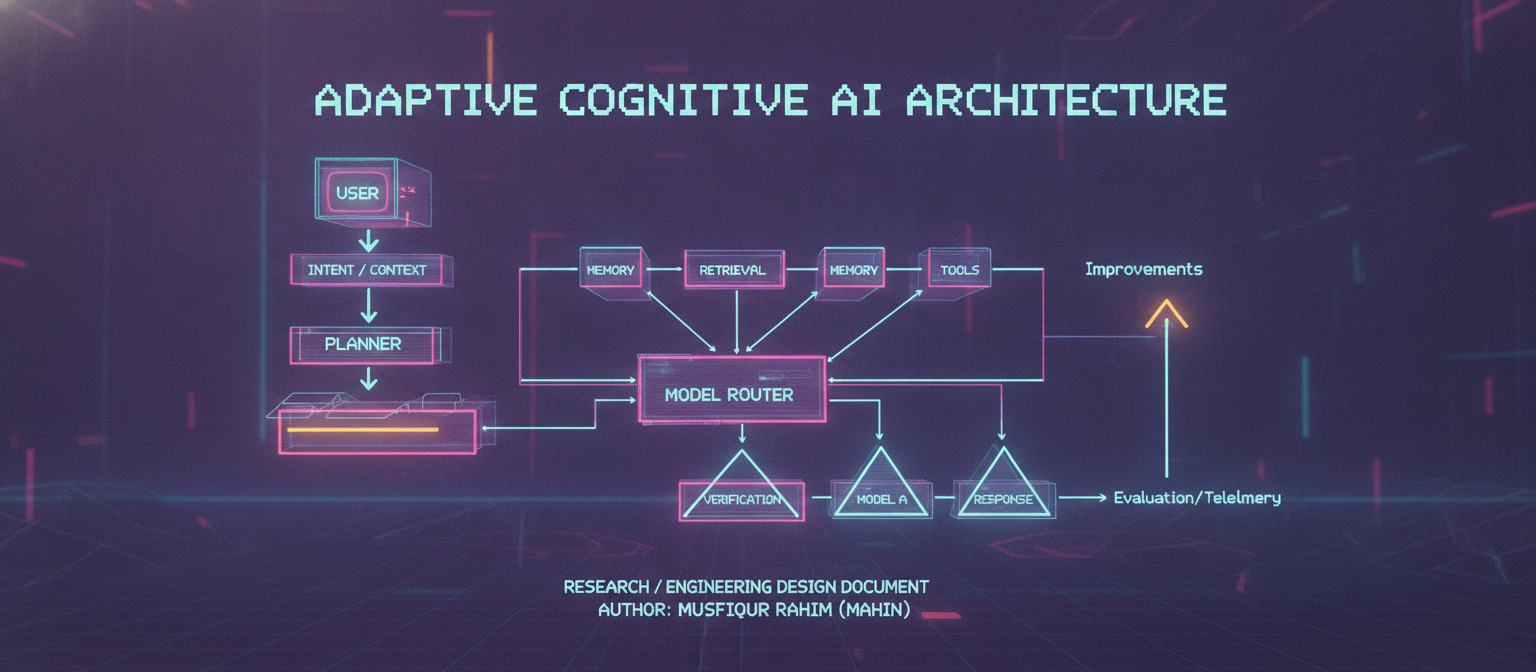
17.14 Final Architecture

The complete conceptual system can be represented as:

                              ┌───────────────┐
                              │     USER      │
                              └───────┬───────┘
                                      │
                                      ▼
                            ┌──────────────────┐
                            │ Intent / Context │
                            └────────┬─────────┘
                                     │
                                     ▼
                            ┌──────────────────┐
                            │     PLANNER      │
                            └────────┬─────────┘
                                     │
                    ┌────────────────┼────────────────┐
                    ▼                ▼                ▼
             ┌────────────┐   ┌────────────┐   ┌────────────┐
             │   MEMORY   │   │ RETRIEVAL  │   │   TOOLS    │
             └─────┬──────┘   └─────┬──────┘   └─────┬──────┘
                   │                │                │
                   └────────────────┼────────────────┘
                                    ▼
                           ┌─────────────────┐
                           │  MODEL ROUTER   │
                           └────────┬────────┘
                                    │
                    ┌───────────────┼───────────────┐
                    ▼               ▼               ▼
               ┌─────────┐     ┌─────────┐     ┌─────────┐
               │ Model A │     │ Model B │     │ Model C │
               └────┬────┘     └────┬────┘     └────┬────┘
                    └───────────────┼───────────────┘
                                    ▼
                           ┌─────────────────┐
                           │   VERIFICATION  │
                           └────────┬────────┘
                                    │
                                    ▼
                             ┌────────────┐
                             │  RESPONSE  │
                             └─────┬──────┘
                                   │
                                   ▼
                         ┌────────────────────┐
                         │ Evaluation/Telemetry│
                         └─────────┬──────────┘
                                   │
                                   ▼
                              Improvements

17.15 Final Implementation Roadmap

The practical order should be:

STEP 1
Basic Model Interface
        ↓
STEP 2
Orchestrator
        ↓
STEP 3
Planner
        ↓
STEP 4
Retrieval
        ↓
STEP 5
Memory
        ↓
STEP 6
Verification
        ↓
STEP 7
Model Routing
        ↓
STEP 8
Tool Gateway
        ↓
STEP 9
Evaluation System
        ↓
STEP 10
Security Hardening
        ↓
STEP 11
Load Testing
        ↓
STEP 12
Staging Deployment
        ↓
STEP 13
Controlled Production

At every stage:

IMPLEMENT
   ↓
TEST
   ↓
MEASURE
   ↓
DOCUMENT

17.16 Research Appendix A — Minimum Prototype

A realistic first prototype does not need dozens of services.

A minimal version could contain:

1. API Server
2. One Foundation Model
3. Planner
4. Retrieval Module
5. Simple Memory Store
6. Verification Module
7. Benchmark Runner
8. Logging

This is enough to test the central architecture.


17.17 Research Appendix B — Example Request

A complex request could flow through the system as follows:

User:
"Analyze these research papers and compare their conclusions."

Step 1 — Intent

Research comparison

Step 2 — Planner

1. Identify papers
2. Extract claims
3. Compare methodologies
4. Compare conclusions
5. Identify disagreements
6. Produce synthesis

Step 3 — Retrieval

Relevant sections
      ↓
Evidence Context

Step 4 — Model Routing

Research task
      ↓
Research-capable model

Step 5 — Generation

Draft comparison

Step 6 — Verification

Check claims against sources

Step 7 — Final Response

Evidence-backed synthesis

This example demonstrates why a modular architecture can be useful for complex tasks.


17.18 Research Appendix C — Example Test Matrix

TaskBaselineRetrievalPlanningMemoryVerificationFull ACAI
QATestTestTestTestTestTest
CodingTestTestTestTestTestTest
ResearchTestTestTestTestTestTest
MathTestTestTestTestTestTest
Long ContextTestTestTestTestTestTest

The actual numerical results should be filled only after running experiments.


17.19 Research Appendix D — Minimum Metrics

A first evaluation can begin with:

1. Task Accuracy
2. Task Completion
3. Error Rate
4. Latency
5. Cost

Later, additional metrics can be added:

Retrieval Precision
Retrieval Recall
Planning Quality
Memory Retrieval Quality
Verification Detection Rate
Human Preference
Reliability

17.20 Research Appendix E — Minimum Technology Stack

The architecture does not require a single mandatory technology stack.

A practical implementation could use:

Frontend
   ↓
Web Application

Backend
   ↓
API + Orchestrator

Storage
   ↓
SQL / Document Database

Retrieval
   ↓
Vector Search

Models
   ↓
One or More Model Providers

Evaluation
   ↓
Python / Benchmark Framework

Deployment
   ↓
Cloud or Local Infrastructure

The exact technologies should be selected based on project requirements rather than added merely for complexity.


17.21 Final Statement

ACAI should ultimately be judged by one thing:

Evidence.

Not by the size of its architecture.

Not by the number of models.

Not by the number of agents.

Not by the length of its prompts.

Not by an impressive demonstration.

The strongest version of this project would be one where another researcher can take the implementation, run the benchmark, reproduce the experiments, inspect the failures, and independently determine whether the proposed architecture provides a meaningful advantage.

That is what would transform ACAI from an interesting concept into a serious engineering and research contribution.


References

For the final publication, references should be added to the specific technical claims actually used in the paper.

Useful foundational areas to reference include:

  1. Transformer architectures and modern sequence modeling.
  2. Retrieval-augmented generation.
  3. Tool-using language models.
  4. AI-agent architectures.
  5. Long-term and external memory for language models.
  6. Model routing and mixture-of-experts systems.
  7. LLM evaluation methodologies.
  8. Human evaluation of generated text.
  9. AI security and prompt-injection research.
  10. Reliable distributed-system design.
  11. Model calibration and uncertainty estimation.
  12. Reproducible machine-learning experimentation.

The bibliography should be constructed from the actual papers and sources used in the final research version, rather than inserting references merely to make the document appear more academic.


Final Conclusion

The proposed ACAI architecture provides a framework for investigating whether AI systems can become more capable and reliable through modular coordination rather than dependence on a single model call.

Its architecture combines:

Planning
+
Memory
+
Retrieval
+
Model Routing
+
Tools
+
Verification
+
Evaluation

But the architecture itself is not the final result.

The real contribution will come from the experiments.

The project should therefore follow this final principle:

                 BUILD
                   ↓
                 TEST
                   ↓
                MEASURE
                   ↓
                COMPARE
                   ↓
                ANALYZE
                   ↓
                IMPROVE
                   ↓
               REPRODUCE

If measurable improvements are demonstrated, the evidence can support a research claim.

If improvements are not demonstrated, the experiments still provide valuable information about which assumptions were wrong.

That is the difference between an AI concept and a scientifically testable AI system.


END OF DOCUMENT

ACAI — Adaptive Cognitive AI Architecture

Research / Engineering Design Document

Prepared as a proposed, experimentally testable architecture

Author: Musfiqur Rahim (Mahin)


🚀 Connect with Black Shadow Team Across the Web! 🌐

We are actively sharing our latest cybersecurity research, AI safety insights, ethical hacking content, and tech updates across multiple platforms. Follow and subscribe to stay updated with our official channels:

📝 Articles & Research Papers:

Medium: https://medium.com/@blackshadowteam.net

Substack: https://blackshadowteam.substack.com

Dev.to: https://dev.to/black_shadow_team

HackerNoon: https://hackernoon.com/u/black-shadow-team

Hashnode: https://hashnode.com/@black-shadow-team

Blogspot: https://black-shadow-team.blogspot.com/

💻 Code & Open Source:

GitHub: https://github.com/blackshadowteamnet-netizen

WordPress: https://profiles.wordpress.org/blackshadowteam

📱 Social Media & Updates:

X (Twitter): https://x.com/BlackShadoTeam

Facebook Page: https://www.facebook.com/profile.php?id=61591268330812

Facebook Profile: https://www.facebook.com/profile.php?id=100090580510673

Instagram: https://www.instagram.com/black_shadow_team_x/

Threads: https://www.threads.net/@blacky_mahin_x

Bluesky: https://bsky.app/profile/black-shadow-team.bsky.social

💬 Community & Discussions:

Reddit: https://www.reddit.com/user/blackshadowteamoffic/

Quora (Bangla): https://bn.quora.com/profile/Black-Shadow-Team

Mix: https://mix.com/black_shadow_team

Discord: https://discord.com/channels/1518981404074184725/1518981404632023143

🎵 Short Videos & Audio:

TikTok: https://www.tiktok.com/@blackshadowteam.net

SoundCloud: https://on.soundcloud.com/VBWtOYsgktkw37kAza

Goodreads: https://www.goodreads.com/user/show/203582586-black-shadow-team-team

Stay connected and join our growing cybersecurity community! 🛡️✨

Comments

Popular posts from this blog

Adaptive Cognitive AI (ACAI): Chapter 1 — Introduction & System Vision

Chapter 2 (Part 2) Knowledge Retrieval Engine

Adaptive Cognitive AI (ACAI) Chapter 2 (Part 1).