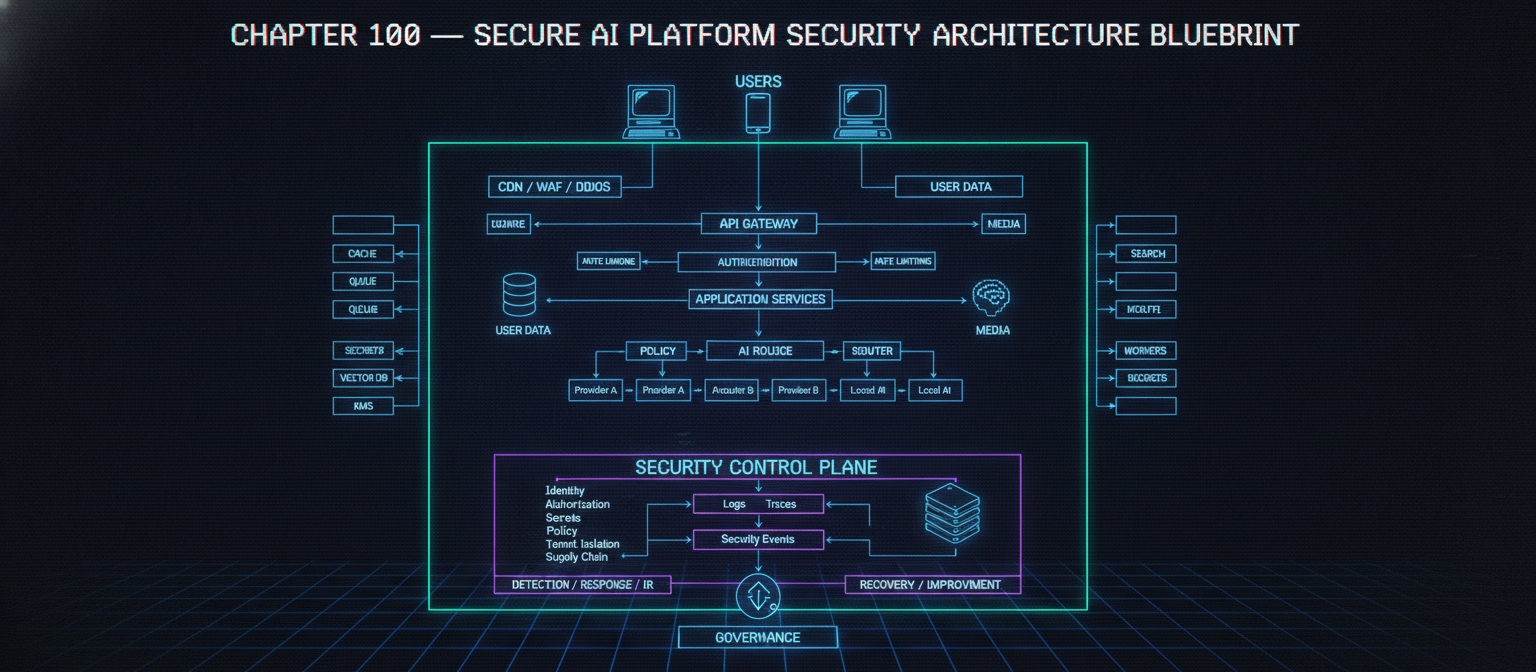
Chapter 100 — Secure AI Platform Security Architecture Blueprint
100.1 Introduction
A secure AI platform requires more than individual security controls.
Authentication, encryption, network segmentation, AI safety, database security, monitoring, backup, and governance must work together as one architecture.
This chapter combines the major security concepts developed throughout the previous chapters into a single end-to-end reference architecture.
The objective is to establish a practical blueprint for a production-grade AI platform that can support:
web and mobile clients,
AI inference,
RAG,
agents,
media processing,
user accounts,
subscriptions,
object storage,
databases,
queues,
external providers,
observability,
security operations,
governance,
disaster recovery.
The architecture follows one fundamental principle:
Every request, identity, dataset, model, tool, service, and external dependency should have an explicit trust boundary and appropriate security controls.
100.2 Reference Architecture
A high-level architecture can be represented as:
                         USERS
                           │
              ┌────────────┴────────────┐
              │                         │
          Web Client                Mobile Client
              │                         │
              └────────────┬────────────┘
                           ↓
                    CDN / Edge Layer
                           ↓
                    WAF / DDoS Layer
                           ↓
                     API Gateway
                           ↓
              ┌────────────┴────────────┐
              │                         │
        Authentication            Rate Limiting
              │                         │
              └────────────┬────────────┘
                           ↓
                    Application Layer
                           │
       ┌───────────────────┼────────────────────┐
       ↓                   ↓                    ↓
   User Service        AI Service          Media Service
       │                   │                    │
       ↓                   ↓                    ↓
   PostgreSQL         AI Policy Engine      Job Queue
                           │                    │
                           ↓                    ↓
                     AI Router             Workers
                           │                    │
              ┌────────────┼────────────┐       ↓
              ↓            ↓            ↓   Object Storage
          Provider A   Provider B   Local AI
              │            │
              └────────────┴────────────┘
                           │
                           ↓
                    External Services

Supporting layers:

    Cache ─ Queue ─ Search ─ Vector DB ─ Secrets ─ KMS
                           │
                           ↓
                Logging / Metrics / Tracing
                           │
                           ↓
                      SIEM / SOC
                           │
                           ↓
              Detection / Incident Response
100.3 Security Architecture Layers
The platform should be viewed as multiple cooperating layers.
Layer 1 — User and Client
Controls include:
secure authentication,
session protection,
client-side validation,
secure storage,
CSP,
safe file handling.
Layer 2 — Edge
Controls include:
TLS,
CDN,
WAF,
DDoS protection,
request filtering.
Layer 3 — API
Controls include:
authentication,
authorization,
rate limiting,
input validation,
schema validation,
API monitoring.
Layer 4 — Application
Controls include:
business authorization,
policy enforcement,
tenant isolation,
secure workflows.
Layer 5 — AI
Controls include:
model routing,
prompt validation,
output validation,
AI safety policies,
tool permissions,
agent isolation.
Layer 6 — Data
Controls include:
encryption,
access control,
classification,
retention,
backups,
deletion.
Layer 7 — Infrastructure
Controls include:
network segmentation,
workload identity,
container security,
runtime protection,
infrastructure policy.
Layer 8 — Operations
Controls include:
monitoring,
detection,
incident response,
recovery,
governance.
100.4 Trust Boundaries
A trust boundary identifies where assumptions about security change.
Important boundaries include:
Internet
   │
   ▼
Edge
   │
   ▼
API Gateway
   │
   ▼
Application
   │
   ├── Database
   ├── Object Storage
   ├── Queue
   └── AI Layer
          │
          ├── External Models
          └── Tools
Each boundary should have explicit controls.
100.5 Zero-Trust Architecture
The platform should not automatically trust:
users,
devices,
internal services,
AI models,
agents,
plugins,
external APIs,
network locations.
Instead, access should be based on:
Identity + Authentication + Authorization + Context + Policy
100.6 Identity Plane
The identity plane manages:
users,
service identities,
administrators,
AI agents,
workloads.
Each identity should have a defined purpose.
Example:
User Identity
Service Identity
Worker Identity
Agent Identity
Administrator Identity
Identities should not be casually interchangeable.
100.7 Authentication
Authentication establishes:
Who or what is making this request?
Possible mechanisms include:
password authentication,
passkeys,
MFA,
OAuth/OIDC,
service credentials,
workload identity.
The strongest available authentication should be applied according to risk.
100.8 Authorization
Authentication alone is insufficient.
Authorization determines:
What is this identity allowed to do?
A secure platform should enforce authorization at the server side.
100.9 Policy Engine
A centralized policy layer can provide consistent security decisions.
Request
  ↓
Identity
  ↓
Policy Engine
  ↓
Allow / Deny / Require Approval
Policies can consider:
user role,
tenant,
resource,
operation,
data classification,
risk level.
100.10 Tenant Isolation
Multi-tenant systems must prevent cross-tenant access.
Tenant boundaries should be enforced across:
database records,
object storage,
caches,
vector databases,
search indexes,
queues,
logs,
AI memory.
The tenant identifier should never be treated as sufficient authorization by itself.
100.11 Application Layer
The application layer coordinates business functionality.
Important services may include:
User Service
Project Service
AI Service
Media Service
Billing Service
Notification Service
Search Service
Administration Service
Each service should have a clearly defined responsibility.
100.12 API Gateway
The gateway provides the first major application security boundary.
Possible responsibilities:
Business authorization should still occur within the appropriate application service.
100.13 Input Validation
All externally supplied data should be treated as untrusted.
Validation should cover:
type,
length,
format,
allowed values,
file type,
request size,
schema.
Validation should occur before sensitive processing.
100.14 Output Validation
Application outputs should also be validated.
This is particularly important for AI systems.
Model Output
    ↓
Schema Validation
    ↓
Safety Validation
    ↓
Business Validation
    ↓
Application
AI output should not automatically become trusted application instructions.
100.15 AI Security Boundary
The AI layer should have its own security boundary.
It should contain:
provider routing,
model policies,
prompt handling,
output validation,
token controls,
safety filters,
tool authorization,
AI telemetry.
100.16 AI Provider Router
The provider router abstracts external and internal models.
AI Request
    ↓
AI Policy
    ↓
Provider Router
    ├── Provider A
    ├── Provider B
    ├── Provider C
    └── Local Model
Routing decisions may consider:
task,
privacy requirements,
model capability,
cost,
latency,
availability.
100.17 AI Data Boundary
Before sending data to a model, determine:
What data is being transmitted?
Is the provider approved?
Is the data allowed to leave the platform?
Does the provider retain it?
Is redaction required?
100.18 Prompt Security
Prompts should not be treated as inherently trusted.
AI applications should defend against:
prompt injection,
indirect prompt injection,
malicious retrieved content,
instruction conflicts,
unsafe tool requests.
The application should maintain the authoritative security policy outside the model.
100.19 RAG Security
The RAG pipeline should enforce:
Query
 ↓
Identity
 ↓
Tenant Filter
 ↓
Authorization
 ↓
Retrieval
 ↓
Content Validation
 ↓
Context Construction
 ↓
Model
Retrieval should never bypass normal authorization.
100.20 Memory Security
AI memory should be treated as sensitive application data.
Controls should include:
Users should be able to understand and control appropriate memory behavior.
100.21 Agent Security
Agents should have:
unique identity,
explicit permissions,
limited tools,
resource limits,
action logging,
approval controls.
An agent should not automatically inherit all permissions of the person who created it.
100.22 Tool Authorization
Tool calls should pass through authorization.
Agent
  ↓
Tool Request
  ↓
Policy Engine
  ↓
Permission Check
  ↓
Tool
Sensitive tools should require stronger controls.
100.23 Agent Sandboxing
Where agents execute code or untrusted operations, use isolation appropriate to the risk.
Possible controls include:
100.24 Human Approval
High-impact agent operations should support human approval.
Examples:
The approval workflow should be auditable.
100.25 Media Security Layer
AI media systems must treat uploaded files as untrusted.
The pipeline should include:
Upload
  ↓
Quarantine
  ↓
Validation
  ↓
Malware Scanning
  ↓
Metadata Analysis
  ↓
Sandbox Processing
  ↓
Output Validation
  ↓
Trusted Storage
100.26 Object Storage Security
Object storage should use:
private buckets/containers,
scoped access,
signed URLs where appropriate,
encryption,
lifecycle policies,
malware scanning,
tenant isolation.
Public access should not be the default.
100.27 Database Security
The database layer should implement:
Application users should not receive direct database access.
100.28 Cache Security
Caches can contain sensitive information.
Security considerations include:
A cache key should never accidentally expose another user's data.
100.29 Queue Security
Queues should enforce:
authenticated producers,
authenticated consumers,
message validation,
retry limits,
dead-letter handling,
tenant isolation,
sensitive-data controls.
100.30 Secrets Architecture
Secrets should be stored separately from source code.
Examples:
API credentials,
database passwords,
signing keys,
encryption keys,
provider credentials.
The application should retrieve secrets through an approved secret-management mechanism.
100.31 Cryptographic Architecture
Encryption should protect:
Data in transit
Use appropriately secured TLS connections.
Data at rest
Use storage/database encryption.
Sensitive application values
Use appropriate cryptographic protection.
Keys should be managed separately from the data they protect.
100.32 Key Management
A mature key architecture includes:
Key Management System
        │
        ├── Encryption Keys
        ├── Signing Keys
        ├── Rotation
        ├── Access Policies
        └── Audit Logs
Keys should have lifecycle management.
100.33 Network Architecture
Network segmentation can separate:
Internet Zone
    ↓
Edge Zone
    ↓
Application Zone
    ↓
Data Zone
    ↓
Management Zone
The exact implementation depends on infrastructure.
100.34 Service-to-Service Security
Internal communication should use authenticated service identities.
Do not assume:
Internal network = trusted network.
Service authorization should remain explicit.
100.35 Kubernetes Security
If Kubernetes is used, important controls include:
namespace isolation,
RBAC,
workload identity,
admission controls,
image verification,
network policies,
resource limits,
pod security controls,
secret management.
100.36 Container Security
Containers should use:
minimal images,
pinned dependencies,
non-root execution where practical,
vulnerability scanning,
read-only filesystems where appropriate,
restricted capabilities.
100.37 CI/CD Security
The build pipeline should verify:
Source
 ↓
Code Review
 ↓
Dependency Scan
 ↓
SAST
 ↓
Tests
 ↓
Build
 ↓
Artifact Verification
 ↓
Security Gates
 ↓
Deployment
Production deployment should not depend on an uncontrolled developer workstation.
100.38 Software Supply Chain
Supply-chain security should cover:
source repositories,
package registries,
dependencies,
build systems,
container images,
AI models,
plugins.
Maintain provenance for production artifacts.
100.39 SBOM
Maintain an inventory of software components.
The SBOM should support:
vulnerability response,
dependency visibility,
license management,
incident investigation.
100.40 Observability Architecture
The platform should collect:
Metrics
Performance and availability.
Logs
Security and application events.
Traces
Distributed request flow.
Security Events
Authentication, authorization, policy, and suspicious behavior.
100.41 Security Telemetry Pipeline
Applications
   │
   ├── Logs
   ├── Metrics
   ├── Traces
   └── Security Events
          ↓
     Telemetry Layer
          ↓
         SIEM
          ↓
   Detection Engineering
          ↓
         SOC
100.42 AI Security Monitoring
AI-specific telemetry may include:
prompt-injection detections,
policy violations,
abnormal tool calls,
unusual token consumption,
unexpected provider routing,
suspicious retrieval patterns,
agent action anomalies.
Logging should respect privacy and data-minimization requirements.
100.43 Security Detection
Detection engineering should transform telemetry into actionable signals.
Example:
Event
 ↓
Normalization
 ↓
Correlation
 ↓
Risk Assessment
 ↓
Detection
 ↓
Alert
 ↓
Triage
100.44 SOC Architecture
A security operations center can coordinate:
monitoring,
alert triage,
threat hunting,
incident response,
detection engineering,
security investigations.
Not every organization needs a large internal SOC; managed services may provide some functions.
100.45 Incident Response
A standard lifecycle is:
Prepare
  ↓
Detect
  ↓
Analyze
  ↓
Contain
  ↓
Eradicate
  ↓
Recover
  ↓
Learn
AI incidents should be incorporated into the same operational model.
100.46 AI Incident Examples
Potential events include:
unauthorized data exposure,
compromised AI provider credential,
agent executing an unauthorized action,
malicious document entering a RAG corpus,
model artifact compromise,
cross-tenant retrieval,
unsafe automated workflow.
100.47 Backup Architecture
Critical data should have appropriate backups.
Backup domains may include:
database,
object storage,
configuration,
infrastructure,
security logs,
model metadata.
Backups should themselves be protected.
100.48 Backup Isolation
A compromised production environment should not automatically be able to destroy every backup.
Where practical, use:
100.49 Disaster Recovery
The platform should define:
RTO
How quickly service should be restored.
RPO
How much data loss is acceptable.
These values should be based on business requirements.
100.50 High Availability
Critical services can use redundancy across:
instances,
zones,
regions,
providers,
where justified by risk and cost.
High availability should not be confused with backup.
100.51 Governance Layer
Governance provides organizational control over the architecture.
It should define:
policies,
standards,
risk ownership,
control ownership,
exceptions,
evidence,
review cycles.
100.52 Security Control Framework
Controls should be mapped to:
Risk
 ↓
Control Objective
 ↓
Security Control
 ↓
Implementation
 ↓
Evidence
 ↓
Validation
This makes security measurable.
100.53 Security Metrics
Useful executive metrics may include:
critical vulnerabilities,
mean time to remediate,
incident frequency,
authentication attacks,
security-control coverage,
backup recovery success,
third-party risk exposure.
Metrics should support decisions rather than simply generate dashboards.
100.54 Continuous Validation
Security architecture should be tested continuously.
Testing may include:
100.55 Production Release Gate
A production release should satisfy appropriate conditions:
Code Complete
     ↓
Tests Passed
     ↓
Security Checks
     ↓
AI Evaluation
     ↓
Dependency Review
     ↓
Deployment Approval
     ↓
Canary / Progressive Release
     ↓
Monitoring
     ↓
Full Deployment
100.56 Configuration Security
Production configuration should be:
version-controlled,
validated,
reviewed,
protected,
monitored for drift.
Security policies should not depend on undocumented manual changes.
100.57 Policy-as-Code
Where practical, security requirements can be encoded into automated policy.
Examples:
disallow public storage,
require encryption,
restrict privileged workloads,
prevent unapproved container images,
require specific deployment conditions.
Automation reduces human configuration errors.
100.58 Cost and Security
Security architecture must also consider economics.
Controls should be prioritized based on:
Risk Reduction / Cost / Operational Impact
Expensive controls are not automatically better.
The objective is appropriate protection for the actual risk.
100.59 Performance and Security
Security controls should be designed with performance in mind.
Examples:
caching policy decisions where safe,
asynchronous malware scanning,
efficient authorization,
appropriate queueing,
controlled model routing.
Performance optimization must not silently remove important security controls.
100.60 Complete Request Lifecycle
A secure AI request can follow:
1. User sends request
        ↓
2. TLS protects transport
        ↓
3. CDN / WAF evaluates traffic
        ↓
4. API Gateway receives request
        ↓
5. Authentication verifies identity
        ↓
6. Authorization verifies permission
        ↓
7. Tenant boundary is established
        ↓
8. Input is validated
        ↓
9. Policy Engine evaluates operation
        ↓
10. AI Service processes request
        ↓
11. RAG retrieves authorized context
        ↓
12. Model Router selects approved model
        ↓
13. Model generates output
        ↓
14. Output is validated
        ↓
15. Tool actions require authorization
        ↓
16. Result is returned
        ↓
17. Security telemetry is recorded
        ↓
18. Monitoring evaluates behavior
100.61 Complete Media Request Lifecycle
For uploaded media:
Upload
 ↓
Authentication
 ↓
Authorization
 ↓
Tenant Validation
 ↓
Quarantine Storage
 ↓
File Validation
 ↓
Malware Scan
 ↓
Metadata Inspection
 ↓
Sandbox Processing
 ↓
AI Processing
 ↓
Output Validation
 ↓
Trusted Storage
 ↓
Signed Access
 ↓
Audit Logging
100.62 Complete Agent Lifecycle
User Request
 ↓
Authentication
 ↓
Authorization
 ↓
Agent Policy
 ↓
Planning
 ↓
Tool Selection
 ↓
Tool Authorization
 ↓
Execution Sandbox
 ↓
Output Validation
 ↓
Human Approval if Required
 ↓
Action
 ↓
Audit Log
 ↓
Monitoring
100.63 Complete RAG Lifecycle
Document
 ↓
Upload
 ↓
Validation
 ↓
Malware Scan
 ↓
Text Extraction
 ↓
Classification
 ↓
Chunking
 ↓
Embedding
 ↓
Vector Storage
 ↓
Tenant / ACL Metadata
 ↓
User Query
 ↓
Authorization
 ↓
Filtered Retrieval
 ↓
Context Validation
 ↓
Model
 ↓
Output Validation
100.64 Complete Deployment Lifecycle
Developer
   ↓
Source Repository
   ↓
Pull Request
   ↓
Code Review
   ↓
Automated Tests
   ↓
Security Scanning
   ↓
Dependency Verification
   ↓
Build
   ↓
Artifact Verification
   ↓
Staging
   ↓
AI Evaluation
   ↓
Security Approval
   ↓
Canary
   ↓
Production
   ↓
Monitoring
   ↓
Rollback if Required
100.65 Complete Incident Lifecycle
Telemetry
   ↓
Detection
   ↓
Alert
   ↓
Triage
   ↓
Severity Assessment
   ↓
Containment
   ↓
Investigation
   ↓
Eradication
   ↓
Recovery
   ↓
Validation
   ↓
Post-Incident Review
   ↓
Control Improvement
100.66 Complete Governance Lifecycle
Business Requirement
       ↓
Risk Assessment
       ↓
Security Requirement
       ↓
Control Design
       ↓
Implementation
       ↓
Testing
       ↓
Evidence
       ↓
Monitoring
       ↓
Audit
       ↓
Risk Review
       ↓
Improvement
100.67 Security Architecture Control Matrix
| Domain | Primary Controls |
|---|
| Identity | MFA, sessions, workload identity |
| Authorization | RBAC/ABAC, policy engine |
| Network | TLS, segmentation, WAF |
| API | validation, rate limits, gateway |
| AI | routing, policy, output validation |
| Agents | least privilege, sandboxing, approvals |
| RAG | ACL filtering, tenant isolation |
| Media | quarantine, scanning, sandbox |
| Database | encryption, access control |
| Storage | private access, signed URLs |
| Secrets | secret manager, rotation |
| Containers | image verification, runtime controls |
| CI/CD | scanning, signed artifacts |
| Monitoring | logs, metrics, traces, SIEM |
| Incident Response | detection, containment, recovery |
| Backup | isolation, encryption, testing |
| Governance | policies, risk register, evidence |
| Third Parties | vendor assessment, monitoring, exit plans |
100.68 Minimum Secure Production Baseline
Before launching a serious AI platform, establish at minimum:
Identity
Application
AI
Data
Infrastructure
Operations
Governance
100.69 Security Architecture Maturity
Level 1 — Basic
authentication,
HTTPS,
basic authorization,
backups.
Level 2 — Controlled
centralized secrets,
security testing,
monitoring,
access reviews.
Level 3 — Integrated
Zero Trust,
AI security,
tenant isolation,
DevSecOps,
policy enforcement.
Level 4 — Advanced
continuous validation,
automated detection,
AI red teaming,
progressive delivery,
advanced resilience.
Level 5 — Adaptive
Security becomes continuously measurable and automatically improved through:
telemetry,
risk analysis,
automated controls,
continuous testing,
incident learning,
architecture evolution.
100.70 Practical Implementation Order
For a beginner implementing this architecture, do not attempt to build everything simultaneously.
A practical sequence is:
Phase 1 — Foundation
Build:
Next.js application
Backend/API
Database
Authentication
Basic authorization
Phase 2 — Core Data
Add:
Object storage
File upload
Database models
Queue
Cache
Phase 3 — AI
Add:
AI provider abstraction
Model routing
Prompt handling
Output validation
AI safety controls
Phase 4 — Knowledge
Add:
Document ingestion
Embeddings
Vector search
RAG
Memory
Phase 5 — Advanced AI
Add:
Agents
Tool calling
Tool authorization
Sandboxing
Human approval
Phase 6 — Security
Add:
Secrets management
encryption
network controls
tenant isolation
security logging
Phase 7 — Media
Add:
quarantine
malware scanning
sandboxed media processing
metadata controls
trusted output storage
Phase 8 — DevSecOps
Add:
Git workflow
dependency scanning
SAST
container scanning
CI/CD security
Phase 9 — Operations
Add:
monitoring
SIEM/SOC integration
detection
incident response
backup/recovery
Phase 10 — Governance
Add:
policies
risk register
vendor management
compliance evidence
continuous improvement.
100.71 Security Architecture Principle
The entire architecture can be summarized as:
IDENTITY
   +
AUTHORIZATION
   +
DATA PROTECTION
   +
AI SAFETY
   +
ISOLATION
   +
VALIDATION
   +
MONITORING
   +
RECOVERY
   +
GOVERNANCE
   =
SECURE AI PLATFORM
No single control provides complete security.
Security emerges from the combination of multiple independent controls.
100.72 Final Reference Architecture
The complete platform can ultimately be represented as:
                              INTERNET
                                  │
                                  ▼
                         ┌─────────────────┐
                         │ CDN / WAF / DDoS│
                         └────────┬────────┘
                                  │
                                  ▼
                         ┌─────────────────┐
                         │   API GATEWAY   │
                         └────────┬────────┘
                                  │
                    ┌─────────────┴─────────────┐
                    │                           │
                    ▼                           ▼
              AUTHENTICATION              RATE LIMITING
                    │                           │
                    └─────────────┬─────────────┘
                                  ▼
                       ┌─────────────────────┐
                       │ APPLICATION SERVICES│
                       └──────────┬──────────┘
                                  │
          ┌───────────────────────┼────────────────────────┐
          │                       │                        │
          ▼                       ▼                        ▼
      USER DATA               AI SERVICES              MEDIA
          │                       │                        │
          ▼                       ▼                        ▼
     PostgreSQL             POLICY ENGINE              QUEUE
                                  │                        │
                                  ▼                        ▼
                            AI ROUTER                  WORKERS
                                  │                        │
                     ┌────────────┼────────────┐          │
                     │            │            │          ▼
                     ▼            ▼            ▼     OBJECT STORAGE
                 Provider A   Provider B   Local AI
                     │            │
                     └────────────┴────────────┘
                                  │
                                  ▼
                         EXTERNAL SERVICES

                    ┌───────────────────────────┐
                    │ SECURITY CONTROL PLANE    │
                    │                           │
                    │ Identity                  │
                    │ Authorization             │
                    │ Secrets                   │
                    │ Encryption                │
                    │ Policy                    │
                    │ Tenant Isolation          │
                    │ AI Safety                 │
                    │ Supply Chain              │
                    └────────────┬──────────────┘
                                 │
                                 ▼
                    ┌───────────────────────────┐
                    │ OBSERVABILITY              │
                    │                           │
                    │ Logs                      │
                    │ Metrics                   │
                    │ Traces                    │
                    │ Security Events            │
                    └────────────┬──────────────┘
                                 │
                                 ▼
                         ┌───────────────┐
                         │ SIEM / SOC    │
                         └───────┬───────┘
                                 │
                                 ▼
                    DETECTION / RESPONSE / IR
                                 │
                                 ▼
                      RECOVERY / IMPROVEMENT
                                 │
                                 └──────→ GOVERNANCE
100.73 Final Conclusion
The previous chapters described individual security domains.
This chapter connects them into one architecture.
A production-grade AI platform should therefore be designed as a collection of controlled trust boundaries rather than as a single application.
The most important architectural relationships are:
Identity → Authorization → Policy → Application
Application → AI Policy → Model → Validation
Application → Data Authorization → Database / Storage / RAG
Agent → Tool Authorization → Sandbox → Action
External Input → Validation → Quarantine → Processing → Trusted Output
Source → Build → Verification → Deployment → Monitoring
Telemetry → Detection → Incident Response → Recovery → Learning
Risk → Control → Evidence → Validation → Governance
The final objective is not to create a platform that can never fail.
That is unrealistic.
The objective is to build a platform where:
failures are constrained,
unauthorized actions are difficult,
sensitive data is protected,
suspicious behavior is detected,
incidents can be contained,
systems can recover,
and lessons continuously improve the architecture.
The complete security philosophy can therefore be summarized as:
Verify everything appropriate. Minimize privilege. Isolate failures. Protect data. Validate AI behavior. Monitor continuously. Recover safely. Improve continuously.
This reference architecture provides the foundation for turning the previous research chapters into an actual implementation plan.
End of Chapter 100



Comments
Post a Comment