71.1 Introduction
Security prevention is only one part of a secure AI architecture.
Even a highly protected system can experience:
compromised accounts
exposed API keys
unauthorized data access
malicious uploads
prompt injection
model abuse
agent misuse
database compromise
cloud misconfiguration
ransomware
service outages
supply-chain compromise
accidental data exposure
Therefore, an AI platform requires a formal Incident Response (IR) capability.
The objective is not merely to prevent every incident.
The objective is to:
detect incidents quickly,
understand what happened,
contain the threat,
protect users and data,
eradicate the underlying cause,
recover safely,
preserve evidence,
communicate appropriately,
learn from the incident,
improve the security architecture.
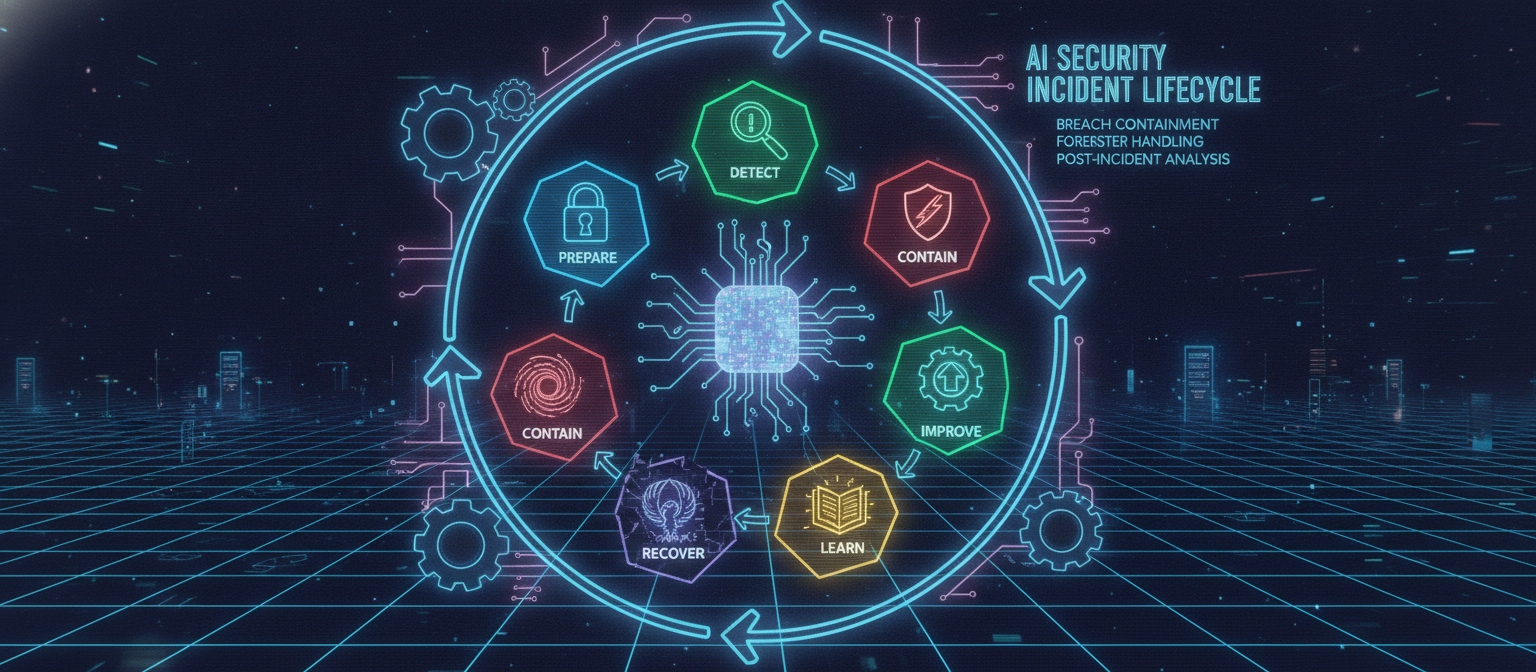
A mature incident-response lifecycle can be represented as:
Prepare
  ↓
Detect
  ↓
Analyze
  ↓
Contain
  ↓
Eradicate
  ↓
Recover
  ↓
Learn
  ↓
Improve
  ↺
71.2 What Is a Security Incident?
A security incident is an event that threatens or violates the confidentiality, integrity, or availability of a system or its information.
Examples for AI applications include:
Confidentiality incidents
unauthorized document access
cross-tenant data leakage
exposed API credentials
leaked private prompts
accidental PII disclosure
Integrity incidents
poisoned documents
modified model artifacts
manipulated database records
unauthorized configuration changes
compromised software packages
Availability incidents
denial of service
resource exhaustion
queue flooding
model-provider outage
database failure
ransomware
AI-specific incidents
prompt-injection-driven data disclosure
unauthorized agent action
malicious tool invocation
memory poisoning
unsafe model behavior
compromised AI provider credentials
71.3 Incident Severity
Not every security event has the same impact.
A useful classification is:
| Severity | Description |
|---|
| Informational | No meaningful security impact |
| Low | Limited impact |
| Medium | Material security concern |
| High | Significant security impact |
| Critical | Severe compromise or major business/user impact |
Severity should consider:
71.4 Incident Response Team
A mature organization should define responsibilities before an incident occurs.
Possible roles include:
Incident Commander
Security Lead
Application Engineer
Infrastructure Engineer
Database Engineer
AI/ML Engineer
Privacy/Legal Representative
Communications Lead
Business Owner
Small teams may combine several roles.
The important requirement is that responsibilities are predetermined.
During an incident, people should not waste critical time asking:
“Who is responsible for this?”
71.5 Incident Response Preparation
Preparation should happen before an incident.
Required preparations include:
A simplified preparation architecture:
Policies
   ↓
Runbooks
   ↓
Monitoring
   ↓
Detection
   ↓
Response Team
   ↓
Backups
   ↓
Recovery Testing
71.6 Security Runbooks
A runbook provides predefined instructions for common incidents.
Examples:
API key compromise
Account takeover
Database exposure
Malicious file upload
Cross-tenant data leak
Agent abuse
Cloud credential compromise
Ransomware
Model artifact compromise
DDoS/resource exhaustion
Runbooks should contain:
71.7 Detection
An incident can only be investigated effectively if it is detected.
Detection signals may come from:
authentication logs
authorization failures
API gateway logs
database audit logs
storage events
model activity
agent actions
network monitoring
endpoint monitoring
vulnerability scanners
user reports
provider alerts
Example:
Repeated authentication failures
        ↓
Detection rule
        ↓
Alert
        ↓
Security investigation
71.8 AI-Specific Detection Signals
AI applications require additional signals.
Examples include:
unusual prompt volume
sudden token consumption
abnormal model usage
repeated policy violations
unusual tool invocation
unexpected tool chains
large retrieval requests
abnormal memory access
unexpected cross-tenant references
repeated jailbreak attempts
unusual file-processing activity
These signals should be correlated with conventional security telemetry.
71.9 Incident Triage
Triage determines whether an event is actually an incident and how severe it is.
A basic triage process:
Alert
 ↓
Validate
 ↓
Identify affected system
 ↓
Identify affected users/data
 ↓
Estimate severity
 ↓
Assign incident owner
 ↓
Begin response
Important questions include:
What happened?
When did it begin?
Is it still occurring?
Which systems are affected?
Which users are affected?
What data may be affected?
What privileges does the attacker have?
Can the attack spread?
What evidence exists?
71.10 Incident Timeline
Investigators should build a timeline.
Example:
10:02 — suspicious login
10:04 — unusual API activity
10:07 — large retrieval request
10:09 — abnormal tool invocation
10:11 — security alert
10:15 — account disabled
10:18 — tokens revoked
10:25 — affected service isolated
10:40 — investigation completed
A reliable timeline helps determine:
initial access
persistence
lateral movement
data access
containment time
recovery time
71.11 Containment
Containment prevents an incident from becoming larger.
Containment may involve:
disabling an account
revoking tokens
rotating API keys
isolating a service
blocking suspicious traffic
disabling a compromised tool
quarantining uploaded files
suspending an AI workflow
restricting affected tenants
Containment should be proportional to the risk.
71.12 Immediate vs Long-Term Containment
Containment can occur in two stages.
Immediate containment
Goal:
Stop ongoing damage.
Examples:
Revoke credentials
Disable compromised account
Block malicious traffic
Pause dangerous workflow
Isolate service
Long-term containment
Goal:
Maintain safe operation while remediation occurs.
Examples:
Move workload to isolated environment
Apply temporary access restrictions
Disable vulnerable functionality
Increase monitoring
Restrict affected API routes
71.13 Credential Compromise Response
Suppose an API key is compromised.
The response should generally be:
Detect
 ↓
Identify credential
 ↓
Revoke
 ↓
Issue replacement
 ↓
Review historical usage
 ↓
Identify affected resources
 ↓
Investigate
 ↓
Update secret-management controls
Simply replacing the key without reviewing historical activity can leave important questions unanswered.
71.14 Account Takeover Response
For suspected account takeover:
Suspicious activity
 ↓
Session revocation
 ↓
Credential reset
 ↓
MFA verification
 ↓
Review account activity
 ↓
Check data access
 ↓
Check API keys
 ↓
Check connected applications
 ↓
Restore access
The investigation should determine whether the attacker accessed:
personal data
files
projects
AI history
payment-related metadata
API credentials
administrative functions
71.15 Data Breach Investigation
A suspected data breach requires careful analysis.
Questions include:
What data was accessed?
Which users were affected?
Was data copied?
Was data modified?
Was data deleted?
How long was unauthorized access possible?
Which credentials were used?
Which API endpoints were accessed?
Were logs available?
Was the data encrypted?
Were backups affected?
Avoid assuming that every suspicious event is automatically a confirmed breach.
Evidence should support conclusions.
71.16 Cross-Tenant Data Leakage
For multi-tenant AI systems, cross-tenant leakage is especially serious.
A suspected event should trigger:
Identify affected tenant
        ↓
Identify leaked resource
        ↓
Determine access path
        ↓
Determine all potentially affected tenants
        ↓
Disable vulnerable path
        ↓
Preserve evidence
        ↓
Patch authorization boundary
        ↓
Run regression tests
The organization should verify whether the problem was:
71.17 Prompt Injection Incident Response
Prompt injection should be treated as a security event when it produces an unauthorized effect.
For example:
Malicious document
      ↓
RAG
      ↓
Prompt injection
      ↓
Agent
      ↓
Unauthorized tool action
Response should focus on the actual security consequence, not merely the existence of a malicious prompt.
Possible actions:
71.18 Agent Incident Response
If an AI agent performs an unauthorized action:
Detect
 ↓
Stop agent execution
 ↓
Revoke temporary permissions
 ↓
Preserve agent state/logs
 ↓
Identify executed actions
 ↓
Reverse safe reversible actions
 ↓
Investigate root cause
 ↓
Patch policy
 ↓
Regression test
Agent logs should ideally provide:
agent identity
user identity
requested task
plan
tool selected
tool arguments
authorization decision
execution result
timestamps
71.19 Malicious File Incident
If a suspicious file reaches the media-processing pipeline:
Detection
 ↓
Quarantine
 ↓
Stop processing
 ↓
Preserve evidence
 ↓
Scan
 ↓
Identify affected systems
 ↓
Remove malicious artifacts
 ↓
Review parser/codec
 ↓
Patch pipeline
 ↓
Retest
Do not automatically process suspicious files merely to investigate them.
Analysis should occur in controlled environments.
71.20 Forensic Evidence
Forensics attempts to reconstruct what happened.
Evidence may include:
authentication logs
API logs
database audit records
object-storage events
network telemetry
system logs
container logs
agent traces
model requests
model responses
workflow state
security alerts
configuration history
Evidence should be protected against unauthorized modification.
71.21 Evidence Preservation
Evidence should be:
A useful evidence record includes:
Evidence ID
Source
Timestamp
Collector
Integrity information
Storage location
Access history
Related incident
71.22 Chain of Custody
Where formal investigation or legal processes require it, evidence handling should maintain a chain of custody.
Conceptually:
Evidence created
      ↓
Collected
      ↓
Recorded
      ↓
Stored
      ↓
Analyzed
      ↓
Transferred if necessary
      ↓
Archived
Each important transfer should be documented.
71.23 Log Integrity
Attackers may attempt to erase evidence.
Security logging should therefore consider:
centralized collection
restricted write permissions
immutable or append-oriented storage
integrity verification
separate administrative boundaries
Application servers should not have unlimited ability to modify historical security records.
71.24 Root-Cause Analysis
Incident response should distinguish between:
symptom
and
root cause.
Example:
Symptom:
Unauthorized document access

Immediate cause:
Missing authorization filter

Root cause:
Security boundary was not represented in the data-access abstraction

Contributing factor:
No cross-tenant regression test

Systemic cause:
Security requirements were not mapped to automated tests
Fixing only the symptom can allow the vulnerability to return.
71.25 Eradication
Eradication removes the cause of compromise.
Possible actions:
patch vulnerable software
remove malicious code
rotate credentials
revoke sessions
remove compromised dependencies
rebuild containers
replace compromised artifacts
fix authorization logic
remove poisoned documents
update security policies
A compromised component should not simply be restarted and assumed safe.
71.26 Clean Rebuilds
For serious compromise, rebuilding from known-good sources may be safer than attempting to clean an unknown environment.
Example:
Known-good source
      ↓
Verified dependencies
      ↓
Clean build
      ↓
Security scan
      ↓
Signed artifact
      ↓
Trusted deployment
This reduces uncertainty about hidden persistence.
71.27 Recovery
Recovery restores normal operation safely.
Recovery should be staged.
Containment
 ↓
Validated clean environment
 ↓
Restore data/configuration
 ↓
Security verification
 ↓
Limited traffic
 ↓
Monitoring
 ↓
Full operation
Do not immediately restore full privileges without verification.
71.28 Backup Security
Backups are critical during incidents.
A robust backup architecture should consider:
Backups should not automatically be assumed safe.
If an attacker can modify production data and backups through the same credentials, recovery can fail.
71.29 Disaster Recovery
Disaster recovery addresses severe availability or integrity failures.
Potential scenarios include:
A disaster-recovery plan should define:
RTO — Recovery Time Objective
and
RPO — Recovery Point Objective
RTO asks:
How quickly must service be restored?
RPO asks:
How much recent data can the organization tolerate losing?
71.30 AI-Specific Disaster Recovery
AI platforms have additional recovery dependencies:
Application
Database
Object Storage
Vector Store
Model Registry
Prompt Configuration
Policy Engine
Secrets
Queues
Workflow State
AI Provider
Recovery must account for all of them.
A database restore without the corresponding object-storage or vector-store state may produce an inconsistent application.
71.31 Model Artifact Recovery
Model artifacts should be recoverable from trusted sources.
Recovery should verify:
artifact identity
version
checksum/signature
source
approval status
deployment status
Example:
Backup model
 ↓
Integrity verification
 ↓
Security evaluation
 ↓
Approval
 ↓
Deployment
A backup should not automatically bypass model approval.
71.32 RAG Recovery
RAG systems require recovery of:
source documents
document metadata
access-control metadata
chunking configuration
embeddings
vector indexes
Security-sensitive metadata must be restored consistently.
Otherwise, a restored vector index might contain documents whose current authorization no longer permits access.
71.33 Memory Recovery
AI memory systems require special attention.
After recovery, verify:
user ownership
tenant ownership
retention policies
deleted memories
access permissions
memory version
poisoning indicators
A deleted memory should not silently reappear merely because an old backup was restored.
71.34 Communication During Incidents
Communication should be:
Potential audiences include:
internal teams
affected users
customers
service providers
regulators
legal representatives
Avoid speculation presented as fact.
A useful structure is:
What happened
What is known
What is not yet known
What was affected
What actions were taken
What users should do
What happens next
Legal and regulatory requirements vary by jurisdiction and incident type, so appropriate legal/privacy review may be necessary.
71.35 User Notification
If users may be affected, notifications should prioritize useful information.
Users may need to know:
whether their account was affected
what information may have been exposed
whether credentials should be changed
whether sessions were revoked
whether further action is required
Avoid unnecessarily revealing technical details that could facilitate additional attacks.
71.36 Incident Documentation
Every significant incident should produce an incident record.
Suggested fields:
Incident ID
Detection time
Incident start estimate
Severity
Affected systems
Affected users
Affected data
Initial hypothesis
Confirmed cause
Containment actions
Evidence
Remediation
Recovery
Communication
Lessons learned
Follow-up actions
Owner
Closure date
71.37 Post-Incident Review
After recovery, conduct a structured review.
Questions include:
What happened?
Why did it happen?
Why wasn't it prevented?
Why wasn't it detected earlier?
Which controls failed?
Which controls worked?
Was response fast enough?
Was evidence sufficient?
Did communication work?
What should change?
The purpose should be improvement, not blame.
71.38 Security Regression After an Incident
Every major incident should create regression tests.
Example:
Incident:
Cross-tenant document access

Fix:
Authorization filter added

Regression:
User B requests User A document

Expected:
403
The incident should therefore permanently improve the automated security suite.
71.39 Incident Knowledge Base
Organizations should maintain a security knowledge base containing:
previous incidents
root causes
detection signals
remediation
lessons learned
regression tests
updated runbooks
This prevents the organization from repeatedly solving the same problem.
71.40 Mean Time Metrics
Useful incident-response metrics include:
MTTD
Mean Time to Detect.
MTTA
Mean Time to Acknowledge.
MTTC
Mean Time to Contain.
MTTR
Mean Time to Recover/Respond, depending on organizational definition.
The objective is not simply to minimize every number independently.
The objective is to reduce real-world security impact.
71.41 Incident Simulation
Organizations should regularly perform exercises.
Examples:
Scenario A:
API key compromise

Scenario B:
Database exposure

Scenario C:
Cross-tenant data leak

Scenario D:
Malicious document

Scenario E:
Agent tool abuse

Scenario F:
Cloud outage

Scenario G:
Ransomware
Participants should practice:
detection
communication
containment
evidence preservation
recovery
71.42 Tabletop Exercises
A tabletop exercise is a discussion-based simulation.
Example:
Security team receives alert:
"Large volume of unusual AI API requests."

Question:
What happens next?
The team walks through the response without necessarily modifying production systems.
Tabletop exercises are relatively low-risk and can reveal organizational weaknesses.
71.43 Technical Recovery Exercises
Technical exercises validate that recovery procedures actually work.
Examples:
A documented backup is not proof of recoverability.
A successfully tested restore is stronger evidence.
71.44 Fail-Safe Behavior
During an incident, security-sensitive functionality should degrade safely.
Example:
Policy engine unavailable
        ↓
Sensitive action
        ↓
DENY
rather than:
Policy engine unavailable
        ↓
Sensitive action
        ↓
ALLOW
The exact behavior depends on business requirements, but security-critical operations should be deliberately designed for failure conditions.
71.45 Incident Containment Architecture
A secure AI platform can use:
                 Detection
                    ↓
              Incident Queue
                    ↓
             Incident Manager
                    ↓
       ┌────────────┼────────────┐
       ↓            ↓            ↓
   Credential    Service      Data
   Containment   Isolation   Protection
       ↓            ↓            ↓
       └────────────┼────────────┘
                    ↓
                Forensics
                    ↓
                Eradication
                    ↓
                 Recovery
                    ↓
             Regression Tests
                    ↓
             Security Review
71.46 Security Operations Center Integration
For larger platforms, security telemetry can feed a SOC/SIEM environment.
Relevant events include:
authentication
authorization
network activity
cloud activity
API requests
database access
storage activity
AI usage
agent actions
security alerts
Correlation can reveal attacks that are difficult to detect from one system alone.
71.47 AI Security Operations
AI can assist security operations, but AI-generated analysis should not automatically become authoritative.
Possible uses include:
Human verification remains important for high-impact decisions.
71.48 Security Automation
Safe automation can reduce response time.
Examples:
Suspicious credential
 ↓
Automatic revocation

Malicious upload
 ↓
Automatic quarantine

Compromised session
 ↓
Automatic session invalidation

Severe anomaly
 ↓
Automatic rate reduction
However, automation should have carefully defined boundaries.
High-impact destructive actions may require human approval.
71.49 Emergency Privileged Access
Incident response sometimes requires elevated privileges.
Emergency access should be:
strongly authenticated
narrowly scoped
time-limited
logged
monitored
reviewed afterward
Emergency privileges should not become permanent administrative access.
71.50 Security Incident Lifecycle
The complete lifecycle is:
Preparation
    ↓
Detection
    ↓
Triage
    ↓
Investigation
    ↓
Containment
    ↓
Evidence Preservation
    ↓
Eradication
    ↓
Recovery
    ↓
Validation
    ↓
Communication
    ↓
Post-Incident Review
    ↓
Regression Testing
    ↓
Architecture Improvement
71.51 Final Incident Response Checklist
[ ] Incident-response plan exists
[ ] Roles are defined
[ ] Escalation paths exist
[ ] Monitoring is enabled
[ ] Security alerts are tested
[ ] Logs are centrally protected
[ ] Backups exist
[ ] Backup restoration is tested
[ ] Credential-rotation procedure exists
[ ] Account-compromise runbook exists
[ ] Data-breach runbook exists
[ ] AI-specific incident procedures exist
[ ] Agent incident procedures exist
[ ] RAG incident procedures exist
[ ] Media-processing incident procedures exist
[ ] Evidence preservation process exists
[ ] Communication process exists
[ ] Disaster-recovery plan exists
[ ] Tabletop exercises are performed
[ ] Technical recovery exercises are performed
[ ] Incident regression tests are created
[ ] Post-incident reviews are completed
71.52 Final Principle
A secure AI platform must assume that incidents can occur.
The objective is therefore not:
“We will never be compromised.”
A stronger engineering objective is:
“If something goes wrong, we can detect it, contain it, understand it, recover safely, and permanently improve the system.”
The strongest AI security architecture combines prevention, detection, containment, investigation, recovery, and learning.
The complete security loop becomes:
Prevent
  ↓
Detect
  ↓
Respond
  ↓
Recover
  ↓
Learn
  ↓
Improve
  ↺
Security maturity is demonstrated not by the absence of incidents alone, but by the system's ability to minimize their impact and continuously become more resilient.


Comments
Post a Comment