Chapter 81 — Secure AI Platform Testing Strategy
81.1 Introduction
Testing a modern AI platform requires much more than checking whether buttons work.
An AI platform combines:
Each layer can fail independently, and failures can interact.
Therefore, a mature testing strategy must verify:
Correctness, security, safety, reliability, performance, privacy, scalability, and recoverability.
The objective is not simply to prove that the platform works under ideal conditions.
The objective is to demonstrate that it continues to behave correctly under expected, unexpected, adversarial, and degraded conditions.
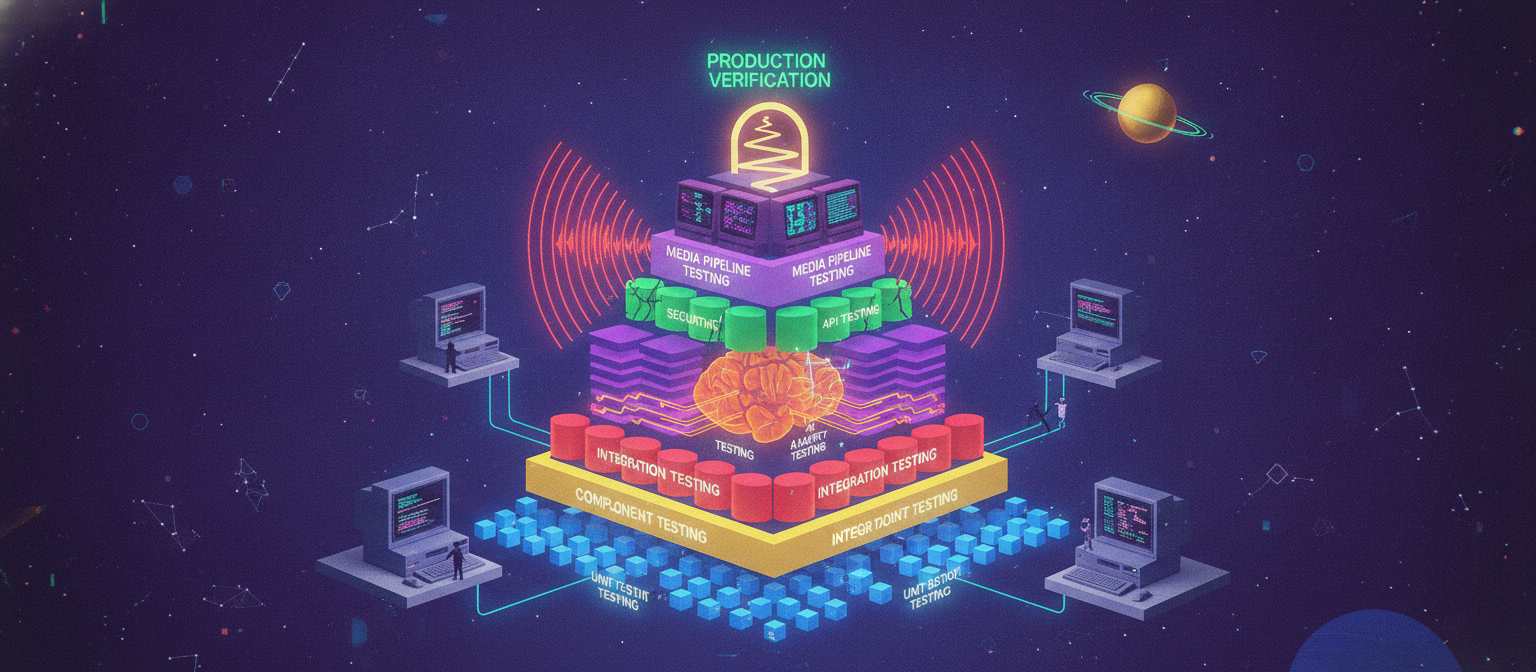
81.2 Testing Pyramid
A useful testing architecture begins with multiple layers.
                 End-to-End
                    /\
                   /  \
             Integration
                /      \
             Component
              /        \
             Unit Tests
Generally:
unit tests are numerous and fast
integration tests verify interactions
end-to-end tests verify complete workflows
AI platforms require additional layers around this traditional pyramid.
81.3 AI Testing Layers
A comprehensive strategy can be represented as:
Unit Testing
     ↓
Component Testing
     ↓
Integration Testing
     ↓
API Testing
     ↓
Security Testing
     ↓
AI Safety Testing
     ↓
Media Pipeline Testing
     ↓
Performance Testing
     ↓
Chaos Testing
     ↓
End-to-End Testing
     ↓
Production Verification
No single testing method is sufficient.
81.4 Test Strategy
Before writing tests, define:
what must be tested
what can fail
what must never happen
acceptable performance
acceptable AI quality
security boundaries
recovery behavior
release criteria
A test strategy should prioritize high-risk components.
For example:
Authentication
Authorization
Payments
Private media
AI inference
Tenant isolation
usually deserve more rigorous testing than purely cosmetic UI elements.
81.5 Unit Testing
Unit tests verify small pieces of logic independently.
Examples:
A unit test should ideally be:
deterministic
fast
isolated
repeatable
81.6 Authorization Unit Tests
Authorization logic deserves particularly strong coverage.
Test cases should include:
Owner → allowed
Member → allowed where permitted
Unrelated user → denied
Unknown tenant → denied
Missing identity → denied
Expired session → denied
Revoked membership → denied
The important security property is:
Access should fail closed when authorization information is missing or invalid.
81.7 State-Machine Testing
AI jobs often use explicit states.
For example:
CREATED
 ↓
QUEUED
 ↓
RUNNING
 ↓
POST_PROCESSING
 ↓
SUCCEEDED
Tests should verify invalid transitions are rejected.
For example:
SUCCEEDED → RUNNING
should normally be invalid unless explicitly supported by the design.
This prevents corrupted job state.
81.8 Integration Testing
Integration tests verify that multiple components work together.
Examples:
API + Database
API + Authentication
API + Queue
Worker + Storage
Worker + AI provider
Billing + Usage
Notification + Job system
Integration testing discovers problems that unit tests cannot detect.
81.9 Database Integration Testing
Database tests should verify:
For multi-tenant applications, every important data-access path should be tested against multiple tenants.
81.10 Cross-Tenant Testing
A critical security test is:
Tenant A
 ↓
Attempts to access Tenant B resource
 ↓
Expected result:
DENIED
This should be tested across:
database records
media files
vector records
AI memory
caches
queues
notifications
analytics
exports
Cross-tenant isolation should be treated as a system-wide invariant.
81.11 API Testing
API tests should verify:
Valid requests
correct authentication
valid parameters
supported resources
Invalid requests
malformed JSON
missing parameters
invalid IDs
unsupported formats
excessive input
Security cases
81.12 API Contract Testing
API contracts should define:
Contract tests help ensure that frontend and backend changes do not silently break each other.
81.13 Frontend Testing
Frontend tests should verify:
rendering
interaction
navigation
form validation
loading states
error states
permission-aware UI
accessibility
However:
Frontend restrictions are not security boundaries.
Even if a button is hidden, the server must independently enforce authorization.
81.14 File Upload Testing
AI media applications require extensive upload testing.
Test:
The server should validate uploaded content independently of client-provided information.
81.15 Media Pipeline Testing
For image, video, audio, and document processing, test:
Upload
 ↓
Validation
 ↓
Quarantine
 ↓
Scanning
 ↓
Processing
 ↓
Output validation
 ↓
Storage
 ↓
Delivery
Every transition should have success and failure tests.
81.16 Malformed Media Testing
Media parsers can encounter unusual input.
Testing should include:
The purpose is to verify that malformed media produces controlled failure rather than service instability.
81.17 Resource Exhaustion Testing
AI media operations can consume large amounts of resources.
Test:
Expected behavior should be controlled rejection or throttling rather than uncontrolled resource consumption.
81.18 Security Testing
Security testing should include:
authentication testing
authorization testing
session testing
input validation
injection testing
access-control testing
file-upload security
secrets exposure testing
API abuse testing
tenant isolation testing
Security testing should be continuous rather than a one-time pre-launch activity.
81.19 Dependency Security Testing
Dependencies should be continuously checked for:
A software bill of materials can improve visibility into the dependency inventory.
81.20 Secret-Exposure Testing
Automated checks should attempt to detect accidental exposure of:
API keys
passwords
private tokens
signing secrets
database credentials
cloud credentials
Potential locations include:
source code
Git history
logs
frontend bundles
build artifacts
error messages
configuration files
81.21 Authentication Testing
Test:
Authentication failures should not reveal unnecessary information.
81.22 Session Testing
Test whether:
sessions expire correctly
revoked sessions stop working
privilege changes take effect
session identifiers are protected
logout invalidates appropriate state
sensitive actions require appropriate authentication
81.23 AI Safety Testing
AI systems require tests beyond conventional security.
Test:
The objective is not simply to maximize refusal.
The objective is to achieve:
Correct behavior for both allowed and disallowed requests.
81.24 False Refusal Testing
An AI safety system can fail in two directions.
False acceptance
Unsafe content is incorrectly allowed.
False refusal
Safe content is incorrectly blocked.
Both matter.
For example:
Safe request
   ↓
Incorrect refusal
can damage usability.
Therefore evaluation should measure both:
unsafe-request blocking
safe-request acceptance
81.25 Prompt Injection Testing
AI applications that process external content should test indirect prompt injection.
For example:
User
 ↓
Document
 ↓
Retrieved text
 ↓
AI model
The document may contain instructions unrelated to the user's legitimate request.
Testing should verify that:
retrieved content is treated as untrusted data
system instructions remain authoritative
tool permissions are not expanded by retrieved text
sensitive information is not disclosed
81.26 Agent Security Testing
If the platform contains AI agents, test:
tool authorization
action limits
planning boundaries
approval requirements
tool input validation
tool output validation
sandbox restrictions
termination conditions
An agent should not gain new privileges merely because it generated an instruction requesting them.
81.27 Tool-Calling Tests
For every tool, test:
Authorized invocation
Unauthorized invocation
Malformed arguments
Oversized arguments
Unexpected tool response
Timeout
Tool failure
Repeated invocation
Tools should validate their own inputs.
81.28 AI Output Validation Testing
AI outputs should not automatically be trusted.
Test:
malformed output
missing fields
unexpected content
invalid URLs
unsafe generated media
schema violations
excessive output size
Structured AI outputs should be validated against explicit schemas.
81.29 Model Regression Testing
When a model changes, run a standardized evaluation set.
Compare:
Old model
vs.
New model
Metrics may include:
quality
accuracy
safety
refusal behavior
latency
cost
consistency
A new model should not automatically replace an existing production model simply because it is newer.
81.30 Prompt Regression Testing
Prompt changes should also be tested.
A small prompt modification can change:
output quality
safety behavior
token usage
latency
refusal rates
Therefore prompts should be versioned and evaluated like code.
81.31 Dataset Testing
AI evaluation datasets should be tested for:
correctness
duplication
leakage
outdated examples
missing edge cases
privacy problems
label inconsistencies
A flawed benchmark can create false confidence.
81.32 Multilingual Testing
AI platforms serving multiple languages should evaluate behavior across supported languages.
Test:
translations
mixed-language prompts
code-switching
regional terminology
safety behavior
output consistency
A safety policy that works well in one language may perform differently in another.
81.33 Multimodal Testing
For image, video, audio, and text systems, test combinations such as:
Text → Image
Image → Text
Image → Image
Text + Image → Output
Audio → Text
Video → Analysis
Adversarial content should also be included where appropriate.
81.34 Performance Testing
Performance testing should measure:
throughput
p50 latency
p95 latency
p99 latency
queue time
inference time
database latency
storage latency
error rate
Tests should represent realistic workloads.
81.35 Load Testing
Load testing asks:
Can the platform handle expected traffic?
Example:
100 requests/sec
500 requests/sec
1,000 requests/sec
The correct targets depend on actual requirements.
81.36 Stress Testing
Stress testing intentionally exceeds normal capacity.
For example:
Normal capacity
      ↓
2× load
      ↓
5× load
      ↓
10× load
The goal is to determine:
81.37 Spike Testing
Spike testing introduces sudden traffic increases.
Example:
100 jobs/minute
        ↓
5,000 jobs/minute
The system should ideally:
81.38 Soak Testing
Soak testing runs a realistic workload for a long period.
It helps detect:
81.39 Fuzz Testing
Fuzzing sends unexpected or malformed inputs to software.
Potential targets include:
APIs
parsers
file processors
metadata handlers
serialization
authentication inputs
AI tool arguments
The objective is to discover crashes and unexpected states.
81.40 Property-Based Testing
Property-based testing verifies general rules instead of only fixed examples.
For example:
Property:
A user must never access another tenant's resource.
Generate many combinations of:
users
tenants
resource IDs
permissions
and verify the invariant remains true.
This is especially valuable for authorization systems.
81.41 Chaos Testing
Chaos testing intentionally introduces controlled failures.
Examples:
Database unavailable
AI provider unavailable
Queue unavailable
Storage unavailable
Worker crashes
Network latency increases
The purpose is to verify resilience.
Chaos experiments must be carefully controlled.
81.42 Failure Injection
A failure-injection test might simulate:
AI Provider
     X
     |
Application
     ↓
Fallback provider
Expected result:
81.43 Disaster Recovery Testing
Recovery testing verifies:
database restoration
object restoration
queue recovery
service restart
region failover
credential recovery
tenant data consistency
A backup that has never been successfully restored should not be considered fully validated.
81.44 Backup Restore Testing
A useful test sequence is:
Backup
 ↓
Restore
 ↓
Integrity verification
 ↓
Application startup
 ↓
Authorization verification
 ↓
Tenant isolation verification
 ↓
Functional test
Recovery should restore not only data, but also correct access-control behavior.
81.45 Continuous Integration Testing
Every code change should trigger appropriate automated tests.
Conceptually:
Developer change
      ↓
Lint
      ↓
Unit tests
      ↓
Type checks
      ↓
Integration tests
      ↓
Security checks
      ↓
Build
Higher-risk changes may trigger additional test suites.
81.46 Continuous Delivery Verification
Before production deployment:
Build
 ↓
Test
 ↓
Security scan
 ↓
Deploy staging
 ↓
Integration verification
 ↓
Canary
 ↓
Production
Production deployment should include automatic monitoring.
81.47 Test Environments
A mature platform may use:
Development
Testing
Staging
Production
Each environment should have appropriate isolation.
Production data should not casually be copied into lower environments.
Synthetic or anonymized datasets are safer for many testing purposes.
81.48 Test Data Security
Test datasets can accidentally contain sensitive information.
Controls include:
synthetic data
anonymization
pseudonymization
access controls
retention limits
encryption
Testing environments should not become an uncontrolled copy of production data.
81.49 End-to-End Testing
End-to-end testing verifies complete user journeys.
Example:
Signup
 ↓
Login
 ↓
Upload image
 ↓
Create AI job
 ↓
Queue
 ↓
Inference
 ↓
Output validation
 ↓
Storage
 ↓
Display result
 ↓
Export
This confirms that the complete system works together.
81.50 Critical User Journeys
Not every possible workflow needs equal E2E coverage.
Prioritize:
login
signup
payment
upload
AI generation
editing
export
sharing
deletion
account recovery
These workflows directly affect security, revenue, and user trust.
81.51 Production Smoke Tests
After deployment, run lightweight verification.
Examples:
Homepage accessible
Login functional
API responsive
Database reachable
Queue operational
AI health check operational
Storage accessible
Smoke tests should be safe and should not create uncontrolled costs.
81.52 Synthetic Monitoring
Synthetic users can periodically perform controlled workflows.
For example:
Synthetic account
 ↓
Login
 ↓
Small test generation
 ↓
Verify result
 ↓
Cleanup
This can detect failures before real users report them.
Synthetic workloads should have strict limits.
81.53 Test Observability
Tests should produce useful evidence:
test result
execution duration
environment
build version
model version
dataset version
failure details
For AI evaluation, also record the relevant model and policy versions.
81.54 Security Regression Tests
Once a security vulnerability is fixed, create a permanent regression test.
For example:
Bug:
Tenant A could access Tenant B asset.

Fix:
Authorization check added.

Regression test:
Tenant A → Tenant B asset → DENY
This prevents the same vulnerability from silently returning later.
81.55 Golden Test Cases
Maintain a set of important known cases.
Examples:
valid login
invalid login
authorized resource
unauthorized resource
safe AI request
unsafe AI request
valid image
malformed image
successful generation
provider failure
These become baseline tests for future releases.
81.56 Testing the Billing System
Billing requires particularly careful testing.
Test:
successful payment
failed payment
duplicate webhook
delayed webhook
cancelled subscription
expired subscription
entitlement changes
refunds
usage calculation
quota enforcement
Financial state should remain consistent even when events arrive more than once.
81.57 Testing Webhooks
Webhook tests should include:
Valid webhook
Duplicate webhook
Out-of-order webhook
Malformed webhook
Invalid signature
Delayed webhook
Provider retry
Webhook processing should be idempotent where appropriate.
81.58 Testing Notifications
Test:
successful delivery
provider failure
duplicate notification
invalid recipient
revoked account
deleted content
expired link
Notification failures should not corrupt the primary job state.
81.59 Testing Deletion
Deletion deserves dedicated testing.
When a user deletes a resource, verify:
Database record
Object storage
Cache
Vector index
AI memory
Search index
Derived assets
are handled according to the platform's retention and deletion policies.
81.60 Testing Privacy Controls
Verify that:
private resources remain private
deletion requests are honored
consent settings are enforced
analytics do not expose sensitive data
logs are appropriately redacted
exports contain only authorized information
81.61 Test Coverage
Coverage metrics are useful but incomplete.
High code coverage does not automatically mean high security.
For example:
95% code coverage
can still coexist with:
Broken tenant isolation
Therefore coverage should be combined with:
81.62 Risk-Based Testing
Testing effort should follow risk.
A useful prioritization model is:
Risk =
Probability × Impact
High-risk areas deserve stronger testing.
Examples:
Payment authorization
High risk

Tenant isolation
High risk

Cosmetic animation
Lower risk
81.63 Test Automation
Automate repetitive tests wherever possible.
Good automation candidates include:
unit tests
API tests
authorization tests
regression tests
dependency scanning
static analysis
model evaluation
performance benchmarks
deployment smoke tests
Human review remains valuable for complex UX and AI-quality evaluation.
81.64 Human-in-the-Loop Testing
Human evaluation is useful when automated metrics cannot reliably judge:
Human reviewers should use standardized evaluation criteria.
81.65 Release Gates
A release can require:
Unit tests → PASS
Integration → PASS
Security → PASS
AI safety → PASS
Performance → PASS
Cost → ACCEPTABLE
Regression → PASS
Only then should deployment continue.
Critical failures should block release.
81.66 Test Failure Handling
When a test fails:
preserve evidence
identify affected component
classify severity
reproduce
fix
add regression coverage
rerun relevant tests
evaluate whether other components are affected
A failed test should produce learning, not merely a red status indicator.
81.67 Testing Documentation
Maintain:
test strategy
test cases
test datasets
security tests
AI evaluation suites
performance benchmarks
recovery procedures
known limitations
Each test suite should have an owner.
81.68 Secure Testing Architecture
A mature architecture can look like:
                    Source Code
                        |
                  CI Test Pipeline
                        |
        +---------------+---------------+
        |               |               |
      Unit         Integration       Security
        |               |               |
        +---------------+---------------+
                        |
                  AI Evaluation
                        |
              Performance Testing
                        |
                  Staging
                        |
                 E2E Testing
                        |
                    Canary
                        |
                  Production
                        |
              Synthetic Monitoring
                        |
              Continuous Feedback
This creates a continuous verification loop.
81.69 Master Testing Checklist
Functional
Security
AI
Performance
Reliability
Privacy
Operations
81.70 Final Principle
Testing should not be treated as the final stage of development.
Instead:
Design
 ↓
Threat Model
 ↓
Implement
 ↓
Test
 ↓
Measure
 ↓
Deploy
 ↓
Monitor
 ↓
Learn
 ↓
Improve
Testing is therefore part of the entire lifecycle.
For AI systems, this is especially important because behavior can change when:
81.71 Conclusion
A secure AI platform requires a layered testing strategy covering:
unit testing
component testing
integration testing
API testing
frontend testing
security testing
file and media testing
AI safety evaluation
model and prompt regression
multilingual and multimodal evaluation
performance testing
fuzzing
property-based testing
chaos testing
disaster recovery testing
end-to-end testing
production verification
The most important lesson is:
A test suite should verify not only that the platform works, but that it fails safely, protects its boundaries, controls resource consumption, preserves user data, and continues to behave correctly as the system evolves.
For a large AI media platform, testing becomes a continuous verification system connecting engineering, security, AI safety, operations, and product quality.
The ultimate objective is not to achieve a perfect test score.
It is to establish enough automated and human evidence that the platform's most important security, safety, reliability, and correctness properties remain true throughout its lifecycle.



Comments
Post a Comment