Chapter 82 — Secure AI Platform Quality Engineering & AI Evaluation
82.1 Introduction
A secure AI platform cannot be considered production-ready merely because its software tests pass.
Traditional software testing primarily asks:
Does the system behave according to its specification?
AI quality engineering must ask a broader set of questions:
Is the AI output useful?
Is it accurate enough for the intended task?
Is it consistent?
Does it remain safe under adversarial inputs?
Does it hallucinate?
Does it preserve user intent?
Does it respect authorization boundaries?
Does quality degrade when models, prompts, datasets, or providers change?
Does performance remain acceptable at scale?
Does the system behave correctly across languages and modalities?
Can humans verify important outputs?
Can poor-quality outputs be detected before users depend on them?
Therefore, AI quality engineering combines:
Software quality engineering
Model evaluation
Data quality
Prompt evaluation
Safety evaluation
Human evaluation
Reliability measurement
Continuous production monitoring
The objective is not to prove that an AI system is perfect.
The objective is to establish measurable evidence that the system is useful, safe, reliable, observable, and controllable within its intended operating conditions.
82.2 Quality Engineering vs Traditional Testing
Traditional testing generally focuses on deterministic behavior.
For example:
Input: 2 + 2
Expected: 4
An AI system may instead receive:
User: Explain quantum computing for a beginner.
There may be many acceptable answers.
Therefore, AI quality cannot always be evaluated through exact string matching.
A mature evaluation system combines:
Deterministic Tests
        +
Statistical Evaluation
        +
Human Evaluation
        +
Safety Evaluation
        +
Production Monitoring
This creates a broader quality model.
82.3 AI Quality Dimensions
A useful AI quality framework can include the following dimensions.
82.3.1 Correctness
Does the system produce factually correct results?
Examples:
mathematical correctness
factual accuracy
correct classification
correct extraction
correct tool selection
82.3.2 Relevance
Does the output actually answer the user's request?
An answer can be factually correct but irrelevant.
Example:
User request:
Summarize this document.

Poor result:
A long explanation about document formats.
The information may be correct but fails the task.
82.3.3 Completeness
Does the response cover the important requirements?
For structured tasks, define explicit criteria.
Example:
Required fields:

name
date
amount
status
reference
The evaluation should verify whether all required fields were produced.
82.3.4 Consistency
Repeated equivalent inputs should produce reasonably consistent behavior.
This does not mean every generated sentence must be identical.
Instead, important semantic requirements should remain stable.
82.3.5 Robustness
The system should remain functional when inputs vary.
Examples:
82.3.6 Safety
The system must avoid unacceptable outputs and unsafe actions.
Safety evaluation can include:
82.3.7 Reliability
The system should continue functioning under realistic operational conditions.
Quality therefore includes:
AI Quality
+
Availability
+
Latency
+
Error Rate
+
Recovery
82.4 Quality Metrics
Every important AI feature should have measurable quality metrics.
Examples include:
| Metric | Purpose |
|---|
| Accuracy | Correctness |
| Precision | Positive prediction quality |
| Recall | Coverage of relevant cases |
| F1 | Balance of precision and recall |
| Hallucination rate | Unsupported claims |
| Task success rate | End-to-end usefulness |
| Safety violation rate | Unsafe behavior |
| Refusal accuracy | Appropriate refusal behavior |
| Tool-call accuracy | Correct tool selection |
| Citation accuracy | Evidence correctness |
| Human rating | Expert/user judgment |
| Latency | Responsiveness |
| Failure rate | Operational reliability |
Metrics must be tied to actual product requirements.
A metric without a decision rule is often just a dashboard number.
82.5 Golden Datasets
A golden dataset is a carefully reviewed evaluation dataset representing important real-world cases.
It should contain examples such as:
Normal requests
Edge cases
Ambiguous requests
Multilingual requests
Long requests
Adversarial requests
Safety-sensitive requests
Failure cases
Historical production failures
Each example should have expected evaluation criteria.
For example:
Case ID: SUM-001

Input:
Document containing three paragraphs.

Expected:
- preserve major facts
- omit irrelevant details
- no fabricated information
- concise summary
Golden datasets should be versioned.
Example:
golden-v1
golden-v2
golden-v3
This makes evaluation reproducible.
82.6 Golden Dataset Governance
Golden datasets themselves require security controls.
They may contain:
Therefore:
Dataset
   ↓
Classification
   ↓
Access Control
   ↓
Versioning
   ↓
Evaluation
   ↓
Audit
Do not automatically copy production data into evaluation datasets.
Production data should be minimized, sanitized, and appropriately authorized before reuse.
82.7 Human Evaluation
Some AI outputs cannot be reliably judged using automated metrics alone.
Human evaluation is useful for:
writing quality
explanation quality
helpfulness
visual quality
nuanced correctness
conversational quality
instruction following
Human evaluators should receive explicit criteria.
For example:
Score 1 — Poor
Fails the task or contains major errors.
Score 2 — Weak
Partially useful but requires substantial correction.
Score 3 — Acceptable
Generally correct and usable.
Score 4 — Strong
Correct, relevant, clear, and well structured.
Score 5 — Excellent
Highly accurate, useful, clear, and complete.
Evaluation instructions should be documented so that different evaluators apply similar standards.
82.8 Inter-Rater Agreement
When multiple human evaluators review the same outputs, disagreement should be measured.
If one evaluator gives:
5
and another gives:
1
the evaluation process may be ambiguous.
Possible causes include:
unclear rubric
insufficient evaluator training
subjective task
ambiguous expected answer
inconsistent interpretation
Quality engineering should therefore monitor evaluator agreement and investigate unusually high disagreement.
82.9 Model Benchmarking
Models should not be selected solely because they appear impressive in general benchmarks.
A model should be evaluated against the platform's actual workload.
Example:
Model A
Accuracy: 91%
Latency: 900 ms
Cost: $0.004/request

Model B
Accuracy: 94%
Latency: 1.8 s
Cost: $0.011/request

Model C
Accuracy: 89%
Latency: 400 ms
Cost: $0.001/request
The best model depends on the product requirement.
For a safety-critical task, accuracy may dominate.
For a high-volume lightweight task, cost and latency may matter more.
82.10 Task-Specific Evaluation
Different AI features require different metrics.
Text Generation
Evaluate:
factuality
relevance
completeness
style adherence
instruction following
hallucination
Document Extraction
Evaluate:
field accuracy
missing-field rate
formatting accuracy
confidence calibration
Image Generation
Evaluate:
Video Generation
Evaluate:
temporal consistency
prompt adherence
frame quality
motion stability
artifact frequency
Speech Systems
Evaluate:
transcription accuracy
word error rate
language coverage
pronunciation quality
latency
Agents
Evaluate:
task completion
correct tool selection
unauthorized action rate
recovery behavior
planning quality
escalation correctness
82.11 Hallucination Testing
Hallucination occurs when an AI system produces information that is unsupported, fabricated, or incorrectly presented as fact.
Testing should include:
Known-answer questions
Unknown-answer questions
Incomplete-context questions
Conflicting-source questions
Long-context questions
RAG questions
Citation-required questions
A robust system should not always attempt an answer.
Sometimes the correct behavior is:
"I don't have enough information to determine that."
This is an important quality property.
82.12 RAG Evaluation
Retrieval-Augmented Generation requires evaluation of multiple stages.
Query
 ↓
Retrieval
 ↓
Ranking
 ↓
Context construction
 ↓
Generation
 ↓
Citation
Each stage can fail independently.
Retrieval Metrics
Examples:
recall@k
precision@k
hit rate
ranking quality
Generation Metrics
Examples:
groundedness
completeness
factual correctness
citation correctness
A system may generate an excellent answer from poor retrieval, or a poor answer from excellent retrieval.
Therefore the entire pipeline should be evaluated.
82.13 Citation Quality
If the system presents citations or sources, evaluate whether they actually support the generated claims.
A useful evaluation model is:
Claim
 ↓
Referenced Source
 ↓
Evidence Verification
 ↓
Support / Partial Support / Unsupported
The system should not receive full credit simply because a URL or document reference exists.
The evidence must actually support the claim.
82.14 Prompt Evaluation
Prompts are production artifacts and should be tested like software.
Each prompt version should have:
Prompt ID
Version
Owner
Purpose
Model compatibility
Evaluation dataset
Known limitations
Safety requirements
Release status
Example:
summarizer-v1
summarizer-v2
summarizer-v3
Before deployment:
Prompt
 ↓
Golden Dataset
 ↓
Quality Evaluation
 ↓
Safety Evaluation
 ↓
Regression Comparison
 ↓
Approval
 ↓
Deployment
82.15 Regression Testing for AI
A model or prompt update can unexpectedly reduce quality.
Example:
Previous version:
Accuracy = 94%

New version:
Accuracy = 87%
Even if the new model is better on a general benchmark, it may be worse for the platform's specific workload.
Every significant AI change should therefore run a regression suite.
Compare:
Old Model
vs
New Model
Across:
quality
safety
latency
cost
reliability
tool usage
multilingual performance
82.16 Safety Regression
Safety must be included in regression testing.
Suppose:
Old model:
Unsafe response rate = 0.5%

New model:
Unsafe response rate = 2.1%
The new model may be more capable while being less suitable for the platform.
A deployment gate can require:
Safety score >= threshold
and:
Critical safety violations = 0
where appropriate.
82.17 False Refusal Evaluation
Safety systems can fail in two directions.
False Acceptance
The system allows something it should block.
False Refusal
The system blocks something legitimate.
A mature AI platform evaluates both.
Example:
Legitimate request
        ↓
Should answer
        ↓
System refuses
        ↓
False refusal
Overly aggressive safety controls can reduce product usefulness.
The objective is:
High Safety
+
High Utility
rather than maximum refusal.
82.18 Multilingual Evaluation
AI quality should not be assumed to transfer equally across languages.
Evaluation should include languages supported by the product.
Test:
For a Bangladesh-focused application, for example, Bengali and Banglish may deserve dedicated evaluation rather than treating English performance as representative.
82.19 Multimodal Evaluation
AI media platforms often process:
Text
Images
Audio
Video
Documents
Evaluation should therefore test cross-modal behavior.
Examples:
Image → Caption
Image → Edit instruction
Document → Summary
Audio → Transcript
Video → Description
Text → Image
Text → Video
The evaluation framework should identify errors introduced at modality boundaries.
82.20 Agent Evaluation
AI agents require additional evaluation because they can perform actions.
Important metrics include:
Task success rate
Tool selection accuracy
Invalid tool-call rate
Unauthorized action rate
Human escalation accuracy
Recovery success rate
Maximum action count
Policy violation rate
An agent that completes a task while violating an authorization rule is not a successful system.
Therefore:
Task Success
+
Policy Compliance
+
Authorization Compliance
+
Resource Compliance
should be evaluated together.
82.21 Tool-Calling Evaluation
For every tool call, verify:
Was the correct tool selected?
Was the correct operation selected?
Were arguments valid?
Was the user authorized?
Was the action necessary?
Was the result interpreted correctly?
Was the action logged?
This turns tool calling into an observable quality boundary.
82.22 Evaluation of Autonomous Failure Handling
Agents and workflows should be evaluated not only on success but also on failure.
Examples:
Tool unavailable
API timeout
Invalid response
Permission denied
Database unavailable
Model unavailable
Conflicting information
Human approval unavailable
The expected result may be:
Detect failure
 ↓
Stop unsafe action
 ↓
Retry if safe
 ↓
Escalate if necessary
 ↓
Record event
82.23 Quality Thresholds
Each production AI capability should define thresholds.
Example:
Task success >= 95%

Critical safety violation = 0

Hallucination rate <= 2%

P95 latency <= 3 seconds

Tool authorization failures = 0

Availability >= 99.9%
These numbers are examples only.
Real thresholds should be derived from the feature's risk, user expectations, and operating requirements.
82.24 Quality Gates
A release should not automatically proceed merely because the build succeeds.
A mature release pipeline can use:
Code Tests
   ↓
Data Validation
   ↓
Model Evaluation
   ↓
Prompt Evaluation
   ↓
Safety Evaluation
   ↓
Performance Evaluation
   ↓
Cost Evaluation
   ↓
Human Approval
   ↓
Canary Deployment
   ↓
Production Monitoring
Any critical failure should block or restrict deployment.
82.25 Canary Evaluation
Instead of immediately sending all traffic to a new AI version:
100% old version
transition gradually:
99% old
1% new
then:
90% old
10% new
then:
50% old
50% new
and finally:
100% new
provided quality and safety metrics remain within acceptable limits.
82.26 Online Quality Monitoring
Offline evaluation is not enough.
Real-world traffic can contain inputs that were not present in the test dataset.
Production monitoring should therefore measure:
quality signals
user feedback
correction rate
retry rate
abandonment
safety events
hallucination reports
tool failures
model errors
latency
cost
The monitoring system should distinguish between:
System failure
Model failure
User behavior
External dependency failure
82.27 User Feedback as a Quality Signal
Useful signals include:
Thumbs up
Thumbs down
Retry
Regenerate
Edit output
Copy output
Report problem
Cancel generation
Switch model
These signals should not automatically be treated as ground truth.
For example, a user may dislike an answer even when it is factually correct.
Therefore feedback should be combined with other evaluation signals.
82.28 Quality Drift
AI quality can degrade over time even when software code does not change.
Reasons include:
This is called quality drift or related forms of distribution/model drift.
Continuous evaluation helps detect it.
82.29 Data Drift Monitoring
Suppose the system originally receives:
80% English
20% Bengali
Later:
40% English
60% Bengali
The model may behave differently if Bengali was underrepresented during evaluation.
Therefore monitor important input distributions.
Possible signals:
Language distribution
Input length
File type
Task type
Model usage
Feature usage
Error categories
82.30 Evaluation Data Leakage
Evaluation datasets must be protected from accidental contamination.
If test examples are repeatedly exposed during training or prompt optimization, evaluation results can become misleading.
A clean evaluation architecture separates:
Development Data
Validation Data
Test Data
Production Monitoring Data
The final test set should have restricted access.
82.31 Secure Evaluation Infrastructure
Evaluation environments may execute untrusted AI inputs.
Therefore they should use:
Never allow an evaluation prompt to gain unrestricted access to production infrastructure.
82.32 Benchmark Reproducibility
A benchmark should record:
Dataset version
Model version
Prompt version
System configuration
Temperature/settings
Retrieval configuration
Tool configuration
Evaluation code version
Evaluator version
Timestamp
Without this metadata, comparing results becomes difficult.
82.33 AI Evaluation Registry
A production platform can maintain an evaluation registry.
Example:
Evaluation
 ├── ID
 ├── Dataset Version
 ├── Model Version
 ├── Prompt Version
 ├── Metrics
 ├── Safety Results
 ├── Human Results
 ├── Cost
 ├── Latency
 ├── Decision
 └── Approval
Possible decisions:
PASS
PASS_WITH_RESTRICTIONS
REVIEW
FAIL
82.34 Quality Scorecards
Every production AI capability can have a scorecard.
Example:
Feature: Document Summarization

Correctness:       96%
Relevance:         97%
Completeness:      94%
Hallucination:      1.2%
Safety:             PASS
P95 latency:        2.1s
Cost/request:       $0.003
Human rating:       4.4/5
This gives engineering, security, and product teams a common view.
82.35 Quality vs Cost
Higher quality is not always free.
A larger model may produce better results but increase:
Therefore evaluate:
Quality / Cost
rather than quality alone.
A smaller model may be preferable when it satisfies the required quality threshold at significantly lower cost.
82.36 Quality vs Latency
Users often prefer a slightly less capable model that responds quickly over a highly capable model that takes too long.
A routing strategy may therefore use:
Simple request → Fast model

Complex request → Advanced model

High-risk request → Advanced model + validation
This must remain consistent with security and authorization policies.
82.37 Evaluation of Graceful Degradation
The system should be tested when the preferred model is unavailable.
Example:
Primary Model
     ↓ unavailable
Secondary Model
     ↓ unavailable
Safe fallback
Evaluation should confirm that fallback behavior does not introduce:
82.38 Quality Incident Management
A quality failure should be treated as an engineering incident when it materially affects users.
Example:
Quality anomaly detected
        ↓
Incident created
        ↓
Affected version identified
        ↓
Traffic reduced
        ↓
Root cause investigated
        ↓
Correction evaluated
        ↓
Regression test added
        ↓
Safe redeployment
The final objective is not simply fixing the immediate issue.
The organization should prevent recurrence.
82.39 Root Cause Analysis
AI failures can originate from many layers.
User Input
 ↓
Preprocessing
 ↓
Retrieval
 ↓
Prompt
 ↓
Model
 ↓
Tool
 ↓
Postprocessing
 ↓
UI
Therefore avoid automatically blaming the model.
For example, a hallucinated answer may actually originate from:
Bad retrieval
rather than:
Bad model
Root-cause analysis should examine the complete pipeline.
82.40 Quality Failure Taxonomy
Maintain standardized failure categories.
Example:
Q01 — Factual Error
Q02 — Missing Information
Q03 — Irrelevant Response
Q04 — Hallucination
Q05 — Safety Failure
Q06 — False Refusal
Q07 — Tool Selection Error
Q08 — Authorization Failure
Q09 — Retrieval Failure
Q10 — Formatting Failure
Q11 — Performance Failure
Q12 — Multilingual Failure
Q13 — Multimodal Failure
Q14 — Reliability Failure
This allows trends to be measured over time.
82.41 Continuous Improvement Loop
A mature quality system forms a feedback loop:
Production
   ↓
Observability
   ↓
Failure Detection
   ↓
Failure Classification
   ↓
Golden Dataset Update
   ↓
Evaluation
   ↓
Fix
   ↓
Regression Test
   ↓
Deployment
   ↓
Monitoring
This is one of the most important properties of a mature AI platform.
The evaluation dataset should evolve from real failures.
82.42 Security and Quality Integration
Security and quality should not be treated as separate systems.
For example:
A tool call may be technically successful
but:
Unauthorized
Therefore:
Functional Success ≠ Secure Success
Similarly:
A refusal may be safe
but:
Incorrect
Therefore:
Safety ≠ Utility
A mature evaluation framework measures both.
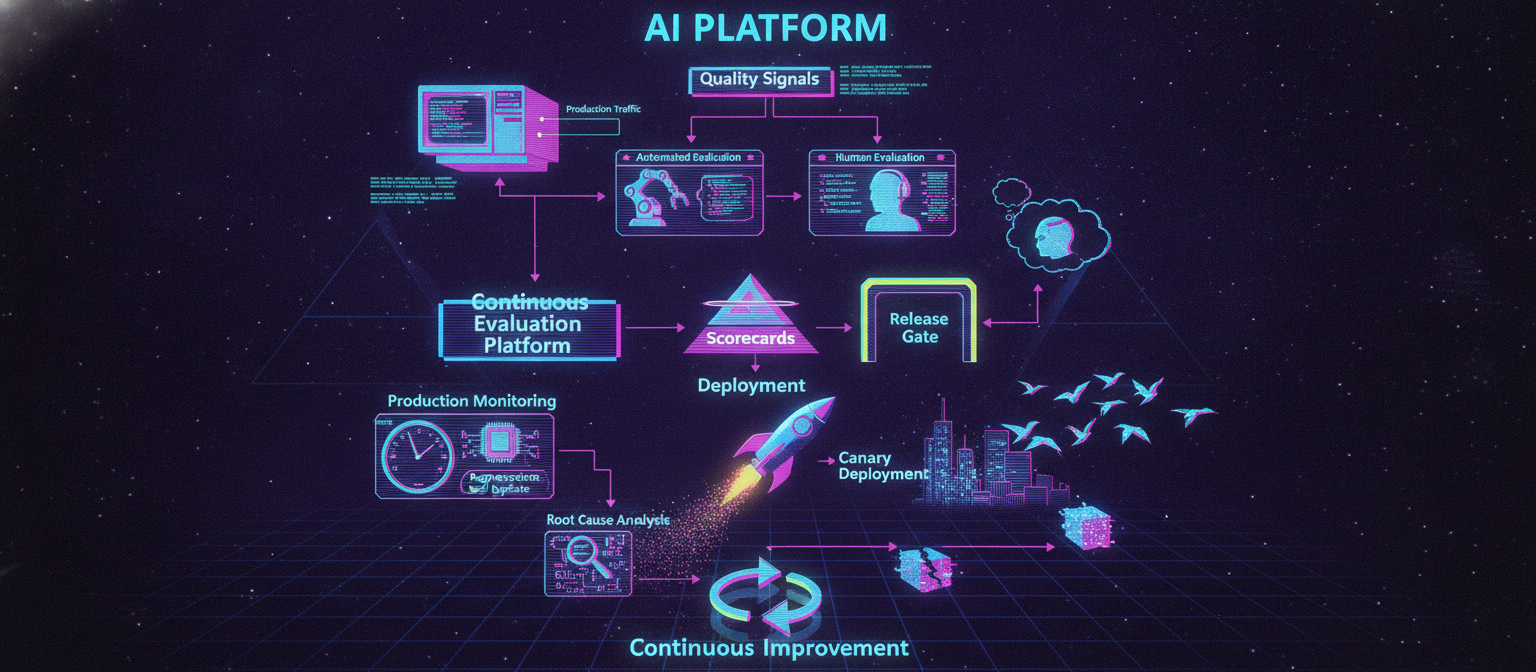
82.43 AI Quality Architecture
A complete architecture can be represented as:
                    ┌──────────────────────┐
                    │ Production Traffic   │
                    └──────────┬───────────┘
                               ↓
                    ┌──────────────────────┐
                    │ Quality Signals      │
                    └──────────┬───────────┘
                               ↓
             ┌─────────────────────────────────┐
             │ Continuous Evaluation Platform  │
             └───────┬───────────┬─────────────┘
                     ↓           ↓
              ┌──────────┐ ┌─────────────┐
              │ Automated │ │ Human       │
              │ Evaluation│ │ Evaluation  │
              └─────┬────┘ └──────┬──────┘
                    └───────┬─────┘
                            ↓
                    ┌──────────────┐
                    │ Scorecards   │
                    └──────┬───────┘
                           ↓
                    ┌──────────────┐
                    │ Release Gate │
                    └──────┬───────┘
                           ↓
                    ┌──────────────┐
                    │ Deployment   │
                    └──────────────┘
82.44 Recommended Evaluation Lifecycle
The recommended lifecycle is:
Step 1 — Define the task
Clearly describe what success means.
Step 2 — Define failure
Document unacceptable outcomes.
Step 3 — Build evaluation data
Create representative and adversarial examples.
Step 4 — Establish baseline
Measure the existing production system.
Step 5 — Test candidate changes
Evaluate new models, prompts, retrieval strategies, or code.
Step 6 — Compare
Measure quality, safety, latency, reliability, and cost.
Step 7 — Human review
Use experts where automated evaluation is insufficient.
Step 8 — Approve
Record an explicit release decision.
Step 9 — Canary
Deploy gradually.
Step 10 — Monitor
Compare real-world behavior with expected behavior.
Step 11 — Learn
Turn important failures into new evaluation cases.
82.45 Quality Engineering Checklist
Dataset
Model
Prompt
RAG
Agents
Production
Governance
82.46 Master Quality Architecture
The complete model can be summarized as:
                    AI PLATFORM
                         │
          ┌──────────────┼──────────────┐
          ↓              ↓              ↓
       Software         Data           AI
       Testing         Quality       Evaluation
          │              │              │
          └──────────────┼──────────────┘
                         ↓
                 Safety Evaluation
                         ↓
                 Human Evaluation
                         ↓
                Quality Scorecards
                         ↓
                  Release Gates
                         ↓
                 Canary Deployment
                         ↓
               Production Monitoring
                         ↓
                  Failure Detection
                         ↓
                 Root Cause Analysis
                         ↓
               Regression Test Update
                         ↓
                Continuous Improvement
82.47 Final Principle
A production AI platform should never depend on the assumption that a model is automatically good because it is powerful.
AI quality must be measured, tested, compared, monitored, and continuously improved.
The strongest quality engineering approach combines:
Golden Datasets
+
Automated Evaluation
+
Human Evaluation
+
Safety Metrics
+
Regression Testing
+
Model Benchmarking
+
RAG Evaluation
+
Agent Evaluation
+
Production Monitoring
+
Continuous Improvement
The most important principle is:
An AI system is production-quality only when its useful behavior, safe behavior, failure behavior, and change behavior can all be measured and controlled.
Quality engineering therefore becomes a permanent lifecycle rather than a final pre-release activity.
A mature AI platform continuously asks:
Is it correct?

Is it useful?

Is it safe?

Is it reliable?

Is it affordable?

Is it still performing well?

What changed?

What failed?

Can we reproduce the failure?

Can we detect it automatically?

Can we prevent it from happening again?
When these questions are built directly into the architecture, AI evaluation becomes an operational control system rather than merely a benchmark report.



Comments
Post a Comment