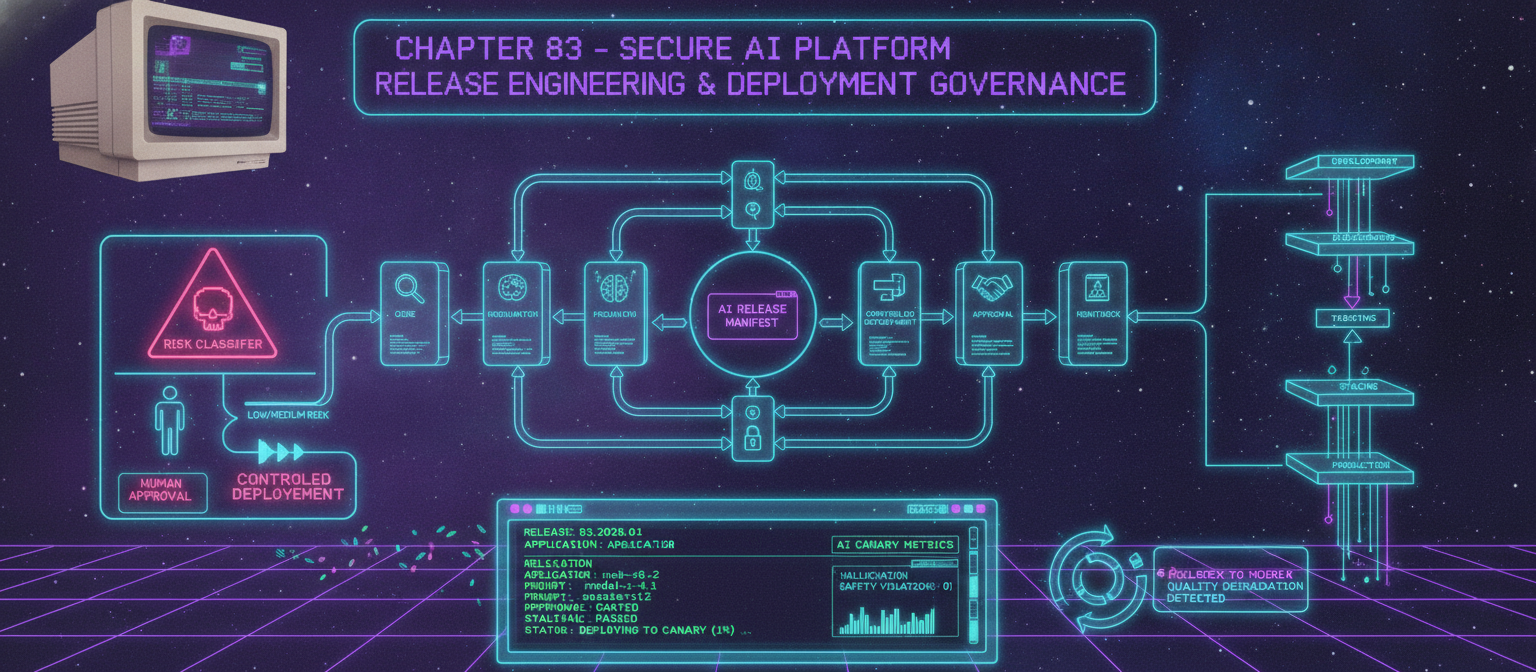
Chapter 83 — Secure AI Platform Release Engineering & Deployment Governance
83.1 Introduction
A secure AI platform does not become production-ready simply because a new version has been built successfully.
Every production release can change:
AI systems introduce an additional challenge: a release can be technically successful while still producing worse outputs.
Therefore, release engineering must control not only whether software can be deployed, but also whether the resulting system is safe and acceptable to operate.
A mature AI release process combines:
Code
+
Configuration
+
Models
+
Prompts
+
Datasets
+
Policies
+
Infrastructure
+
Security Controls
with:
Testing
+
Evaluation
+
Approval
+
Controlled Deployment
+
Monitoring
+
Rollback
The fundamental goal is:
Every production change should be identifiable, evaluated, authorized, observable, and reversible.
83.2 Release Engineering vs Deployment
These concepts are related but different.
Deployment
Moving software or configuration into an environment.
Release
Making a capability available to users.
For example:
New AI editor code deployed
does not necessarily mean:
AI editor enabled for everyone
A release can be controlled through:
feature flags
tenant allowlists
percentage rollout
staged rollout
geographic rollout
internal-only release
This separation provides an important safety boundary.
83.3 What Constitutes an AI Release?
Traditional applications often focus on code releases.
AI platforms must track many more artifacts.
A release may contain:
Application Code
Model Version
Prompt Version
System Instructions
Safety Policy Version
RAG Configuration
Embedding Model
Dataset Version
Tool Definitions
Workflow Configuration
Feature Flags
Infrastructure Configuration
Therefore an AI release should have a complete release manifest.
Example:
Release: 83.2026.01

Application:
web-v8.4.2

Model:
model-x-4.1

Prompt:
assistant-v12

Safety Policy:
policy-v7

RAG:
knowledge-v19

Embedding:
embed-v5

Feature Flags:
editor_ai=true
video_ai=false
The exact naming convention can vary, but the principle should remain the same.
83.4 Release Identity
Every production release should have a unique identifier.
Example:
release-2026-08-06-001
The release identity should connect:
Release
 ↓
Code Commit
 ↓
Build Artifact
 ↓
Model
 ↓
Prompt
 ↓
Configuration
 ↓
Evaluation
 ↓
Deployment
 ↓
Monitoring
This creates traceability.
If a problem occurs later, engineering teams should be able to answer:
Exactly what changed?
83.5 Version Everything That Can Change Behavior
A major release-engineering principle is:
If changing an artifact can change system behavior, version it.
This includes:
application code
prompts
models
policies
retrieval configuration
datasets
feature flags
schemas
tool definitions
system configuration
For example:
Prompt v10
Prompt v11
Prompt v12
is much safer than having an untracked prompt that silently changes in production.
83.6 Immutable Release Artifacts
Production artifacts should preferably be immutable.
Instead of:
production/latest
prefer immutable references such as:
application@sha256:...
or an equivalent content-addressed artifact.
This prevents ambiguity about what was actually deployed.
83.7 Environment Separation
A secure platform should separate environments.
Typical environments:
Development
     ↓
Testing
     ↓
Staging
     ↓
Production
Each environment should have separate:
Development credentials should never automatically provide production access.
83.8 Development Environment
Development environments optimize for experimentation.
Typical characteristics:
rapid iteration
local services
test data
mock AI providers
debugging tools
experimental features
However, convenience must not result in accidental access to production data.
83.9 Testing Environment
The testing environment validates:
unit tests
integration tests
security tests
API behavior
AI evaluations
workflow behavior
It should approximate production behavior sufficiently to expose important failures.
83.10 Staging Environment
Staging should be as production-like as practical.
It can validate:
deployment configuration
database migrations
networking
service dependencies
AI provider integration
queues
storage
observability
rollback procedures
Staging is especially important for complex distributed AI systems.
83.11 Production Environment
Production contains real users and real operational consequences.
Therefore production changes require stronger controls:
Identity
+
Authorization
+
Approval
+
Audit
+
Monitoring
+
Rollback
Production should never be treated as another development environment.
83.12 Change Management
Every meaningful production change should have a reason.
A release record can contain:
Change ID
Release ID
Owner
Description
Risk Level
Affected Services
Affected AI Components
Evaluation Results
Security Review
Approval
Deployment Time
Rollback Plan
This makes releases auditable.
83.13 Risk Classification
Not every release has the same risk.
A useful classification is:
Low Risk
Examples:
Medium Risk
Examples:
High Risk
Examples:
authentication changes
authorization changes
safety-policy changes
model changes
agent tool permissions
payment changes
data-retention changes
High-risk changes should receive additional review and testing.
83.14 AI-Specific Change Risk
Changing an AI model can affect multiple dimensions simultaneously.
For example:
New Model
 ↓
Higher capability
 ↓
Different refusal behavior
 ↓
Different hallucination rate
 ↓
Different latency
 ↓
Different cost
 ↓
Different tool behavior
Therefore model upgrades should not be treated as ordinary dependency upgrades.
They require evaluation.
83.15 Release Readiness
Before production release, evaluate:
Functional Readiness
Security Readiness
AI Quality Readiness
Performance Readiness
Reliability Readiness
Cost Readiness
Operational Readiness
Privacy Readiness
A release should proceed only when required gates have passed.
83.16 Release Gates
A production release pipeline can follow:
Code Commit
    ↓
Build
    ↓
Static Analysis
    ↓
Unit Tests
    ↓
Integration Tests
    ↓
Security Tests
    ↓
AI Evaluation
    ↓
Performance Tests
    ↓
Artifact Verification
    ↓
Approval
    ↓
Staging Deployment
    ↓
Smoke Tests
    ↓
Canary
    ↓
Production
Critical failures should block progression.
83.17 Automated Gates
Automation should handle objective checks whenever possible.
Examples:
Build succeeded
Tests passed
No critical vulnerabilities
AI safety threshold passed
Quality threshold passed
Migration validation passed
Artifact signature valid
Required approvals present
Automation reduces human error.
83.18 Human Approval
Automation cannot replace every decision.
Human review can be required for:
high-risk model changes
security-policy changes
authorization changes
major database migrations
production agent permissions
sensitive data-processing changes
The approval should be explicit and auditable.
83.19 Separation of Duties
The person who creates a high-risk production change should not necessarily be the only person who approves it.
A stronger model is:
Developer
   ↓
Reviewer
   ↓
Security/AI Approval
   ↓
Release System
The exact roles depend on organizational size.
The principle is to avoid unchecked privileged changes.
83.20 Feature Flags
Feature flags allow deployment and release to be separated.
Example:
Code deployed
       ↓
Feature disabled
       ↓
Internal testing
       ↓
Feature enabled for selected users
       ↓
Gradual rollout
This reduces blast radius.
83.21 Secure Feature Flags
Feature flags themselves are security-sensitive configuration.
They should support:
authentication
authorization
audit logging
versioning
change history
environment separation
Do not allow ordinary client-side users to manipulate server-side entitlement flags.
83.22 Tenant-Based Rollout
Multi-tenant AI platforms can release features to selected tenants.
Example:
Tenant A → enabled
Tenant B → disabled
Tenant C → enabled
This enables controlled testing.
However, tenant selection must be enforced server-side.
The browser should not be trusted to decide whether a feature is authorized.
83.23 Canary Releases
A canary release exposes a new version to a small amount of traffic.
Example:
99% → old version
1%  → new version
Monitor:
errors
latency
quality
safety
cost
user feedback
If the new version remains healthy, increase traffic gradually.
83.24 AI Canary Metrics
Traditional canary monitoring focuses on technical metrics.
AI canaries should additionally monitor:
Hallucination
Safety Violations
Task Success
Refusal Behavior
Tool Errors
User Feedback
Generation Cost
A deployment that has excellent CPU metrics but poor AI quality should still be stopped.
83.25 Blue-Green Deployment
Blue-green deployment maintains two environments.
Blue → Current Production
Green → New Version
Traffic initially goes to Blue.
After Green passes validation:
Blue
  ↓
Traffic Switch
  ↓
Green
If a serious problem occurs:
Green
  ↓
Rollback
  ↓
Blue
This can provide fast recovery.
83.26 Rolling Deployment
A rolling deployment gradually replaces instances.
Example:
Old Old Old Old

Old New Old Old

New New Old Old

New New New Old

New New New New
This reduces immediate disruption.
However, compatibility between old and new versions must be considered.
83.27 Database Migration Safety
Database migrations are especially important because rollback is not always simple.
A safer pattern is:
Expand
 ↓
Deploy compatible application
 ↓
Migrate data
 ↓
Switch behavior
 ↓
Contract
Avoid making destructive schema changes simultaneously with application deployment when possible.
83.28 Backward Compatibility
During rolling releases, old and new application versions may temporarily coexist.
Therefore:
Old App
+
New App
may both communicate with:
Same Database
The schema should remain compatible during the transition.
83.29 AI Model Rollback
Model rollback should be as straightforward as code rollback.
Example:
Model v8
   ↓
Model v9
   ↓
Quality degradation detected
   ↓
Return to Model v8
The platform should preserve the previous known-good model configuration.
83.30 Prompt Rollback
Prompts should also support rollback.
Example:
Prompt v17
   ↓
Prompt v18
   ↓
Unexpected behavior
   ↓
Prompt v17
Prompt configuration should therefore not be hidden inside arbitrary application code.
83.31 Policy Rollback
Safety policies require special caution.
If a policy change produces unintended behavior, the platform should have a controlled rollback procedure.
However, rollback must not restore a known-vulnerable security policy simply because it was historically stable.
Security exceptions require explicit review.
83.32 Configuration Rollback
Configuration can be just as dangerous as code.
Examples:
model routing
token limits
rate limits
storage settings
network policies
feature flags
tool permissions
Configuration changes should therefore be versioned and auditable.
83.33 Release Manifests
A release manifest can provide a complete deployment description.
Example:
Release ID
Application artifact
Database migration version
Model version
Prompt version
Safety policy version
RAG configuration version
Feature flag configuration
Infrastructure version
Evaluation result
Approval record
This creates a reproducible release state.
83.34 Artifact Integrity
Production artifacts should be protected against tampering.
Controls can include:
The deployment system should verify artifacts before executing them.
83.35 Build Provenance
A production artifact should have traceable origins.
Example:
Source Commit
     ↓
Build System
     ↓
Dependencies
     ↓
Build Artifact
     ↓
Security Scan
     ↓
Signature
     ↓
Deployment
This helps answer:
Where did this production artifact come from?
83.36 Supply-Chain Verification
Release engineering should connect with supply-chain security.
Verify:
dependencies
containers
model files
plugins
build tools
packages
generated artifacts
Unknown or untrusted artifacts should not automatically enter production.
83.37 Secrets During Release
Release pipelines frequently require credentials.
Secrets should be:
Secrets should never be hard-coded into source code.
83.38 CI/CD Security
CI/CD infrastructure is highly privileged.
A compromised pipeline can potentially modify production systems.
Therefore:
Developer
 ↓
Source Repository
 ↓
CI
 ↓
Artifact Registry
 ↓
Deployment Controller
 ↓
Production
must be protected at every boundary.
Use:
least privilege
branch protections
approval gates
isolated runners
secret controls
artifact verification
audit logs
83.39 Release Observability
Every deployment should produce observable events.
Examples:
Release Started
Build Completed
Approval Granted
Staging Deployed
Canary Started
Traffic Increased
Rollback Triggered
Release Completed
These events should be correlated with application and infrastructure telemetry.
83.40 Deployment Health Checks
After deployment, verify:
Application
health endpoint
API functionality
database connectivity
AI
model availability
prompt execution
retrieval functionality
safety controls
Infrastructure
queue health
storage access
network connectivity
worker availability
User Experience
login
generation
upload
editing
export
83.41 Smoke Testing
Smoke tests provide a fast validation after deployment.
A minimal AI platform smoke suite might verify:
Login
 ↓
Create project
 ↓
Upload safe test asset
 ↓
Run AI operation
 ↓
Receive output
 ↓
Save result
 ↓
Export result
The test should use controlled non-sensitive data.
83.42 Production Synthetic Testing
Synthetic monitoring periodically performs controlled workflows against production.
For example:
Synthetic User
 ↓
Authentication
 ↓
Test Request
 ↓
AI Processing
 ↓
Expected Response
This can detect failures before large numbers of users report them.
83.43 Automatic Rollback
Some failures can trigger automated rollback.
Examples:
Error rate exceeds threshold
or:
Critical service unavailable
or:
Safety metric crosses critical threshold
Automatic rollback should be conservative.
A system should not repeatedly deploy and rollback because of noisy measurements.
83.44 Rollback Decision Model
A useful approach:
Normal
  ↓
Anomaly
  ↓
Validate
  ↓
Severity?
 ├── Low → Monitor
 ├── Medium → Reduce rollout
 └── Critical → Stop / Rollback
This avoids overreacting to harmless fluctuations.
83.45 Rollback Testing
A rollback plan is not sufficient unless it has been tested.
Test:
application rollback
model rollback
prompt rollback
configuration rollback
database recovery
queue recovery
storage recovery
Rollback testing should occur regularly.
83.46 Deployment Failure Handling
If deployment fails halfway:
Old version
     ↓
Partial deployment
     ↓
Failure
the platform should have a deterministic recovery strategy.
Possible strategies:
Continue
Rollback
Pause
Escalate
The choice depends on the failure type.
83.47 Graceful Release Cancellation
A deployment should be cancellable when a serious problem is detected.
Cancellation should:
stop future rollout
preserve current state
prevent new traffic where appropriate
maintain service availability
record the cancellation reason
83.48 Release Freeze
During a major incident or unstable period, organizations may temporarily freeze non-essential releases.
A release freeze can reduce variables during incident investigation.
Emergency security fixes may still proceed under an emergency change process.
83.49 Emergency Releases
Emergency releases require speed without abandoning security.
A controlled emergency process can be:
Emergency identified
       ↓
Risk assessment
       ↓
Minimal fix
       ↓
Focused testing
       ↓
Emergency approval
       ↓
Canary / controlled deployment
       ↓
Monitoring
       ↓
Post-release review
Emergency does not mean uncontrolled.
83.50 Production Readiness Review
Before a major release, review:
Architecture
Security
AI Quality
Performance
Reliability
Privacy
Cost
Operations
Support
Rollback
Documentation
The review should produce a clear decision.
GO
GO WITH CONDITIONS
NO-GO
83.51 Release Documentation
Every significant release should document:
what changed
why it changed
affected components
known limitations
evaluation results
security considerations
deployment procedure
rollback procedure
monitoring requirements
This improves operational continuity.
83.52 Release Notes
User-facing release notes should communicate meaningful changes without exposing sensitive internal details.
Examples:
Improved AI image generation reliability.
Improved document-processing performance.
Added additional language support.
Improved export stability.
Internal engineering notes can contain more detailed technical information.
83.53 Release Ownership
Every release should have an owner.
The owner is responsible for:
release coordination
readiness verification
deployment status
rollback decision
communication
post-release review
Ownership prevents ambiguous responsibility.
83.54 Post-Release Monitoring Window
After deployment, define an observation period.
For example:
Deployment
 ↓
Immediate smoke tests
 ↓
Short-term monitoring
 ↓
Extended monitoring
 ↓
Release considered stable
The length depends on system risk and traffic patterns.
83.55 Post-Release Review
After major releases, review:
incidents
quality changes
performance
cost
user feedback
unexpected behavior
rollback events
Important failures should become new regression tests.
83.56 Release Governance Architecture
A complete release-governance model can be represented as:
                  CHANGE REQUEST
                        │
                        ↓
                 RISK CLASSIFIER
                        │
                        ↓
               ┌────────────────┐
               │ Evaluation     │
               │ Test Suite     │
               └───────┬────────┘
                       ↓
                SECURITY REVIEW
                       ↓
                 HUMAN APPROVAL
                       ↓
                 RELEASE MANIFEST
                       ↓
                 SIGNED ARTIFACT
                       ↓
                STAGING DEPLOYMENT
                       ↓
                 SMOKE TESTS
                       ↓
                 CANARY RELEASE
                       ↓
                 MONITORING
                    ↙     ↘
                 PASS     FAIL
                  ↓         ↓
             FULL RELEASE  ROLLBACK
                  ↓         ↓
             OBSERVATION  INCIDENT
                  ↓
             POST-RELEASE REVIEW
83.57 Master Release Checklist
Planning
Versioning
Testing
Security
Deployment
Post-release
83.58 Final Architecture Principle
A secure AI release process should connect:
Version Control
      +
Testing
      +
AI Evaluation
      +
Security Review
      +
Approval
      +
Artifact Integrity
      +
Controlled Deployment
      +
Observability
      +
Rollback
No individual mechanism is sufficient by itself.
Feature flags without authorization can become a security problem.
Canary deployment without AI-quality monitoring can release a low-quality model.
Automated tests without human evaluation can miss nuanced failures.
Rollback without tested recovery procedures can create false confidence.
Therefore release engineering must operate as an integrated control system.
83.59 Final Principle
The safest AI platforms do not ask:
“Can we deploy this?”
They ask:
“Do we have enough evidence that this change is safe, useful, reliable, observable, authorized, and reversible?”
A production release should therefore be:
Identifiable
+
Tested
+
Evaluated
+
Approved
+
Controlled
+
Observable
+
Reversible
The final objective is not to eliminate all change.
The objective is to make change predictable, measurable, controlled, and recoverable.
For an AI platform, release engineering is therefore part of the security architecture itself.



Comments
Post a Comment