Chapter 84 — Secure AI Platform Configuration Management & Policy-as-Code
84.1 Introduction
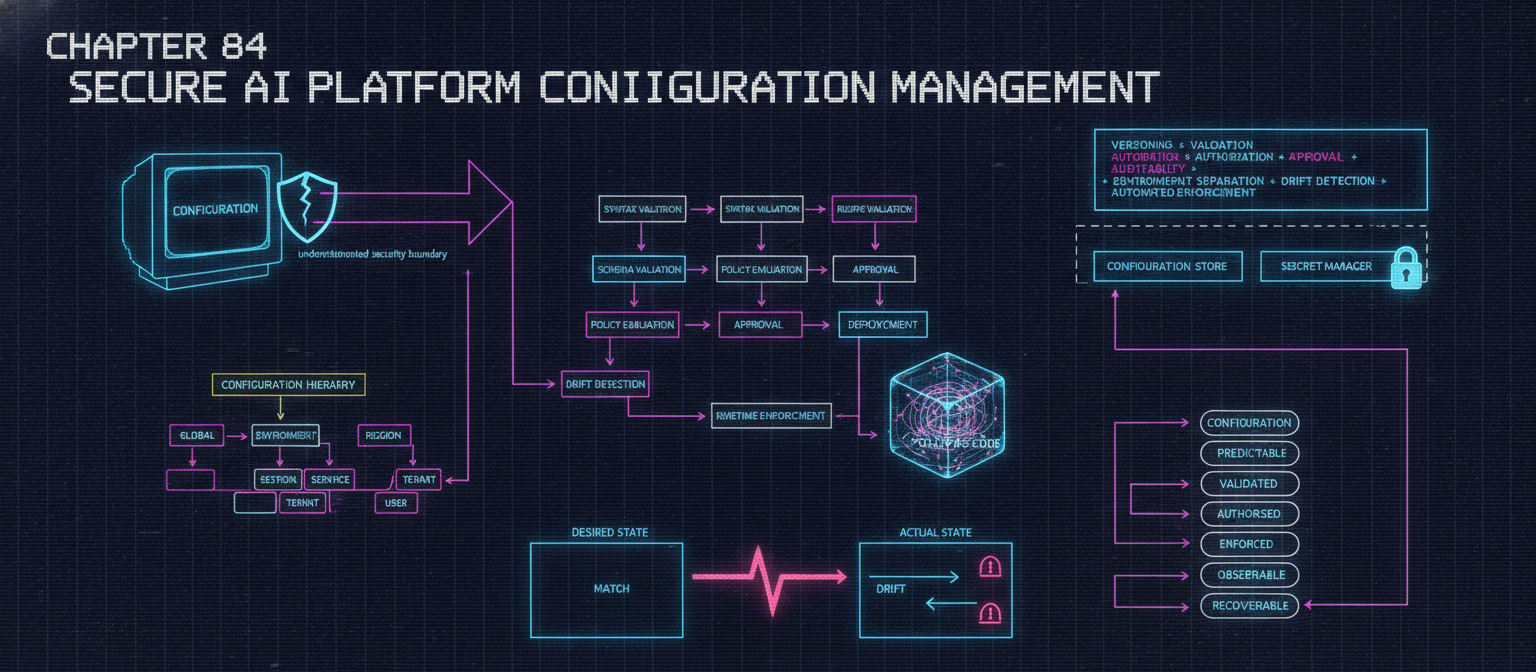
Configuration is one of the most underestimated security boundaries in an AI platform.
A production system can have secure application code and still become vulnerable because of an unsafe configuration.
Examples include:
an overly permissive feature flag
an incorrect model route
an excessive token limit
an exposed service
an incorrect storage policy
an unsafe agent permission
an overly broad database role
a disabled security control
an incorrect retention setting
a production service accidentally using development credentials
Therefore:
Configuration must be treated as production code and security-sensitive data.
A mature configuration architecture provides:
Versioning
+
Validation
+
Authorization
+
Approval
+
Auditability
+
Environment Separation
+
Drift Detection
+
Automated Enforcement
84.2 What Is Configuration?
Configuration is any externally controlled value that changes application or infrastructure behavior without requiring a new source-code implementation.
Examples:
AI model selection
Token limits
Rate limits
Feature flags
Database settings
Storage policies
Queue limits
Timeouts
Security policies
Allowed file types
Retention periods
Agent permissions
Not every value should be configurable.
A system should avoid creating configuration options merely because they are technically possible.
Every configuration parameter increases operational complexity and potentially increases attack surface.
84.3 Configuration Categories
A useful classification is:
Application Configuration
Examples:
API behavior
UI settings
feature behavior
service endpoints
AI Configuration
Examples:
model selection
prompt version
temperature
maximum tokens
routing rules
fallback models
Security Configuration
Examples:
Infrastructure Configuration
Examples:
CPU limits
memory limits
network policies
autoscaling thresholds
Data Configuration
Examples:
retention periods
backup schedules
storage classes
deletion policies
Business Configuration
Examples:
84.4 Configuration vs Secrets
Configuration and secrets should not be treated identically.
Example:
MODEL_NAME=provider-model-x
is configuration.
But:
API_KEY=secret-value
is a secret.
Secrets require stronger protection.
Therefore:
Configuration Store
        +
Secret Manager
should generally be separate security boundaries.
84.5 Configuration Hierarchy
A large platform may have several configuration levels:
Global
  ↓
Environment
  ↓
Region
  ↓
Service
  ↓
Tenant
  ↓
User
For example:
Global:
maximum upload = 100 MB

Tenant:
maximum upload = 50 MB

User:
maximum upload = 20 MB
The system must define precedence explicitly.
Otherwise conflicting values can create unpredictable behavior.
84.6 Configuration Precedence
A predictable model might be:
Default
 ↓
Environment
 ↓
Tenant Policy
 ↓
User Entitlement
 ↓
Request-Specific Allowed Override
However, not every setting should be overrideable.
Security-critical configuration should have a hard upper boundary.
For example:
tenant_token_limit <= platform_max_token_limit
A tenant administrator should never be able to exceed platform-wide safety limits.
84.7 Configuration Schema
Configuration should have a formal schema.
For example:
maxUploadSize:
  type: integer
  minimum: 1
  maximum: 104857600

aiTimeout:
  type: integer
  minimum: 1000
  maximum: 120000
Schema validation prevents invalid values from reaching production.
84.8 Type Safety
Configuration values should have explicit types.
Avoid treating everything as strings.
Bad conceptual model:
MAX_RETRIES="five"
Better:
MAX_RETRIES=5
Typed configuration reduces runtime ambiguity.
84.9 Configuration Validation
Validation should happen before configuration is activated.
Validate:
type
range
format
allowed values
dependencies
security constraints
environment restrictions
Example:
AI_TIMEOUT = 0
should be rejected if zero is invalid.
84.10 Cross-Field Validation
Some settings are valid individually but unsafe together.
Example:
max_retry = 20
timeout = 60 seconds
could produce excessive workload amplification.
Therefore configuration validation should sometimes evaluate relationships.
Example:
retry_budget × timeout <= maximum_operation_budget
The exact rule depends on the system.
84.11 Configuration Dependency Graph
Configuration values often depend on one another.
For example:
Model Selection
      ↓
Token Limit
      ↓
Timeout
      ↓
Cost
Changing one value can affect multiple systems.
A configuration dependency map helps identify those effects.
84.12 Configuration as Code
Infrastructure and important operational policies should preferably be represented declaratively.
Example concept:
Desired State
      ↓
Validation
      ↓
Review
      ↓
Deployment
      ↓
Actual State
This improves reproducibility.
84.13 Policy-as-Code
Policy-as-code means expressing enforceable rules in machine-readable form.
Examples:
Users may access only their authorized tenant.

Production workloads may not use development secrets.

Agent tools require explicit permissions.

Maximum upload size must not exceed platform limit.

Production deployment requires approval.

Untrusted files must pass validation before processing.
Instead of relying solely on documentation, these rules can be enforced automatically.
84.14 Why Policy-as-Code Matters
Human-written documentation can say:
Production services must not expose administrative endpoints.
But policy-as-code can automatically check whether the deployed configuration violates that requirement.
This changes security from:
Remember the rule
to:
Enforce the rule
84.15 Preventive vs Detective Controls
Configuration governance should provide both.
Preventive
Stop unsafe changes before deployment.
Examples:
validation
policy checks
approval gates
schema enforcement
Detective
Identify unsafe states after deployment.
Examples:
drift detection
configuration scanning
monitoring
alerts
A strong system uses both.
84.16 Configuration Lifecycle
A configuration change should follow:
Request
 ↓
Validation
 ↓
Risk Classification
 ↓
Review
 ↓
Approval
 ↓
Versioning
 ↓
Deployment
 ↓
Verification
 ↓
Monitoring
This is similar to software release management.
84.17 Configuration Change Identity
Every important configuration change should receive an identifier.
Example:
CONFIG-2026-00421
The record can contain:
Change ID
Owner
Previous Value
New Value
Reason
Risk
Approver
Timestamp
Environment
Affected Services
Rollback Version
84.18 Immutable Configuration History
Do not silently overwrite configuration history.
Instead:
Version 1
Version 2
Version 3
Version 4
should remain traceable.
This supports:
debugging
auditing
rollback
incident investigation
84.19 Configuration Rollback
A configuration system should support reverting to a known-good version.
Example:
Config v17
   ↓
Config v18
   ↓
Incident
   ↓
Config v17
Rollback should itself be controlled and logged.
84.20 Configuration Drift
Configuration drift occurs when actual system state differs from the intended configuration.
Example:
Desired:
rate_limit = 100/min

Actual:
rate_limit = 500/min
This may occur because of:
manual changes
deployment errors
infrastructure changes
emergency fixes
unauthorized access
Drift should be detected automatically.
84.21 Drift Detection
A basic architecture:
Desired Configuration
        ↓
Configuration Repository
        ↓
Drift Scanner
        ↓
Actual Environment
        ↓
Comparison
        ↓
Alert / Remediation
For critical settings, automatic remediation may be appropriate.
For sensitive production changes, human review may be preferable.
84.22 Configuration Integrity
Configuration stores should be protected against unauthorized modification.
Controls include:
authentication
authorization
version history
integrity verification
audit logging
restricted write access
Configuration should never be writable by arbitrary application users.
84.23 Feature Flags as Configuration
Feature flags are configuration with direct product impact.
Example:
ai_video_generation = false
Changing it to:
ai_video_generation = true
may instantly expose an expensive AI capability to users.
Therefore feature flags need:
84.24 Feature Flag Expiration
Temporary flags should not remain forever.
Example:
experimental_editor_v2
should have:
Created
Owner
Purpose
Expected removal date
Otherwise temporary configuration becomes permanent complexity.
84.25 AI Model Routing Configuration
Model routing is a particularly important AI configuration category.
Example:
Simple task → Small Model
Complex task → Large Model
High-risk task → Validated Model
Routing rules can affect:
quality
cost
latency
safety
privacy
Therefore routing configuration should be versioned and evaluated.
84.26 Token and Resource Limits
Configuration should enforce resource boundaries.
Examples:
max_tokens
max_input_size
max_output_size
max_file_size
max_generation_time
max_agent_steps
max_tool_calls
These values protect against accidental and malicious resource exhaustion.
84.27 Rate-Limit Configuration
Rate limits should be explicit.
Potential dimensions:
Per user
Per tenant
Per API key
Per IP
Per endpoint
Per model
Per operation
Limits should be configurable without weakening global protection.
84.28 Security Policy Configuration
Examples:
Allowed file types
Maximum upload size
Session lifetime
Password requirements
MFA requirements
Allowed tools
Data retention
External provider access
Security configuration should receive stronger governance than ordinary UI settings.
84.29 Agent Policy Configuration
An AI agent may have permissions such as:
read_document
create_draft
search_knowledge
generate_media
send_notification
The policy engine should determine which permissions are available.
Configuration should never allow the model itself to grant new permissions.
84.30 Hard Limits vs Configurable Limits
Some boundaries should be configurable.
Others should be hard-coded or enforced at a lower security layer.
For example:
Tenant maximum = 100 requests/min
but:
Platform absolute maximum = 1000 requests/min
Even if tenant configuration is changed, the platform boundary remains.
This creates defense in depth.
84.31 Environment-Specific Configuration
Development may use:
debug = true
Production should use:
debug = false
Environment-specific configuration must be explicit.
Avoid accidentally inheriting development settings into production.
84.32 Secure Defaults
When configuration is missing, the system should choose a safe default.
Example:
unknown_tool_permission
        ↓
deny
rather than:
unknown_tool_permission
        ↓
allow
This is especially important for authorization and security policies.
84.33 Fail-Closed Configuration
For high-risk security decisions:
Policy unavailable
     ↓
Deny sensitive operation
is often safer than:
Policy unavailable
     ↓
Allow operation
The exact behavior depends on availability requirements, but sensitive authorization should generally fail safely.
84.34 Configuration Validation Pipeline
A secure configuration pipeline can be:
Configuration Change
        ↓
Syntax Validation
        ↓
Schema Validation
        ↓
Semantic Validation
        ↓
Security Policy Check
        ↓
Risk Classification
        ↓
Approval
        ↓
Deployment
        ↓
Runtime Verification
84.35 Policy Testing
Policies themselves require tests.
Examples:
Authorized user → Allow

Unauthorized user → Deny

Cross-tenant access → Deny

Unknown tool → Deny

Oversized upload → Deny

Production secret requested by test workload → Deny
This turns policy into a testable artifact.
84.36 Policy Regression Testing
A policy change can unintentionally weaken another rule.
Therefore maintain policy regression cases.
Example:
Policy v10
 ↓
Policy v11
 ↓
Run security regression suite
Critical authorization rules should remain protected across versions.
84.37 Configuration Testing
Configuration testing should cover:
Valid Values
timeout = 30s
Boundary Values
timeout = maximum_allowed
Invalid Values
timeout = negative
Missing Values
timeout = undefined
Conflicting Values
retry × timeout > resource budget
84.38 Configuration Security Testing
Test for:
Configuration interfaces are part of the attack surface.
84.39 Administrative Configuration UI
If administrators can modify configuration through a web interface, the UI should enforce:
Authentication
Authorization
MFA where appropriate
Validation
Confirmation
Audit Logging
Sensitive configuration changes may require additional confirmation.
84.40 Configuration Audit Logs
Every sensitive configuration change should record:
Who
What
When
Where
Previous Value
New Value
Reason
Approval
Result
Sensitive values such as secrets should not be written directly into logs.
84.41 Secret-Safe Logging
Bad:
API_KEY changed from abc123 to xyz789
Better:
API_KEY reference changed
Logs should contain metadata without exposing secret material.
84.42 Configuration Encryption
Sensitive configuration data should be protected appropriately.
For ordinary configuration, access control may be sufficient.
For secrets:
Secret Manager
+
Encryption
+
Access Policy
+
Audit
should be used.
84.43 Tenant Configuration
Multi-tenant platforms may provide tenant-level configuration.
Example:
Tenant Settings
 ├── allowed_models
 ├── quota
 ├── retention
 ├── feature_access
 └── allowed_tools
Tenant configuration must remain isolated.
Tenant A must never be able to modify Tenant B's settings.
84.44 Configuration Authorization
Use least privilege.
Possible roles:
Viewer
Editor
Security Admin
Platform Admin
Release Manager
Not every administrator should be able to modify every setting.
84.45 Two-Person Approval for Critical Changes
For extremely sensitive configuration, organizations may require two independent approvals.
Example:
Critical Policy Change
      ↓
Approver A
      +
Approver B
      ↓
Deployment
This reduces the risk of unilateral mistakes or abuse.
84.46 Configuration Deployment Strategies
Configuration changes can be deployed using:
Immediate
Useful for low-risk configuration.
Staged
Apply gradually.
Canary
Apply to a small portion of infrastructure.
Tenant-Based
Apply to selected tenants.
Scheduled
Activate at a controlled time.
The strategy should match risk.
84.47 Runtime Configuration Refresh
Some settings may update without application restart.
This is convenient but creates additional risk.
Runtime refresh should include:
validation
authorization
version checks
atomic activation
rollback
audit logging
Never allow arbitrary runtime configuration mutation.
84.48 Atomic Configuration Updates
Related settings should activate together when possible.
Suppose:
Model = X
Prompt = Prompt-X
Policy = Policy-X
Changing only the model could create an incompatible state.
A release bundle can ensure:
Model X
+
Prompt X
+
Policy X
activate as one versioned configuration set.
84.49 Configuration Compatibility
Configuration changes should be checked against dependent services.
Example:
New Model
   ↓
Requires new tokenizer
   ↓
Requires new runtime
The configuration system should identify incompatibilities before deployment.
84.50 Configuration Dependency Validation
A dependency graph can detect:
Config A
  ↓
Service B
  ↓
Model C
  ↓
Database D
before changing A.
This helps prevent unexpected production failures.
84.51 Policy-as-Code Architecture
A complete architecture can be:
              Configuration Repository
                         │
                         ↓
                Schema Validation
                         │
                         ↓
                 Policy Evaluation
                         │
                         ↓
                  Security Review
                         │
                         ↓
                     Approval
                         │
                         ↓
                Configuration Bundle
                         │
                         ↓
                  Deployment System
                         │
                         ↓
                 Runtime Enforcement
                         │
                         ↓
                  Drift Detection
                         │
                         ↓
                  Audit / Monitoring
84.52 Configuration Control Plane
A mature platform can centralize configuration management in a control plane.
                CONFIGURATION CONTROL PLANE
                           │
       ┌───────────────────┼───────────────────┐
       ↓                   ↓                   ↓
   Validation          Policy Engine       Audit Log
       │                   │                   │
       └───────────────────┼───────────────────┘
                           ↓
                  Versioned Configuration
                           ↓
       ┌───────────────────┼───────────────────┐
       ↓                   ↓                   ↓
    API Service         AI Service          Worker
The data plane consumes approved configuration but should not arbitrarily modify the control plane.
84.53 Desired State vs Actual State
Configuration management becomes clearer when separating:
Desired State
from:
Actual State
The control system continuously attempts to ensure:
Desired State = Actual State
while detecting unauthorized differences.
84.54 Configuration Drift Response
When drift is detected:
Drift
 ↓
Classify
 ↓
Critical?
 ├── Yes → Immediate containment
 └── No  → Alert / scheduled remediation
Automatic remediation should be used carefully.
A remediation mechanism must not repeatedly fight legitimate emergency changes.
84.55 Emergency Configuration Changes
During an incident, an emergency change may be necessary.
Example:
Disable unstable feature
The emergency process should still record:
Who
Why
What changed
When
Risk
Rollback plan
After the incident, the temporary configuration should be reviewed.
84.56 Configuration Lifecycle Cleanup
Unused configuration should be removed.
Otherwise systems accumulate:
Old Flags
Old Models
Old Policies
Old Limits
Old Environment Variables
This creates configuration debt.
Periodic cleanup should identify:
unused settings
obsolete flags
deprecated models
duplicate policies
abandoned overrides
84.57 Configuration Debt
Configuration debt can become a security problem.
Example:
Old feature flag
      ↓
Unknown owner
      ↓
Unknown behavior
      ↓
Accidental activation
Therefore configuration should have ownership and lifecycle management.
84.58 Configuration Ownership
Every important configuration object should have:
Owner
Purpose
Environment
Risk
Created Date
Last Modified
Review Date
Expiration Date
This prevents orphaned configuration.
84.59 Configuration Review
High-risk configuration should be reviewed periodically.
Examples:
Periodic review helps detect configuration drift and privilege accumulation.
84.60 Configuration Monitoring Metrics
Useful metrics include:
Configuration changes/day
Unauthorized changes
Drift events
Failed validations
Policy violations
Rollback events
Expired flags
Unreviewed configurations
These provide visibility into configuration health.
84.61 Master Configuration Checklist
Governance
Validation
Security
AI
Operations
84.62 Final Architecture
The complete configuration-security lifecycle is:
             CONFIGURATION REQUEST
                      ↓
                CLASSIFICATION
                      ↓
                  VALIDATION
                      ↓
              POLICY-AS-CODE
                      ↓
               RISK ANALYSIS
                      ↓
                  APPROVAL
                      ↓
                VERSIONING
                      ↓
              SIGNED / TRUSTED
                 CONFIGURATION
                      ↓
                 DEPLOYMENT
                      ↓
              RUNTIME ENFORCEMENT
                      ↓
                MONITORING
                      ↓
              DRIFT DETECTION
                 ↙         ↘
             MATCH        DRIFT
               ↓             ↓
            CONTINUE     INVESTIGATE
                              ↓
                         REMEDIATE /
                           ROLLBACK
84.63 Final Principle
Configuration is not merely a collection of environment variables.
In a modern AI platform, configuration controls:
Identity
Authorization
Models
Prompts
Tools
Resources
Data
Security
Cost
Reliability
User Experience
Therefore configuration must be governed with the same seriousness as application code.
The strongest architecture follows:
Define desired state, validate it, enforce policy automatically, authorize important changes, version everything, detect drift, and maintain a tested rollback path.
Policy-as-code strengthens this model by converting important security requirements from passive documentation into enforceable controls.
The final objective is:
Configuration
      ↓
Predictable
      ↓
Validated
      ↓
Authorized
      ↓
Enforced
      ↓
Observable
      ↓
Recoverable
That is the foundation of secure configuration management for a production AI platform.



Comments
Post a Comment