Chapter 88 — Secure AI Platform Runtime Protection & Workload Security
88.1 Introduction
Secure deployment establishes that an approved workload is allowed to run.
Runtime security answers a different question:
What happens after that workload starts running?
A container may be correctly signed, properly deployed, and authorized, yet still become vulnerable because of:
application bugs
malicious input
compromised dependencies
unexpected process behavior
excessive resource consumption
unsafe file operations
unauthorized network communication
runtime configuration changes
compromised third-party components
model or media-processing vulnerabilities
Therefore, production security must continue after deployment.
A mature AI platform should provide runtime protection across:
containers
processes
filesystems
networks
identities
resources
AI inference services
media-processing workers
background jobs
sandboxed execution environments
The fundamental principle is:
A workload should remain constrained, observable, and controllable throughout its entire runtime lifecycle.
88.2 Runtime Threat Model
A production AI workload can face several categories of runtime threats.
Application compromise
An attacker exploits a vulnerability in the running application.
Dependency exploitation
A vulnerable library behaves unexpectedly after deployment.
Malicious file processing
A crafted image, video, archive, document, or audio file triggers unsafe behavior.
Resource exhaustion
An attacker causes excessive CPU, memory, GPU, storage, or inference consumption.
Network abuse
A compromised workload attempts unauthorized communication.
Credential misuse
A compromised process attempts to use available credentials outside its intended purpose.
Container escape
An attacker attempts to cross the container boundary and affect the host or other workloads.
Lateral movement
A compromised service attempts to access other internal services.
Persistence
Malicious runtime state survives longer than intended.
Runtime security should be designed to limit the impact of each category.
88.3 Defense-in-Depth Runtime Architecture
A strong runtime architecture uses multiple layers:
                    User Request
                         ↓
                Authentication
                         ↓
                Authorization
                         ↓
                  API Gateway
                         ↓
                 Application Layer
                         ↓
                 Runtime Workload
                /        |        \
               ↓         ↓         ↓
          Identity    Network    Resources
               ↓         ↓         ↓
             Files   Processes   Runtime Policy
                \        |        /
                         ↓
                  Monitoring
                         ↓
                 Detection/Response
No single runtime control should be considered sufficient.
88.4 Container Hardening
Containers should be treated as security boundaries with explicit limitations.
Important controls include:
A container should contain only what the application needs.
88.5 Minimal Container Images
Every unnecessary package increases the attack surface.
A large image might contain:
Application
+
Compiler
+
Debugging Tools
+
Package Managers
+
Unused Libraries
+
Shell Utilities
+
Other Software
A minimal production image should contain primarily:
Application
+
Required Runtime
+
Required Libraries
Development tools should generally remain outside the production image unless there is a justified operational requirement.
88.6 Read-Only Root Filesystem
Where possible, the root filesystem should be read-only.
Conceptually:
Container
 ├── Application → Read
 ├── System → Read
 └── Temporary Directory → Controlled Write
This reduces the ability of a compromised process to modify its environment.
Applications that need temporary files can use dedicated writable locations with size and lifecycle controls.
88.7 Linux Capabilities
Operating systems may divide powerful privileges into capabilities.
A workload should not automatically receive every available capability.
The preferred principle is:
Required Capability
       ↓
Explicitly Granted
rather than:
All Capabilities
       ↓
Automatically Granted
Reducing unnecessary capabilities limits the consequences of process compromise.
88.8 Privilege Escalation Protection
Runtime configurations should prevent processes from gaining additional privileges unnecessarily.
Controls may include:
The goal is to make privilege escalation difficult even after an application-level vulnerability is exploited.
88.9 Process Isolation
A workload may run multiple processes, but security-sensitive components should be isolated where practical.
For example:
AI API
   ↓
Inference Worker
   ↓
Sandboxed Model Process
rather than placing every capability inside one highly privileged process.
Isolation can reduce blast radius.
88.10 Media Processing Isolation
AI media platforms often process untrusted files.
Examples include:
JPEG
PNG
WebP
SVG
PDF
MP4
WebM
WAV
MP3
ZIP
other uploaded formats
Media libraries and codecs can be complex.
Therefore, untrusted media should ideally be processed in isolated workers.
User Upload
    ↓
Quarantine
    ↓
Validation
    ↓
Sandboxed Worker
    ↓
Processing
    ↓
Output Validation
    ↓
Trusted Storage
The media-processing worker should not have unrestricted access to the rest of the platform.
88.11 Sandbox Security
A sandbox limits what a potentially dangerous workload can do.
A secure sandbox may restrict:
filesystem access
network access
process creation
system calls
resource consumption
device access
credentials
host visibility
The exact sandbox mechanism depends on the workload and infrastructure.
The important principle is:
Untrusted computation should occur inside an explicitly constrained environment.
88.12 AI Code Execution
Some AI platforms may eventually allow generated code to be executed.
This creates a particularly sensitive runtime boundary.
Generated code should never automatically inherit application privileges.
A safer conceptual model is:
AI Generated Code
       ↓
Validation
       ↓
Isolated Sandbox
       ↓
Resource Limits
       ↓
Restricted Network
       ↓
Execution
       ↓
Output Inspection
The execution environment should be disposable whenever practical.
88.13 Tool-Calling Runtime Security
AI agents may call tools such as:
search
databases
file operations
media processing
messaging
APIs
internal services
Tool access should remain constrained at runtime.
For example:
Agent
 ↓
Tool Authorization
 ↓
Allowed Tool
 ↓
Parameter Validation
 ↓
Execution
The agent should not be able to convert a legitimate tool permission into unrestricted system access.
88.14 Network Egress Control
Outbound communication is an important runtime security boundary.
A compromised workload may attempt to contact:
Therefore, outbound traffic should be controlled according to the workload's legitimate requirements.
A useful model is:
Default
   ↓
Restricted Egress
   ↓
Explicitly Approved Destinations
88.15 Internal Network Segmentation
Production services should not automatically have unrestricted internal connectivity.
For example:
Frontend
   ↓
API
   ↓
AI Gateway
   ↓
Inference
The frontend should not necessarily communicate directly with:
Database
Secret Store
Admin Control Plane
Billing System
Network segmentation reduces lateral movement.
88.16 Metadata Service Protection
Cloud environments may expose metadata services to workloads.
If a compromised workload can obtain sensitive instance or workload credentials through an exposed metadata endpoint, the impact may become much larger.
Therefore, cloud-specific metadata access should be appropriately restricted and protected according to the cloud platform's security model.
This is especially important for workloads handling untrusted input.
88.17 Runtime Identity
A running workload should have a known identity.
The platform should be able to answer:
Which workload made this request?
Which tenant does it belong to?
Which service identity was used?
Which permissions were active?
This enables authorization, auditing, and incident investigation.
88.18 Credential Exposure Prevention
Runtime workloads should not receive credentials they do not need.
For example:
Image Worker
   ↓
Object Storage Access
does not imply:
Image Worker
   ↓
Production Database Administrator
Credential scope should match workload responsibility.
88.19 Resource Abuse Prevention
AI workloads can be particularly resource-intensive.
An attacker may intentionally generate expensive operations.
Examples include:
extremely large requests
repeated inference calls
expensive model selection
huge media files
long-running video processing
excessive concurrent jobs
repeated retries
Runtime protection should therefore enforce:
request limits
concurrency limits
queue limits
CPU limits
memory limits
GPU limits
storage limits
execution timeouts
88.20 AI Cost-Attack Protection
Security is not only about unauthorized access.
An attacker may attempt to increase platform cost.
For example:
Attacker
   ↓
Repeated Expensive Requests
   ↓
AI Inference
   ↓
GPU/Cloud Consumption
   ↓
Unexpected Cost
Controls can include:
per-user quotas
tenant quotas
rate limits
model-specific limits
spending thresholds
anomaly detection
request prioritization
automatic throttling
Cost protection is therefore part of runtime security.
88.21 CPU and Memory Protection
One workload should not be able to consume all available resources.
Resource controls can provide:
Workload A → Limited CPU
Workload B → Limited CPU
Workload C → Limited Memory
If one workload behaves abnormally, the entire platform remains more resilient.
88.22 GPU Resource Protection
AI platforms may share expensive GPU resources.
Controls can include:
workload quotas
GPU allocation
concurrency limits
execution time limits
queue priorities
tenant limits
The platform should detect abnormal GPU consumption.
88.23 Storage Abuse Protection
Media systems can generate large temporary files.
A malicious request could create:
Request
 ↓
Large Temporary Output
 ↓
Repeated Jobs
 ↓
Storage Exhaustion
Protection can include:
88.24 Process Monitoring
Runtime monitoring should observe important process behavior.
Possible signals include:
unexpected process creation
unusual child processes
privilege changes
unexpected executable files
abnormal process termination
unexpected interpreters
unusual resource consumption
Not every unusual event is malicious, so detection systems should combine multiple signals.
88.25 File-System Monitoring
Security-sensitive workloads can monitor important filesystem behavior.
Examples:
unexpected executable creation
modification of protected files
suspicious temporary-file activity
unexpected access to credentials
abnormal file creation rate
This can help detect compromised workloads.
88.26 Runtime Threat Detection
Runtime detection can combine:
Process Signals
+
Network Signals
+
Identity Signals
+
Filesystem Signals
+
Resource Signals
+
Application Logs
into a broader security picture.
For example:
Unexpected Process
       +
Unexpected Network Destination
       +
High CPU
       ↓
Higher Risk Signal
A single event may be harmless; correlated events can be much more meaningful.
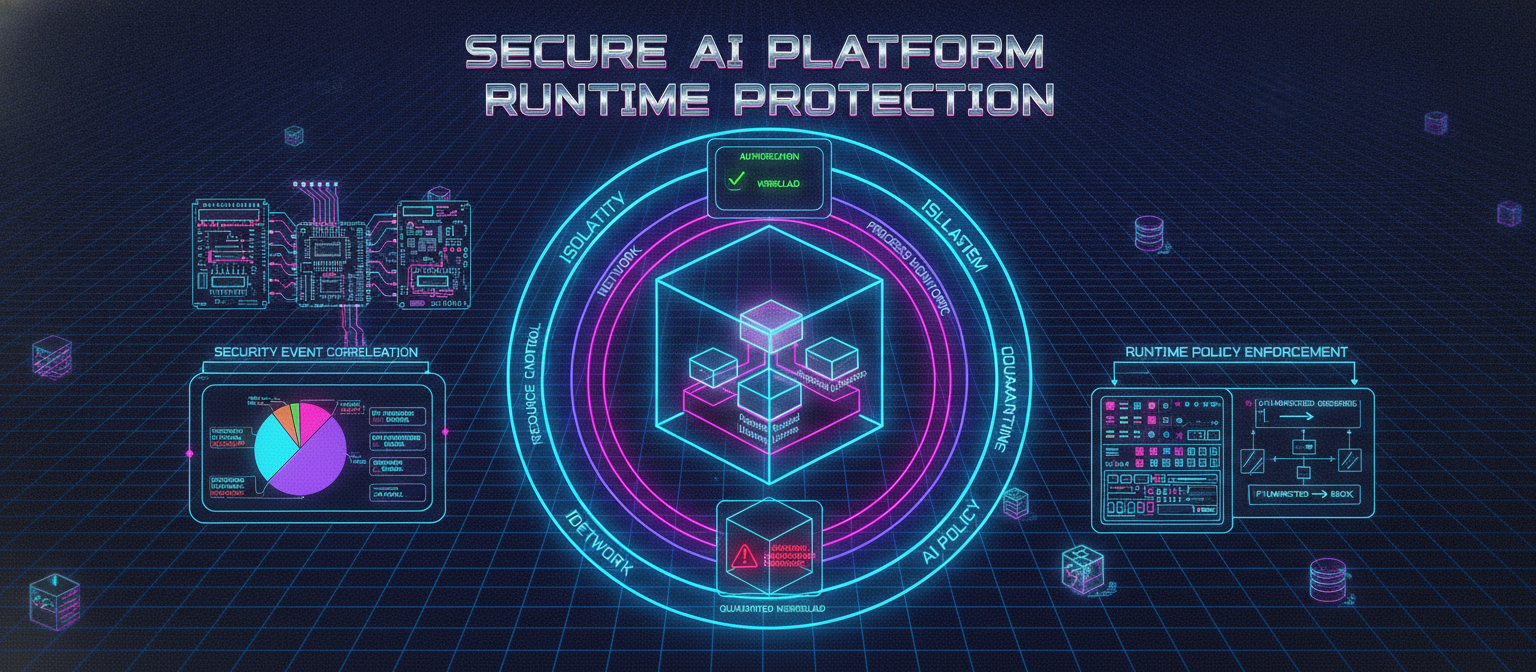
88.27 Security Event Correlation
Runtime events should be connected with identity and deployment data.
For example:
Workload
   ↓
Pod Identity
   ↓
Deployment Version
   ↓
Artifact Digest
   ↓
Source Revision
If an incident occurs, investigators can trace the running workload back through the release chain.
88.28 Runtime Policy Enforcement
Runtime policies should be continuously enforced rather than checked only during deployment.
Examples:
IF workload loses required identity
    → stop or isolate

IF forbidden network connection occurs
    → block or alert

IF resource usage exceeds hard limit
    → throttle or terminate

IF unauthorized filesystem behavior occurs
    → alert or isolate
The exact response depends on the severity and reliability of the detection.
88.29 Quarantine Architecture
When a workload becomes suspicious, immediate deletion may destroy useful evidence.
A controlled quarantine process can be preferable.
Conceptually:
Suspicious Workload
       ↓
Traffic Restricted
       ↓
Network Isolation
       ↓
Credentials Revoked
       ↓
Evidence Preserved
       ↓
Investigation
       ↓
Recover / Rebuild / Destroy
Quarantine should be designed before an incident occurs.
88.30 Runtime Incident Containment
Containment actions may include:
stop traffic
revoke credentials
isolate workload
disable affected feature
stop background jobs
block suspicious network destinations
prevent further artifact promotion
rotate affected credentials
preserve logs and evidence
The response should be proportionate to the confidence and severity of the incident.
88.31 Rebuild Instead of Repair
For compromised containers, rebuilding from a trusted source is often safer than attempting to clean an unknown runtime environment.
Conceptually:
Compromised Workload
       ↓
Preserve Evidence
       ↓
Terminate
       ↓
Rebuild from Trusted Artifact
       ↓
Redeploy
       ↓
Monitor
This reduces the risk of hidden persistence.
88.32 Runtime Configuration Integrity
Production workloads should have expected configuration identities.
For example:
Application Version
Model Version
Policy Version
Configuration Version
Unexpected changes should be detectable.
This protects against configuration drift and unauthorized modification.
88.33 Runtime AI Model Integrity
The runtime should know which model is actually loaded.
It should be possible to verify:
Expected Model
      vs.
Loaded Model
This prevents silent model substitution.
Useful metadata may include:
model identifier
version
artifact digest
provider
deployment environment
safety-evaluation status
88.34 Prompt and Policy Integrity
AI behavior can change through prompt or policy changes.
Therefore, runtime systems should identify:
active system prompt version
active safety-policy version
active routing configuration
active tool definitions
Unexpected changes should generate appropriate alerts or deployment blocks.
88.35 Runtime RAG Security
A RAG service should maintain strict data boundaries.
Runtime controls should ensure:
Tenant A Request
      ↓
Tenant A Retrieval
      ↓
Tenant A Context
and never:
Tenant A Request
      ↓
Tenant B Documents
The retrieval layer should enforce authorization rather than trusting the model to make the decision.
88.36 Runtime Memory Security
AI memory systems require similar runtime controls.
Memory access should be:
authenticated
authorized
tenant-scoped
auditable
deletable
policy-controlled
A compromised agent should not automatically gain unrestricted access to historical memory.
88.37 Runtime Logging
Runtime logs should support both operations and security.
Useful events include:
Sensitive data should not be unnecessarily logged.
88.38 Security Monitoring Pipeline
A mature platform can use:
Runtime
 ├── Application Logs
 ├── Container Events
 ├── Network Events
 ├── Identity Events
 ├── Resource Metrics
 └── Security Alerts
          ↓
      Event Pipeline
          ↓
       Detection
          ↓
     Risk Correlation
          ↓
    Security Response
This connects runtime protection with the incident-response architecture discussed earlier.
88.39 Runtime Security Testing
Runtime controls should be tested continuously.
Testing categories can include:
Container tests
Verify expected privilege and filesystem restrictions.
Network tests
Verify unauthorized communication is blocked.
Identity tests
Verify workloads cannot access unrelated resources.
Resource tests
Verify limits are enforced.
Isolation tests
Verify suspicious workloads can be quarantined.
Recovery tests
Verify workloads can be rebuilt safely.
AI runtime tests
Verify model, prompt, policy, RAG, and tool boundaries remain enforced.
88.40 Runtime Security Failure Modes
Security controls can fail.
Examples include:
Monitoring fails
        ↓
No visibility
or:
Network policy fails
        ↓
Unexpected connectivity
or:
Identity service unavailable
        ↓
Authorization uncertainty
Critical controls should therefore have explicit failure behavior.
For security-sensitive decisions, the platform should generally prefer:
Fail closed when safe operation cannot be established.
However, availability requirements must be considered for each component.
88.41 Graceful Degradation
Not every security failure requires complete platform shutdown.
For example:
Advanced AI Feature
       ↓
Security Dependency Unavailable
       ↓
Disable Advanced Feature
       ↓
Keep Basic Safe Functionality
This can preserve availability without bypassing critical security controls.
88.42 Runtime Security Dashboard
A production security dashboard can monitor:
| Category | Example Metric |
|---|
| Workloads | Running workloads |
| Images | Verified image percentage |
| Identity | Unexpected identity events |
| Network | Blocked connections |
| Resources | CPU/GPU anomalies |
| Filesystem | Suspicious file events |
| AI | Abnormal inference behavior |
| Tools | Unauthorized tool attempts |
| Isolation | Quarantined workloads |
| Deployment | Runtime drift |
| Security | Active incidents |
Dashboards should provide actionable signals rather than overwhelming operators with raw telemetry.
88.43 Runtime Security Checklist
Container
Network
Identity
AI
Runtime Detection
Incident Response
88.44 Reference Runtime Security Architecture
                         Internet
                            │
                            ▼
                    ┌───────────────┐
                    │ API / Gateway │
                    └───────┬───────┘
                            │
                            ▼
                    ┌───────────────┐
                    │ Auth / Policy │
                    └───────┬───────┘
                            │
                            ▼
              ┌──────────────────────────┐
              │     Runtime Platform     │
              │                          │
              │  ┌────────────────────┐  │
              │  │ Application        │  │
              │  └─────────┬──────────┘  │
              │            │             │
              │  ┌─────────▼──────────┐  │
              │  │ AI / Worker        │  │
              │  └─────────┬──────────┘  │
              │            │             │
              │  ┌─────────▼──────────┐  │
              │  │ Sandboxed Process  │  │
              │  └────────────────────┘  │
              │                          │
              │ Identity + Network       │
              │ Resource + Filesystem    │
              │ Runtime Policy           │
              └────────────┬─────────────┘
                           │
                           ▼
                  Monitoring / Detection
                           │
                           ▼
                    Incident Response
The runtime platform should be viewed as a continuously controlled environment rather than a collection of ordinary containers.
88.45 Runtime Security Maturity Model
Level 1 — Basic
container isolation
basic resource limits
application logs
basic network controls
Level 2 — Controlled
workload identities
restricted privileges
network policies
centralized monitoring
resource quotas
Level 3 — Verified
Level 4 — Advanced
Level 5 — Resilient
continuously verified workloads
strong isolation
automated incident containment
evidence-aware response
rapid trusted rebuild
tested runtime disaster recovery
88.46 Final Security Principle
Deployment security establishes that a workload is allowed to start.
Runtime security ensures that the workload remains within its intended boundaries after it starts.
A secure AI platform should continuously enforce:
Identity
+
Authorization
+
Isolation
+
Network Control
+
Resource Control
+
Filesystem Control
+
Process Control
+
AI Policy
+
Monitoring
+
Incident Response
The most important principle is:
Assume that any production workload can eventually encounter a vulnerability or malicious input. Design the runtime so that compromise of one workload does not automatically become compromise of the platform.
A resilient runtime architecture therefore:
limits privileges
restricts network access
isolates untrusted processing
controls resource consumption
protects credentials
verifies AI runtime state
monitors abnormal behavior
detects suspicious activity
supports quarantine
preserves evidence
rebuilds from trusted artifacts
continuously verifies runtime integrity
Chapter 88 Summary
Secure AI runtime protection requires:
container hardening
minimal runtime images
privilege restriction
process isolation
filesystem protection
sandboxed untrusted processing
controlled network egress
internal network segmentation
workload identity
credential isolation
CPU/memory/GPU limits
storage quotas
AI cost-abuse protection
model integrity verification
prompt and policy integrity
RAG and memory isolation
tool-call authorization
runtime monitoring
behavioral detection
security-event correlation
workload quarantine
credential revocation
trusted rebuild
runtime security testing
continuous integrity verification
Core principle:
Secure the workload before execution, constrain it during execution, observe it continuously, and make compromise containable rather than catastrophic.



Comments
Post a Comment