Chapter 91 — Secure AI Platform Security Operations Center (SOC) Architecture
91.1 Introduction
A Security Operations Center (SOC) is the operational function responsible for continuously monitoring, investigating, coordinating, and responding to security events.
For an AI platform, a conventional SOC model must be expanded.
The security team may need visibility into:
identity systems,
APIs,
databases,
object storage,
networks,
Kubernetes,
containers,
model infrastructure,
external AI providers,
RAG systems,
vector databases,
AI agents,
tool execution,
prompts,
policies,
model behavior,
configuration changes,
and tenant activity.
The objective is not simply to watch dashboards.
A mature AI SOC should be able to:
detect suspicious activity,
validate alerts,
understand context,
determine scope,
coordinate investigation,
contain threats,
preserve evidence,
recover safely,
communicate with stakeholders,
and improve security controls afterward.
91.2 SOC Mission
The SOC's central mission is:
Detect, investigate, contain, and coordinate responses to security threats while maintaining trustworthy operation of the AI platform.
This requires four major capabilities:
Monitor
   ↓
Detect
   ↓
Investigate
   ↓
Respond
These capabilities operate continuously.
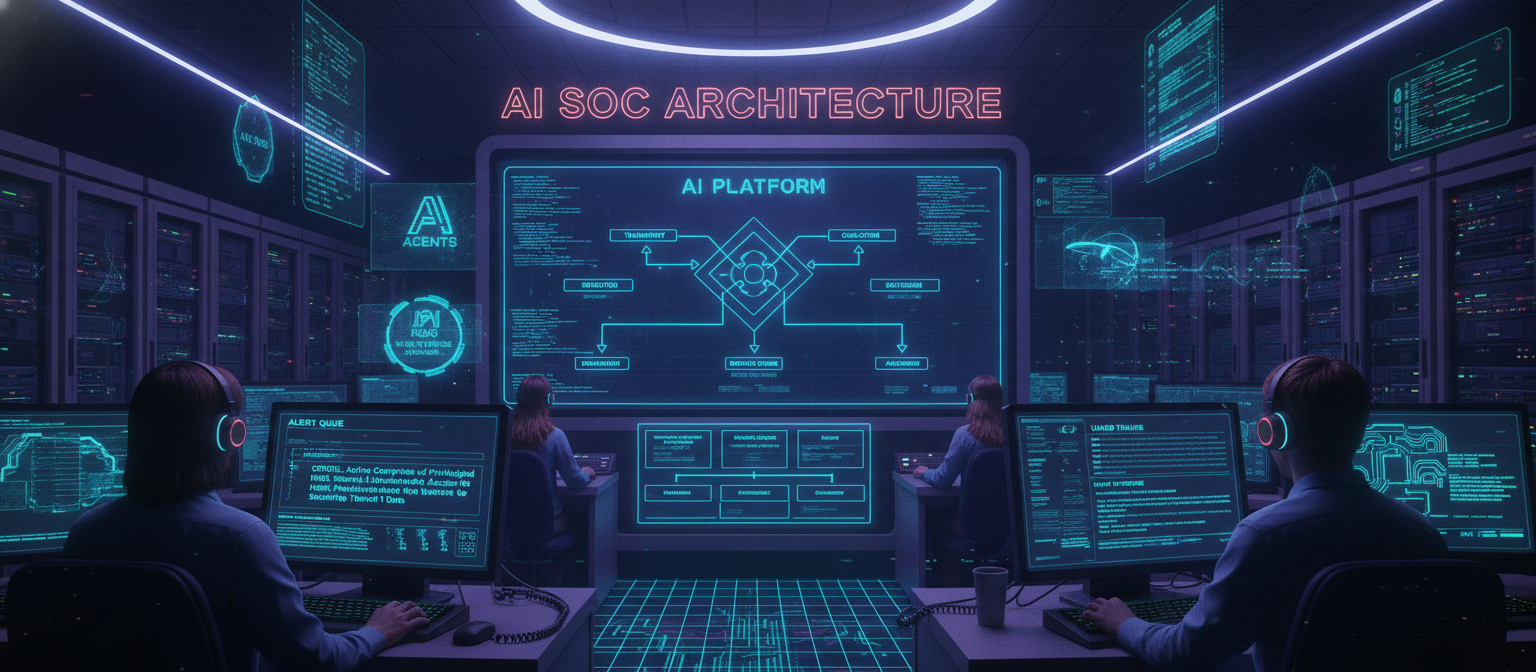
91.3 AI SOC Architecture
A conceptual architecture is:
                    AI PLATFORM
                         |
              +----------+----------+
              |                     |
         Telemetry              Audit Data
              |                     |
              +----------+----------+
                         |
                    Collection
                         |
                    Normalization
                         |
                    Enrichment
                         |
                 Detection Engine
                         |
                    Correlation
                         |
                    Risk Scoring
                         |
                    Alert Queue
                         |
                 +-------+-------+
                 |               |
              Analyst         Automation
                 |               |
                 +-------+-------+
                         |
                    Incident Case
                         |
                 Investigation
                         |
                  Containment
                         |
                    Recovery
                         |
                 Lessons Learned
91.4 SOC Functions
A mature SOC typically performs:
Monitoring
Continuously observing security telemetry.
Detection
Identifying potentially malicious activity.
Triage
Determining which alerts require investigation.
Investigation
Understanding what actually happened.
Threat hunting
Searching proactively for previously undetected threats.
Incident response
Containing and resolving confirmed incidents.
Intelligence
Maintaining information about relevant threats.
Security engineering
Improving detection and prevention controls.
Governance
Maintaining procedures, evidence, ownership, and accountability.
91.5 SOC Operating Model
A useful operating model is:
Telemetry
   ↓
Detection
   ↓
Triage
   ↓
Investigation
   ↓
Classification
   ↓
Containment
   ↓
Eradication
   ↓
Recovery
   ↓
Post-Incident Review
Not every alert becomes an incident.
The SOC must distinguish between:
91.6 Alert Triage
Triage is the process of determining what an alert means and how urgently it should be handled.
An analyst should quickly establish:
what happened,
which identity was involved,
which tenant was involved,
which resource was targeted,
whether the activity is ongoing,
whether security controls were bypassed,
and what the potential impact is.
91.7 Triage Priorities
Alerts can be prioritized using:
severity,
confidence,
asset sensitivity,
affected users,
tenant impact,
attack progression,
current activity,
business impact.
For example:
Critical:
Active compromise of privileged infrastructure

High:
Potential unauthorized access to sensitive tenant data

Medium:
Repeated suspicious authentication behavior

Low:
Single blocked policy violation
91.8 Alert Lifecycle
A typical lifecycle is:
New
 ↓
Assigned
 ↓
Investigating
 ↓
Confirmed / False Positive / Benign
 ↓
Contained
 ↓
Resolved
 ↓
Closed
Every state transition should be auditable.
91.9 Alert Enrichment
Before analysts investigate, alerts should be enriched automatically.
Useful enrichment includes:
identity information,
tenant information,
asset criticality,
recent login history,
recent configuration changes,
deployment history,
threat intelligence,
related events,
related alerts,
model execution information,
agent/tool activity.
This reduces manual investigation time.
91.10 Analyst Investigation View
A useful analyst interface should provide a unified timeline.
Example:
10:01  Authentication failure
10:02  Authentication failure
10:03  Successful login
10:04  New session
10:05  Sensitive document accessed
10:06  Agent started
10:07  Tool request denied
10:08  Large download initiated
10:09  Security alert
The analyst should not need to manually search ten unrelated systems to construct this timeline.
91.11 Case Management
Confirmed incidents should become cases.
A case should contain:
incident ID,
severity,
status,
owner,
affected tenants,
affected identities,
affected resources,
timeline,
evidence,
alerts,
investigation notes,
containment actions,
recovery actions,
final conclusion.
91.12 Case Ownership
Every active incident should have an owner.
Without ownership:
Alert
 → Analyst A assumes Analyst B is handling it
 → Analyst B assumes Analyst C is handling it
 → response delayed
Therefore cases should clearly identify:
91.13 Incident Classification
Incidents can be classified into categories such as:
Classification improves reporting and trend analysis.
91.14 AI-Specific Incident Categories
AI platforms introduce additional categories.
Prompt Injection
Untrusted content manipulates AI behavior.
Agent Tool Abuse
An agent attempts unauthorized actions.
RAG Data Exposure
Retrieval returns information outside the authorized scope.
Model Abuse
Attackers consume disproportionate AI resources.
Model Integrity Incident
An unexpected or unauthorized model artifact is deployed.
AI Policy Failure
Security or safety controls fail to enforce expected behavior.
91.15 Security Operations for RAG
The SOC should monitor:
Query
 ↓
Authorization
 ↓
Retrieval
 ↓
Documents
 ↓
Model
 ↓
Output
If a sensitive document appears in an unauthorized retrieval result, analysts should be able to determine:
who requested it,
which tenant owned it,
why retrieval returned it,
which authorization rule was applied,
which model received it,
whether the content reached the user.
91.16 Security Operations for Agents
Agent incidents require additional telemetry.
Analysts should be able to inspect:
Agent
 ↓
Goal
 ↓
Plan
 ↓
Step sequence
 ↓
Tool calls
 ↓
Authorization
 ↓
Tool results
 ↓
Final output
This allows investigators to distinguish:
91.17 SOC Tool Execution Controls
Security analysts themselves should have controlled access to response tools.
A SOC console should not provide unrestricted production shell access simply because analysts investigate incidents.
Instead use:
predefined actions,
least privilege,
approval workflows,
temporary credentials,
scoped access,
audit logging.
91.18 Incident Response Automation
Automation can handle repetitive tasks.
Examples:
Alert
 ↓
Enrich identity
 ↓
Check recent activity
 ↓
Check threat intelligence
 ↓
Create case
 ↓
Notify analyst
Higher-risk actions can require approval:
Suspend account
Disable production workload
Delete resource
Change firewall policy
91.19 Automated Containment
Possible containment actions include:
Each automated action should have defined scope.
91.20 Containment Safety
Containment can cause operational damage.
For example, automatically disabling an important production service could create a major outage.
Therefore containment policies should specify:
Trigger
Scope
Maximum duration
Approval requirement
Rollback action
Audit requirement
91.21 Emergency Response
Critical incidents may require rapid action.
A controlled emergency process can be:
Detection
 ↓
Emergency classification
 ↓
Immediate containment
 ↓
Incident commander assigned
 ↓
Technical investigation
 ↓
Stakeholder communication
 ↓
Recovery
Emergency actions should still be logged.
91.22 Incident Commander
Large incidents benefit from a designated incident commander.
The incident commander coordinates:
response priorities,
technical teams,
communications,
decision-making,
escalation,
recovery planning.
The incident commander does not necessarily perform every technical action.
Their role is coordination.
91.23 Security Incident Roles
A mature incident response structure may include:
| Role | Responsibility |
|---|
| SOC Analyst | Detection and initial investigation |
| Incident Responder | Containment and technical response |
| Security Engineer | Security-control analysis |
| Platform Engineer | Infrastructure response |
| AI/ML Engineer | Model and AI-runtime analysis |
| Database Engineer | Data-layer investigation |
| Incident Commander | Coordination |
| Privacy/Legal | Regulatory and privacy assessment |
| Communications | Stakeholder communication |
Smaller organizations may combine several roles.
91.24 AI/ML Security Expertise
AI incidents may require specialized knowledge.
For example, a conventional analyst may identify:
unexpected tool call
An AI security specialist may recognize:
indirect prompt injection
→ agent plan manipulation
→ unauthorized tool request
Therefore AI SOC teams benefit from AI-security expertise.
91.25 Threat Hunting
Threat hunting is proactive investigation.
Instead of waiting for:
alert
analysts ask:
Could this attack already be happening without triggering our existing detections?
Threat hunting can search for:
suspicious account behavior,
unusual tool sequences,
abnormal data retrieval,
unusual model usage,
unexpected network connections,
suspicious workloads.
91.26 Threat Hunting Workflow
A practical workflow is:
Threat hypothesis
 ↓
Identify telemetry
 ↓
Search historical data
 ↓
Correlate evidence
 ↓
Validate findings
 ↓
Expand scope
 ↓
Create detection
 ↓
Document results
Threat hunting should produce new security improvements.
91.27 AI Threat Hunting
AI-specific hunting hypotheses might include:
An attacker may be attempting to use retrieved documents to influence agent behavior.
Search for:
suspicious documents,
repeated retrieval,
unusual tool calls,
policy violations,
abnormal task sequences.
Another hypothesis:
A compromised account may be using expensive AI models for automated abuse.
Search for:
91.28 Hunt-to-Detection Pipeline
A useful process is:
Threat Hunt
    ↓
Interesting Pattern
    ↓
Validate
    ↓
Detection Hypothesis
    ↓
Detection Rule
    ↓
Testing
    ↓
Production
This continuously improves security coverage.
91.29 SOC Metrics
SOC performance should be measured.
Useful metrics include:
Mean Time to Detect
Time from suspicious activity to detection.
Mean Time to Triage
Time from alert creation to initial classification.
Mean Time to Respond
Time from confirmation to containment.
Mean Time to Recover
Time from incident to restored secure operation.
False-Positive Rate
Percentage of alerts determined to be benign.
Detection Coverage
Percentage of important threats with meaningful detections.
91.30 Alert Volume
Alert volume alone is not a good measure of SOC quality.
A SOC producing:
100,000 alerts/day
is not necessarily better than one producing:
5,000 alerts/day
Quality matters.
A useful SOC should optimize for:
actionable alerts,
high-quality context,
low unnecessary noise,
fast investigation,
effective containment.
91.31 Analyst Workload
SOC systems should monitor analyst workload.
Signals include:
Excessive workload increases the probability of missed threats.
91.32 Alert Fatigue
Alert fatigue occurs when analysts receive too many low-value alerts.
Symptoms include:
Solutions include:
better correlation,
tuning,
suppression,
prioritization,
enrichment,
automation.
91.33 SOC Shift Coverage
For systems requiring continuous operation, monitoring coverage may need to include:
24 × 7 monitoring
For smaller platforms, automated detection can provide continuous coverage while human analysts operate during defined hours with escalation procedures.
The correct model depends on:
risk,
business requirements,
customer expectations,
incident impact.
91.34 Escalation Policies
An alert should have a defined escalation path.
Example:
Low
 → SOC queue

Medium
 → SOC analyst

High
 → Senior analyst + incident responder

Critical
 → Incident commander + security leadership
Escalation should be based on risk rather than arbitrary hierarchy.
91.35 Communication During Incidents
Security response requires clear communication.
Communication should distinguish between:
confirmed facts,
preliminary findings,
assumptions,
unknowns.
Avoid statements such as:
Everything is compromised.
when the evidence only shows:
One account displayed suspicious behavior.
Precision reduces unnecessary panic.
91.36 Stakeholder Communication
Depending on the incident, stakeholders may include:
engineering,
security,
management,
affected customers,
privacy teams,
legal teams,
service providers.
Communication should be coordinated through defined procedures.
91.37 Customer/Tenant Incident Handling
Multi-tenant AI platforms require special care.
If one tenant is affected, the SOC should determine:
Was another tenant affected?
Was shared infrastructure involved?
Was data isolation maintained?
Were credentials shared?
Was the issue application-specific or platform-wide?
The SOC should avoid exposing one tenant's confidential information to another tenant during investigations.
91.38 Evidence Collection
Evidence may include:
logs,
traces,
alerts,
authentication events,
configuration versions,
model versions,
tool-call records,
network events,
storage events,
container metadata,
deployment records.
Evidence collection should be controlled and documented.
91.39 Evidence Chain
For significant investigations, record:
Evidence ID
Source
Collection time
Collector
Integrity information
Storage location
Access history
This supports trustworthy investigation.
91.40 Forensic Preservation
Evidence that may be needed later should not be overwritten by normal retention processes.
A preservation workflow can be:
Incident
 ↓
Identify relevant evidence
 ↓
Apply preservation hold
 ↓
Copy to protected storage
 ↓
Restrict access
 ↓
Record evidence history
91.41 Security Operations for Containers
The SOC should be able to investigate:
The investigation should connect runtime behavior to the deployed artifact.
91.42 Kubernetes SOC Operations
Relevant events include:
These should be correlated with deployment and administrative activity.
91.43 Cloud Security Operations
Cloud telemetry may include:
Cloud security events should feed the same incident workflow where practical.
91.44 Model Security Operations
The SOC should track:
Unexpected model changes can represent either:
operational error,
supply-chain issue,
malicious modification.
91.45 Prompt and Policy Security Operations
Prompt templates and policies should have:
version,
owner,
deployment history,
approval,
integrity information.
A suspicious behavior change should therefore be traceable to the exact prompt or policy version.
91.46 Security Operations for External Providers
External AI providers introduce additional boundaries.
The SOC should monitor:
provider authentication,
provider errors,
provider changes,
unusual usage,
model changes,
quota anomalies.
Sensitive provider credentials should never be exposed through SOC tooling.
91.47 SOC Access Control
The SOC platform contains extremely sensitive information.
Controls should include:
MFA,
RBAC,
privileged access management,
session recording where appropriate,
least privilege,
periodic access reviews,
audit logging.
SOC accounts should be protected at a higher standard than ordinary user accounts.
91.48 Separation of Duties
High-impact operations should not depend on one unrestricted administrator.
For example:
Analyst
 ↓
Requests containment
 ↓
Authorized responder
 ↓
Executes containment
This reduces insider and accidental risk.
91.49 SOC Break-Glass Access
Emergency privileged access should:
require strong authentication,
have limited duration,
be explicitly justified,
be heavily logged,
trigger enhanced monitoring,
be reviewed afterward.
Break-glass access should be exceptional, not routine.
91.50 SOC Platform Security
The SOC platform itself must be protected against:
credential theft,
unauthorized access,
data manipulation,
alert suppression,
evidence deletion,
malicious automation.
A compromised SOC could hide an attack.
91.51 Monitoring SOC Integrity
Monitor:
detection rule changes,
alert suppression,
analyst privilege changes,
telemetry source removal,
SIEM configuration changes,
automation changes.
These activities should themselves create security events.
91.52 Security Automation Governance
Every automated response should have:
Action
Trigger
Scope
Owner
Authorization
Rollback
Timeout
Audit
This makes automation predictable and safe.
91.53 Automation Testing
Before enabling automatic response:
test in development,
test with synthetic events,
test false positives,
test rollback,
test failure conditions,
test limited production scope,
review results.
Automation should not be deployed directly to unrestricted production.
91.54 SOAR Playbooks
A response playbook may look like:
Suspicious Account
      ↓
Check authentication anomalies
      ↓
Check active sessions
      ↓
Check sensitive-resource access
      ↓
Calculate risk
      ↓
Low risk → monitor
Medium risk → require reauthentication
High risk → temporary restriction
Critical → incident response
The playbook should be versioned and tested.
91.55 Incident Response for Prompt Injection
A possible defensive workflow:
Detection
 ↓
Identify affected agent
 ↓
Identify untrusted input
 ↓
Determine tools requested
 ↓
Review authorization decisions
 ↓
Stop affected task if necessary
 ↓
Quarantine suspicious source
 ↓
Preserve evidence
 ↓
Evaluate impact
 ↓
Improve detection/policy
The goal is containment and analysis, not experimentation against production systems.
91.56 Incident Response for Data Exposure
If unauthorized data access is suspected:
Detect
 ↓
Identify data
 ↓
Identify affected tenant
 ↓
Identify access path
 ↓
Revoke active access if necessary
 ↓
Preserve evidence
 ↓
Determine scope
 ↓
Fix authorization/control
 ↓
Verify isolation
 ↓
Complete post-incident review
91.57 Incident Response for Compromised AI Workload
A compromised workload should generally be treated as untrusted.
Possible process:
Detect
 ↓
Isolate
 ↓
Preserve relevant evidence
 ↓
Identify artifact/image
 ↓
Review credentials
 ↓
Revoke compromised credentials
 ↓
Rebuild from trusted artifact
 ↓
Redeploy
 ↓
Verify runtime integrity
Rebuilding from a trusted source is generally safer than attempting to manually clean a potentially compromised workload.
91.58 Incident Response for Model Integrity
If a model artifact is suspected of being unauthorized:
Detect
 ↓
Stop promotion/use if appropriate
 ↓
Identify artifact digest
 ↓
Compare provenance
 ↓
Check registry history
 ↓
Identify deployments
 ↓
Rollback to approved artifact
 ↓
Investigate supply chain
91.59 Incident Response for Configuration Tampering
A configuration incident should identify:
previous version,
current version,
actor,
approval,
deployment,
affected services.
Then:
Validate
 ↓
Contain
 ↓
Restore approved configuration
 ↓
Verify runtime state
 ↓
Review access
 ↓
Investigate root cause
91.60 Incident Severity Matrix
A practical matrix can consider:
| Impact | Confidence | Suggested Priority |
|---|
| Low | Low | Informational |
| Low | High | Low/Medium |
| Medium | Medium | Medium |
| High | Medium | High |
| Critical | High | Critical |
This should be adapted to the platform's actual risk model.
91.61 Security Operations Runbooks
Common runbooks should cover:
Runbooks reduce response time.
91.62 Runbook Quality
Every runbook should define:
Purpose
Trigger
Required permissions
Investigation steps
Containment steps
Escalation
Evidence requirements
Recovery
Verification
Closure
Runbooks should be tested periodically.
91.63 Security Operations Drills
SOC teams should conduct exercises such as:
account compromise simulation,
data-exposure simulation,
agent compromise simulation,
model rollback exercise,
telemetry outage exercise,
ransomware-style recovery exercise,
tenant-isolation incident exercise.
The goal is to identify weaknesses before real incidents occur.
91.64 Purple-Team Collaboration
Security and engineering teams can collaborate through controlled simulations.
The process is:
Attack simulation
 ↓
Detection
 ↓
SOC investigation
 ↓
Engineering analysis
 ↓
Control improvement
 ↓
Detection retest
The activity should remain authorized and defensive.
91.65 SOC Knowledge Base
The SOC should maintain documentation covering:
architecture,
services,
data flows,
model inventory,
tool inventory,
tenant model,
escalation contacts,
detection rules,
runbooks,
known risks,
previous incidents.
This reduces dependency on individual employees.
91.66 Security Operations Documentation
Important documents include:
incident response plan,
escalation policy,
detection catalog,
threat model,
asset inventory,
contact list,
recovery procedures,
evidence procedures,
communication templates.
Documentation should be reviewed regularly.
91.67 Continuous Improvement
The SOC should continuously improve:
Incident
 ↓
Review
 ↓
Root Cause
 ↓
Control Gap
 ↓
Engineering Change
 ↓
Detection Update
 ↓
Testing
 ↓
Improved Security
Security operations should therefore be part of the engineering feedback loop.
91.68 SOC Maturity Model
Level 0 — Reactive
Manual alert review.
Level 1 — Centralized
Centralized telemetry and alerting.
Level 2 — Managed
Formal triage, case management, and runbooks.
Level 3 — Proactive
Threat hunting and behavioral analytics.
Level 4 — AI-Aware
Dedicated monitoring for models, RAG, agents, prompts, policies, and tools.
Level 5 — Adaptive
Continuous detection engineering, automated response, purple-team validation, measurable coverage, and integrated security engineering.
91.69 SOC Checklist
Monitoring
Detection
Triage
Investigation
Response
Governance
91.70 Reference AI SOC Architecture
                         AI USERS
                            |
                       API GATEWAY
                            |
                IDENTITY / AUTHORIZATION
                            |
              +-------------+-------------+
              |             |             |
             APP           RAG          AGENTS
              |             |             |
              +-------------+-------------+
                            |
                         AI CORE
                            |
              +-------------+-------------+
              |             |             |
           MODELS         TOOLS        STORAGE
              |             |             |
              +-------------+-------------+
                            |
                       TELEMETRY
                            |
                    EVENT COLLECTION
                            |
                    SIEM / DATA LAKE
                            |
                 DETECTION + ANALYTICS
                            |
                       ALERT QUEUE
                            |
                    +-------+-------+
                    |               |
                   SOC           SOAR
                    |               |
                    +-------+-------+
                            |
                     CASE MANAGEMENT
                            |
                    INCIDENT RESPONSE
                            |
               +------------+------------+
               |                         |
          CONTAINMENT                RECOVERY
               |                         |
               +------------+------------+
                            |
                      POST-INCIDENT
                            |
                    CONTROL IMPROVEMENT
91.71 Final Principles
Principle 1 — SOC operations must be continuous
Threats do not follow business hours.
Principle 2 — Context reduces investigation time
Analysts need identity, tenant, AI, infrastructure, and resource context.
Principle 3 — Alerts are not incidents
Triage determines whether an alert represents a meaningful security problem.
Principle 4 — AI requires specialized investigation
Model, RAG, agent, tool, and prompt behavior can materially affect incidents.
Principle 5 — Automation must be controlled
Automated containment should be scoped, reversible, and auditable.
Principle 6 — Evidence must remain trustworthy
Incident investigation depends on reliable telemetry and preserved evidence.
Principle 7 — Threat hunting is essential
Not every threat will trigger an existing detection.
Principle 8 — Security operations must improve engineering
Every incident should produce lessons that improve prevention, detection, and resilience.
Principle 9 — Protect the SOC itself
A compromised SOC can become a mechanism for hiding attacks.
Principle 10 — Measure security operations
Detection, triage, response, coverage, workload, and recovery should be measurable.
91.72 Conclusion
A secure AI platform requires more than security controls embedded in application code.
It requires an operational capability capable of continuously answering:
What happened?
Who was involved?
Which tenant was affected?
What resources were accessed?
Which model or agent was involved?
Which policies were active?
What security controls responded?
What evidence exists?
What is the current risk?
What should happen next?
A mature AI SOC connects:
Monitoring
+
Detection
+
Analytics
+
Threat Hunting
+
Incident Response
+
Automation
+
Evidence
+
Security Engineering
The SOC therefore becomes the operational nervous system of the platform's security program.
Final principle:
A mature AI Security Operations Center should transform continuous telemetry into coordinated defensive action—detecting threats early, giving analysts the context needed to investigate them, containing incidents safely, preserving trustworthy evidence, and feeding every lesson back into the architecture so that the platform becomes more secure over time.



Comments
Post a Comment