94.1 Introduction
Security controls are valuable only when an organization can demonstrate that they:
This is the purpose of security assurance.
For an AI platform, assurance is more complicated than traditional application assurance because security controls may span:
The goal of this chapter is to establish a practical architecture for continuous security assurance and audit readiness without turning security into a purely documentation-driven exercise.
94.2 Security Assurance vs Security Compliance
These concepts should be separated.
Security assurance
Asks:
Do our security controls actually work?
Compliance
Asks:
Do our processes and controls satisfy defined requirements?
A platform can technically satisfy a compliance checklist while still having weak security.
Conversely, a platform can have strong technical security but lack the evidence needed to demonstrate compliance.
A mature program therefore connects:
Security Engineering + Control Validation + Evidence + Governance.
94.3 The Security Assurance Lifecycle
A useful lifecycle is:
Requirement
    |
    v
Security Control
    |
    v
Implementation
    |
    v
Validation
    |
    v
Evidence
    |
    v
Review
    |
    v
Risk Decision
    |
    v
Continuous Monitoring
    |
    +------> Revalidation
This should operate continuously rather than only before an audit.
94.4 Security Control Definition
Every important security control should be clearly defined.
A control record can contain:
Control ID
Control Name
Objective
Risk Addressed
Owner
Implementation
Scope
Frequency
Evidence Source
Validation Method
Expected Result
Exceptions
Review Date
Status
For example:
Control: Production administrator authentication
Objective: Prevent unauthorized administrative access.
Validation: Verify approved authentication requirements are enforced.
Evidence: IAM configuration and security test results.
This structure turns a vague security statement into an independently testable control.
94.5 Control Objectives
Controls should be connected to security objectives.
Examples:
Confidentiality
Prevent unauthorized access to sensitive data.
Integrity
Prevent unauthorized modification.
Availability
Maintain service availability.
Authenticity
Ensure identities and artifacts are genuine.
Accountability
Ensure important actions can be traced.
Privacy
Ensure personal data is handled according to defined requirements.
AI safety
Ensure AI behavior remains within defined security and safety boundaries.
94.6 AI-Specific Control Objectives
AI platforms should additionally define objectives for:
Model integrity
Prompt integrity
RAG isolation
Memory isolation
Agent authorization
Tool authorization
Training-data provenance
Model evaluation
AI safety testing
AI output controls
Human approval
AI provider governance
These objectives should be mapped to concrete controls.
94.7 Control Design
A well-designed control should answer:
What risk does it address?
What asset does it protect?
Who owns it?
What component enforces it?
How frequently does it operate?
How is it tested?
What happens if it fails?
What evidence proves it operated?
If these questions cannot be answered, the control may not be mature enough.
94.8 Preventive, Detective and Corrective Controls
Security assurance should classify controls.
Preventive
Attempt to stop the event.
Examples:
Authorization
Network segmentation
MFA
Input validation
Tool restrictions
Detective
Identify suspicious or incorrect behavior.
Examples:
Monitoring
Security analytics
Integrity monitoring
Alerting
Corrective
Reduce impact after an event.
Examples:
Credential revocation
Isolation
Rollback
Recovery
Incident response
Strong architecture uses all three.
94.9 Manual vs Automated Controls
Controls can be:
Manual
Require human action.
Examples:
Security review
Approval
Periodic access review
Automated
Executed by software.
Examples:
Hybrid
Combine automation and human judgment.
Examples:
Automation generally improves consistency, but humans remain important for ambiguous and high-impact decisions.
94.10 Control Ownership
Each important control should have an accountable owner.
Possible owners include:
Security team
Platform team
Application team
AI engineering team
Data team
Privacy team
Compliance team
Operations team
A control without ownership tends to degrade over time.
94.11 Control Scope
Control scope should be explicit.
For example:
Control:
Production secrets rotation

Scope:
- Production
- AI inference services
- Agent workers
- API services

Excluded:
- Local developer environments
This prevents confusion during validation.
94.12 Control Frequency
Controls may operate:
High-risk technical controls should generally be validated more frequently than low-risk administrative controls.
94.13 Control Effectiveness
A control should be evaluated at multiple levels.
Design effectiveness
Would the control address the risk if implemented correctly?
Implementation effectiveness
Is the control actually deployed?
Operating effectiveness
Does it continue working as intended?
This distinction is essential.
A firewall policy may be correctly designed but incorrectly deployed.
A perfectly deployed policy may later become ineffective because of configuration drift.
94.14 Security Control Testing
Control tests should have clear expectations.
Example:
Test:
Unauthorized tenant access

Expected:
DENY

Observed:
DENY

Status:
PASS
A stronger test also records:
Version
Environment
Timestamp
Test identity
Evidence
Test methodology
94.15 Control Evidence
Evidence should demonstrate that a control operated.
Examples:
Configuration snapshots
Access-review records
Audit logs
Security-test results
Deployment records
Model approval records
Vulnerability reports
Backup-test results
Incident records
Evidence should be:
Authentic, attributable, time-bound, and tamper-resistant.
94.16 Evidence Quality
Not all evidence is equally useful.
Weak evidence
"The system uses encryption."
Stronger evidence
Encryption configuration, key-management settings, and automated validation results demonstrate that the specified production storage paths use approved encryption controls.
Evidence should allow an independent reviewer to understand what happened without relying entirely on verbal explanation.
94.17 Evidence Collection Architecture
A centralized evidence architecture can be represented as:
Security Systems
   |
   +-- IAM
   +-- Cloud
   +-- Kubernetes
   +-- CI/CD
   +-- Application
   +-- AI Platform
   +-- SOC
   |
   v
Evidence Collection
   |
   v
Evidence Repository
   |
   +-- Control Evidence
   +-- Test Results
   +-- Approvals
   +-- Exceptions
   +-- Audit History
   |
   v
Assurance Dashboard
Evidence collection should be automated wherever practical.
94.18 Evidence Integrity
Security evidence can itself become a target.
Attackers might attempt to:
Delete logs
Modify test results
Alter approvals
Hide failed controls
Change timestamps
Therefore evidence systems should provide:
94.19 Evidence Retention
Evidence should have defined retention requirements.
The retention period should consider:
Legal requirements
Regulatory requirements
Contractual obligations
Incident-response needs
Security investigations
Business requirements
Retention should not mean keeping everything forever.
Excessive retention can increase privacy and security risk.
94.20 Evidence Classification
Evidence may contain sensitive information.
For example:
Evidence should therefore receive an appropriate classification and access policy.
94.21 AI Audit Evidence
AI-specific evidence can include:
Model governance
Model inventory
Model version
Model approval
Model evaluation
Prompt governance
Approved system prompts
Prompt versions
Prompt changes
RAG governance
Source inventory
Access controls
Retrieval tests
Citation validation
Agent governance
Tool inventory
Tool permissions
Agent policies
Human approvals
Agent evaluation
Safety
Safety test results
Red-team results
Regression evaluations
Incident records
94.22 Model Approval Evidence
A production model should have an auditable lifecycle:
Model Candidate
      |
      v
Evaluation
      |
      v
Security Review
      |
      v
Safety Review
      |
      v
Approval
      |
      v
Deployment
      |
      v
Monitoring
Evidence should demonstrate that each required stage occurred.
94.23 RAG Assurance
RAG systems require evidence for:
An important assurance question is:
Can the organization demonstrate that a user cannot retrieve data outside their authorization boundary?
This should be proven through automated tests and operational evidence.
94.24 Agent Assurance
Agents require evidence that:
Tools are explicitly defined
Permissions are limited
High-impact actions are controlled
Human approval is enforced where required
Agent actions are logged
Security tests exist
Runtime policies are active
An agent should never be considered safe merely because its prompt says:
"Do not perform unauthorized actions."
The enforcement mechanism must exist outside the model.
94.25 Control Mapping
Organizations often need to map internal controls to external frameworks or contractual requirements.
A mapping structure might be:
| Requirement | Internal Control | Evidence | Owner |
|---|
| Access control | IAM policy | IAM evidence | Security |
| Data protection | Encryption | Config/test | Platform |
| Monitoring | Security telemetry | Logs | SOC |
| AI governance | Model approval | Registry | AI Security |
| Incident response | IR process | Case records | SOC |
One internal control can sometimes satisfy multiple requirements.
94.26 Avoiding Duplicate Controls
Organizations should avoid creating separate controls for every framework requirement when one strong control can satisfy several requirements.
For example:
Centralized privileged-access management
may support:
This reduces unnecessary complexity.
94.27 Control-to-Risk Mapping
Controls should also map to risks.
Risk
 |
 v
Threat
 |
 v
Security Objective
 |
 v
Control
 |
 v
Test
 |
 v
Evidence
This creates traceability from business risk to technical implementation.
94.28 Risk-Based Assurance
Not every control requires equal assurance effort.
High-risk controls may require:
Frequent testing
Independent validation
Automated monitoring
Strong evidence
Formal approval
Lower-risk controls may use:
Periodic review
Automated checks
Sampling
Risk-based assurance prevents the assurance program from becoming unnecessarily expensive.
94.29 Independent Validation
Some controls benefit from independent testing.
Examples:
Independence improves confidence that the system is not simply validating itself.
94.30 Internal Audit
Internal audit can evaluate whether:
Internal audit should provide independent challenge without becoming the engineering owner of controls.
94.31 External Audit
External assessments may evaluate:
Security controls
Evidence
Governance
Risk management
Operational practices
Organizations should prepare continuously rather than attempting to assemble evidence immediately before an assessment.
94.32 Continuous Audit Readiness
Continuous audit readiness means:
Evidence is generated as part of normal secure operations.
Instead of:
Audit announced
      |
      v
Emergency evidence collection
the goal is:
Normal Operation
      |
      v
Continuous Evidence Collection
      |
      v
Evidence Repository
      |
      v
Audit Readiness
This greatly reduces audit preparation effort.
94.33 Audit Evidence Freshness
Evidence can become stale.
For example:
A security configuration from six months ago may not represent the current production environment.
Evidence should therefore have:
Timestamp
Environment
Version
Scope
Collection method
Freshness requirements should depend on the control.
94.34 Continuous Control Monitoring
Continuous monitoring can identify:
This transforms assurance from periodic inspection into ongoing security engineering.
94.35 Control Failure Management
When a control fails:
Control Failure
      |
      v
Risk Assessment
      |
      +---- Low impact --> Track
      |
      +---- Medium --> Remediate
      |
      +---- High --> Escalate
      |
      +---- Critical --> Immediate containment
Control failures should not simply disappear into dashboards.
They need ownership and resolution.
94.36 Compensating Controls
Sometimes a control cannot immediately be restored.
A compensating control may reduce risk.
Example:
Primary Control:
Network restriction unavailable

Compensating Controls:
- Strong authentication
- Narrow authorization
- Rate limiting
- Enhanced monitoring
- Temporary exposure reduction
The exception should have an expiration date.
94.37 Control Exceptions
Every exception should document:
Control
Reason
Risk
Business justification
Compensating controls
Owner
Approval
Expiration
Review date
Exceptions should be treated as risk decisions rather than invisible technical debt.
94.38 Security Assurance Dashboard
A useful dashboard can show:
Security Assurance
 |
 +-- Controls: 96% Passing
 +-- Critical Controls: 100% Passing
 +-- Failed Controls: 3
 +-- Open Exceptions: 7
 +-- Expiring Exceptions: 2
 +-- Evidence Coverage: 98%
 +-- Validation Coverage: 94%
 +-- Overdue Reviews: 1
 +-- Critical Risks: 0
The exact percentages are illustrative.
The important feature is visibility into security posture.
94.39 Control Health States
Controls can use standardized states:
Passing
Warning
Failing
Unknown
Not Applicable
Exception
Under Review
"Unknown" is important.
A system should not automatically treat lack of evidence as proof that a control is functioning.
94.40 AI Control Health
AI platforms can track:
Model control health
Approved version
Integrity
Evaluation status
RAG control health
Isolation
Authorization
Data-source status
Agent control health
Tool permissions
Policy status
Approval mechanism
Safety control health
Evaluation coverage
Regression status
Incident trends
94.41 Continuous Compliance vs Continuous Security
Continuous compliance does not automatically equal continuous security.
A platform might have:
Complete documentation
Current policies
Proper audit records
yet still have a security weakness.
Security assurance therefore needs technical validation.
The strongest model is:
Compliance evidence + technical testing + operational monitoring.
94.42 Security Assurance Testing Layers
A mature program can test at several levels.
Unit level
Security-sensitive functions.
Integration level
Interactions between components.
System level
End-to-end security scenarios.
Production level
Continuous security invariants.
Organizational level
Governance and process effectiveness.
94.43 Security Invariant Assurance
Important invariants should be continuously validated.
Examples:
Tenant A cannot access Tenant B data.
Admin functions require appropriate authorization.
Unapproved models cannot deploy.
Agents cannot exceed assigned tool permissions.
Production secrets cannot appear in logs.
Critical actions generate audit records.
These properties are stronger assurance targets than generic claims.
94.44 Assurance of Security Logging
Logging itself should be validated.
Tests should determine:
Are required events generated?
Are timestamps accurate?
Are identities recorded?
Are correlation IDs present?
Are sensitive values protected?
Can logs be modified?
Are logs retained appropriately?
A security control without reliable telemetry can become difficult to validate.
94.45 Assurance of Incident Response
Incident-response assurance should verify:
Escalation paths
Ownership
Contact procedures
Containment capability
Evidence preservation
Recovery procedures
Communication
Post-incident review
The best way to validate response capability is through controlled exercises.
94.46 Security Drills
Security drills can simulate:
Account compromise
RAG data exposure
Agent misuse
Model integrity failure
Credential compromise
Cloud misconfiguration
Data breach
Service outage
The goal is to identify gaps before real incidents occur.
94.47 AI Security Tabletop Exercises
AI-specific tabletop scenarios may include:
Scenario 1
A malicious document influences an AI agent.
Scenario 2
A model artifact is unexpectedly changed.
Scenario 3
A user discovers another tenant's retrieved content.
Scenario 4
An external AI provider becomes unavailable.
Scenario 5
An agent begins generating abnormal tool activity.
Teams should practice:
Detection
Escalation
Containment
Investigation
Communication
Recovery
94.48 Assurance and Disaster Recovery
Security assurance must include resilience.
Important evidence includes:
Backup tests
Restore tests
Disaster-recovery exercises
Recovery-time measurements
Recovery-point measurements
Failover testing
A backup that has never been restored should not be considered fully validated.
94.49 Assurance and Supply Chain
Supply-chain controls should produce evidence for:
Dependency inventory
SBOM
Vulnerability scans
Model provenance
Artifact signatures
Container scanning
Build provenance
Approval status
This allows the organization to demonstrate what software and AI artifacts entered production.
94.50 Assurance and Change Management
Every important security change should have traceability:
Change Request
      |
      v
Risk Assessment
      |
      v
Approval
      |
      v
Implementation
      |
      v
Validation
      |
      v
Evidence
This provides a complete lifecycle record.
94.51 Configuration Assurance
Security configuration should be validated for:
Correct values
Secure defaults
Authorization
Versioning
Change history
Drift
Required dependencies
Configuration assurance is particularly important for:
IAM
Network policy
Model routing
Tool permissions
AI safety policy
Resource limits
94.52 Evidence Automation
Evidence collection can be integrated into engineering systems.
Examples:
CI/CD
 |
 +-- Security test result
 +-- Dependency scan
 +-- Artifact provenance
 +-- Approval
 |
 v
Evidence Repository
Similarly:
Production
 |
 +-- Control telemetry
 +-- Configuration status
 +-- Audit events
 +-- Security tests
 |
 v
Assurance Platform
Automation reduces manual errors.
94.53 Evidence Normalization
Evidence from different systems should use consistent metadata.
Recommended fields:
Evidence ID
Control ID
Source
Timestamp
Environment
System
Version
Collector
Result
Integrity Metadata
Retention Class
This makes evidence searchable and auditable.
94.54 Evidence Access Control
Evidence access should follow least privilege.
For example:
Developers may view their service's test results.
Security may access broader security evidence.
Auditors may receive controlled read access.
Sensitive incident evidence may require additional restrictions.
Evidence repositories should not become unrestricted data stores.
94.55 Privacy in Audit Evidence
Audit evidence can accidentally contain:
Personal information
User prompts
Documents
Security credentials
Sensitive business data
Evidence collection should therefore apply:
Auditability should not become an excuse for collecting unnecessary sensitive data.
94.56 Assurance of AI Outputs
AI outputs may themselves require control validation.
Depending on the application, assurance may evaluate:
Accuracy
Safety
Privacy
Policy compliance
Citation correctness
Hallucination rate
Refusal behavior
Tool-call correctness
This connects security assurance with AI quality engineering.
94.57 Security Assurance Score
Organizations can create an internal assurance score based on:
Control coverage
Validation coverage
Evidence completeness
Critical-control health
Open exceptions
Security-test results
Drift
Incident history
However, a single score should not replace detailed analysis.
A platform with a high average score but one failed critical control may still have unacceptable risk.
94.58 Critical-Control Override
Critical controls should have special treatment.
For example:
Overall Score = 95%

BUT

Critical Tenant Isolation = FAIL
The platform should still be considered high risk.
This prevents averages from hiding catastrophic weaknesses.
94.59 Security Assurance Maturity Model
Level 1 — Ad Hoc
Manual evidence
Inconsistent controls
Limited ownership
Level 2 — Documented
Control catalog
Defined owners
Basic evidence
Level 3 — Tested
Level 4 — Continuous
Level 5 — Adaptive
Threat intelligence integration
Continuous risk analysis
Automated validation
Architecture-aware assurance
Evidence generated directly from secure operations
94.60 Continuous Audit-Ready Architecture
A mature system can be represented as:
                  GOVERNANCE
                      |
                      v
                CONTROL CATALOG
                      |
          +-----------+-----------+
          |                       |
          v                       v
    CONTROL IMPLEMENTATION    RISK REGISTER
          |                       |
          v                       |
       VALIDATION <---------------+
          |
          v
       EVIDENCE
          |
          v
   ASSURANCE PLATFORM
          |
    +-----+-----+
    |           |
    v           v
 DASHBOARD    AUDIT
    |
    v
CONTINUOUS MONITORING
    |
    v
CONTROL FAILURE
    |
    v
REMEDIATION
    |
    +------> REVALIDATION
This architecture allows security assurance to operate continuously.
94.61 Practical Implementation Plan
A platform can implement assurance in stages.
Stage 1 — Build the control catalog
Document:
Control ID
Objective
Owner
Scope
Frequency
Validation method
Stage 2 — Identify evidence
For each control, define:
What evidence proves this control works?
Stage 3 — Automate testing
Automate critical controls first.
Examples:
Authorization
Tenant isolation
Model integrity
Secrets exposure
Deployment policy
Stage 4 — Centralize evidence
Create a controlled evidence repository.
Stage 5 — Add continuous monitoring
Detect:
Control failures
Drift
Missing evidence
Expired approvals
Stage 6 — Add independent assurance
Use internal or external review for high-risk controls.
94.62 Security Assurance Checklist
Governance
Technical controls
Evidence
Continuous assurance
Audit readiness
94.63 Common Assurance Failures
Failure 1 — Documentation without validation
A control exists only on paper.
Improvement
Test the control technically.
Failure 2 — Evidence assembled only before audit
This creates unnecessary pressure and missing historical evidence.
Improvement
Generate evidence continuously.
Failure 3 — Treating all controls equally
Critical controls can become hidden inside large dashboards.
Improvement
Use risk-based prioritization and critical-control overrides.
Failure 4 — Evidence contains excessive sensitive data
Audit processes accidentally increase privacy risk.
Improvement
Apply data minimization and controlled evidence access.
Failure 5 — No evidence of operating effectiveness
A configuration snapshot proves existence but not continuous operation.
Improvement
Combine configuration evidence with recurring validation.
Failure 6 — No exception lifecycle
Temporary control gaps become permanent.
Improvement
Require owners, compensating controls, expiration dates, and review.
94.64 Key Metrics
Useful assurance metrics include:
Critical control pass rate
Overall control pass rate
Control validation coverage
Evidence coverage
Evidence freshness
Failed-control count
Mean time to remediate control failures
Open exception count
Expired exception count
Overdue review count
Security regression count
Critical security invariant pass rate
Independent validation coverage
These metrics should be connected to risk rather than treated as performance targets in isolation.
94.65 Final Security Assurance Principles
A mature AI security assurance program should follow these principles:
Every important control has an owner.
Every important risk maps to one or more controls.
Every critical control has a validation method.
Evidence should be generated as part of normal operations.
Evidence must be trustworthy and protected.
Critical controls should never be hidden by aggregate scores.
Security invariants should be continuously tested.
Exceptions should expire.
AI-specific controls require AI-specific evidence.
Compliance should support security rather than replace it.
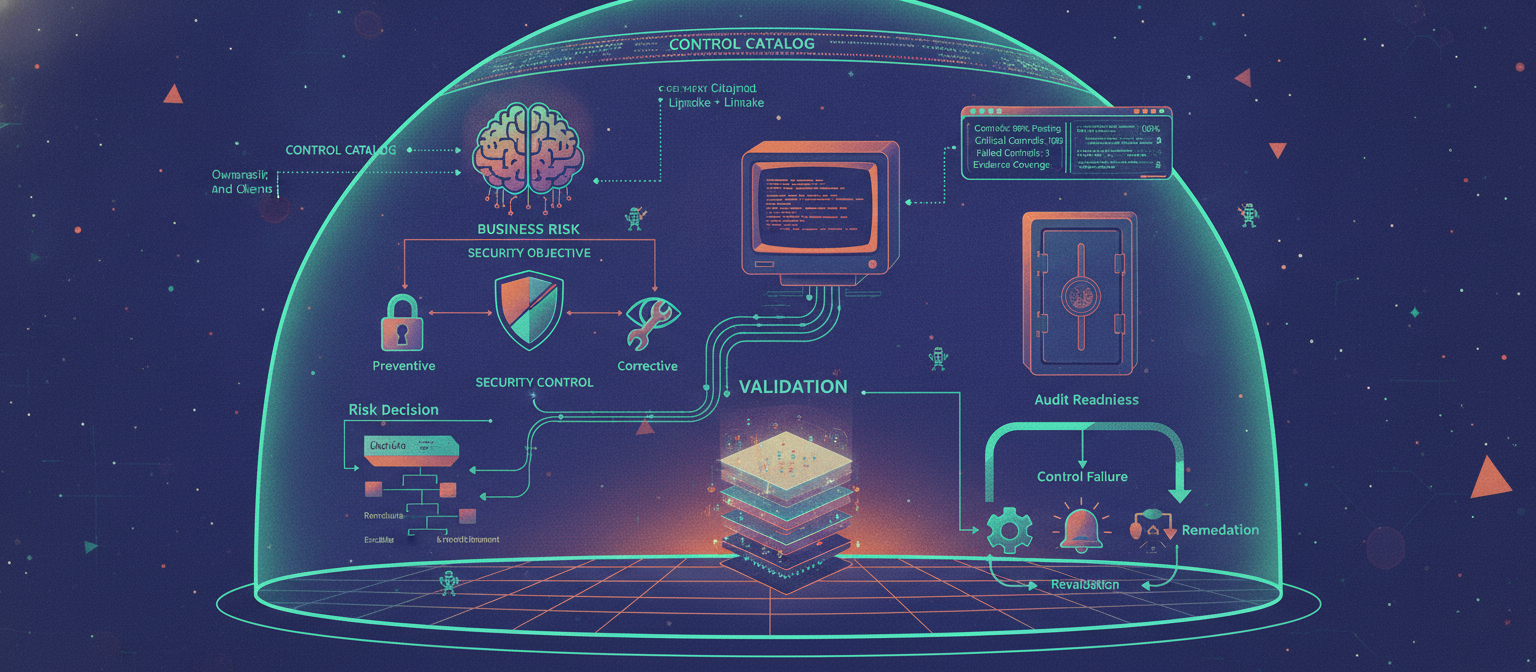
94.66 Final Security Assurance Model
The complete model can be summarized as:
                    BUSINESS RISK
                         |
                         v
                   SECURITY OBJECTIVE
                         |
                         v
                   SECURITY CONTROL
                         |
             +-----------+-----------+
             |           |           |
             v           v           v
         Preventive   Detective   Corrective
             |           |           |
             +-----------+-----------+
                         |
                         v
                     VALIDATION
                         |
                         v
                      EVIDENCE
                         |
                         v
                     ASSURANCE
                         |
             +-----------+-----------+
             |                       |
             v                       v
       Risk Decision            Audit Readiness
             |
             v
      Continuous Monitoring
             |
             v
        Control Failure
             |
             v
          Remediation
             |
             v
         Revalidation
Conclusion
Security assurance is the mechanism that turns security architecture from a collection of intentions into measurable, testable, and accountable protection.
For AI platforms, assurance must extend across:
Identity
Infrastructure
Applications
Data
Models
RAG
Agents
Tools
Supply chains
AI safety
Monitoring
Incident response
Recovery
The strongest architecture does not wait for an audit to ask whether security controls work.
It continuously produces evidence showing:
What the control is
Why it exists
Who owns it
How it is enforced
Whether it is functioning
When it was last tested
What evidence proves the result
What happens when it fails
A mature AI platform should be continuously auditable because its security controls are continuously implemented, validated, monitored, evidenced, and improved.
That is the foundation of continuous security assurance.


Comments
Post a Comment