96.1 Introduction
A secure AI platform cannot remain secure simply because security controls were implemented once.
AI platforms continuously change:
models are updated,
prompts evolve,
datasets change,
dependencies are upgraded,
infrastructure scales,
new tools are connected,
new tenants are onboarded,
APIs are added,
workflows become more autonomous,
and attackers continuously adapt.
Therefore, security must be treated as a continuous engineering capability rather than a one-time implementation task.
This chapter establishes a framework for measuring and improving the security maturity of an AI platform.
The objective is to answer five fundamental questions:
What security controls exist?
Are those controls actually working?
How consistently are they working?
What risks remain?
How should security investments be prioritized?
96.2 Security Maturity Model
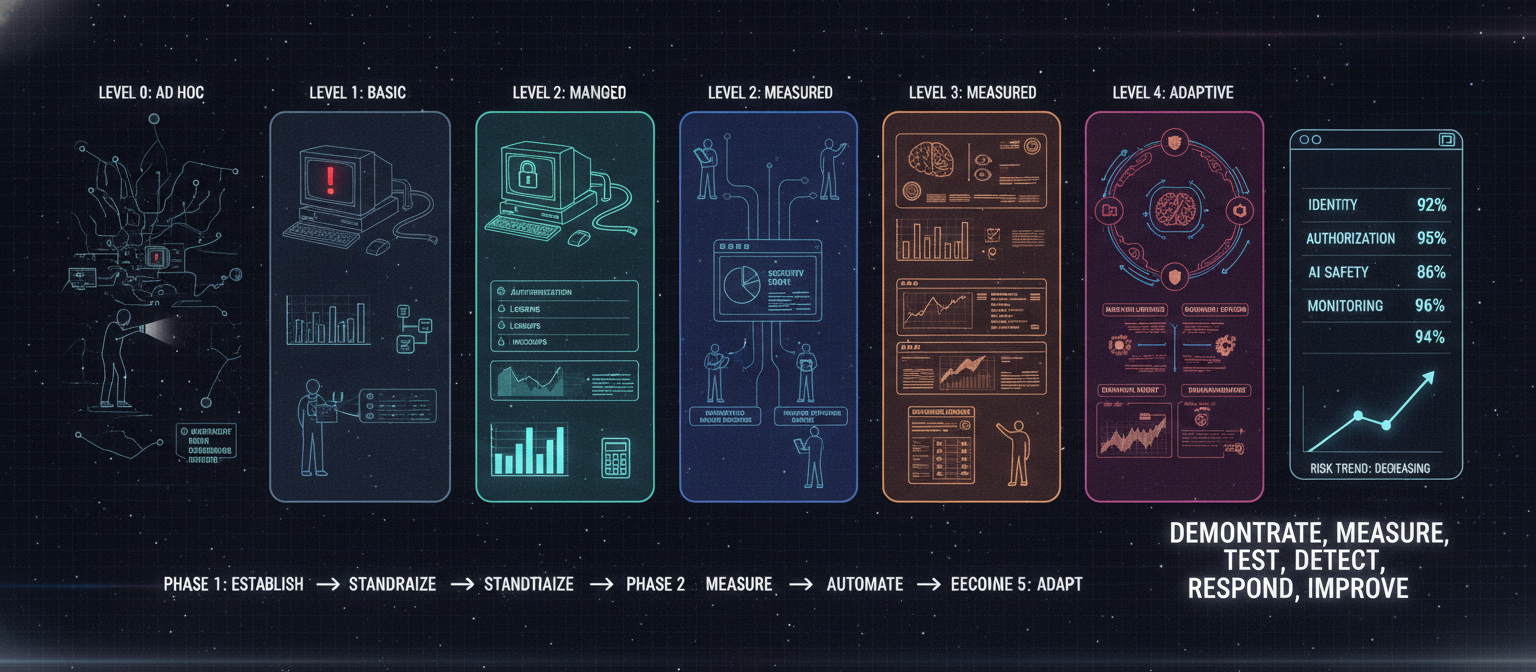
A practical AI security maturity model can use five levels.
Level 0 — Ad Hoc
Security activities are mostly reactive.
Characteristics:
undocumented controls,
manual investigation,
inconsistent access control,
limited monitoring,
security knowledge concentrated in individuals,
no formal risk measurement.
This environment is highly dependent on human vigilance.
Level 1 — Basic
Fundamental security controls exist.
Examples:
However, controls may not be consistently monitored.
Level 2 — Managed
Security processes become repeatable.
Examples:
Security becomes an organizational process rather than an individual responsibility.
Level 3 — Measured
Security effectiveness is measured quantitatively.
Examples:
mean time to detect,
mean time to contain,
patch compliance,
failed authorization rate,
suspicious AI-tool-call rate,
tenant-isolation test results,
model safety regression rate.
Security decisions become evidence-driven.
Level 4 — Adaptive
Security systems continuously learn from operational evidence.
Examples:
automated anomaly detection,
continuous control validation,
adaptive risk scoring,
automated policy testing,
continuous attack-surface discovery,
automated security regression testing.
The platform can detect changes in its own security posture.
96.3 Security Control Inventory
Every important security control should have an identifiable owner and measurable objective.
A control inventory may include:
| Control | Purpose | Owner | Frequency | Evidence |
|---|
| MFA | Protect accounts | Identity Team | Continuous | Authentication logs |
| Authorization | Prevent unauthorized actions | Platform Team | Continuous | Access decisions |
| Encryption | Protect sensitive data | Security Team | Continuous | Configuration evidence |
| Dependency scanning | Detect vulnerable packages | DevSecOps | Per build | Scan reports |
| Model evaluation | Detect AI regressions | AI Team | Per release | Evaluation results |
| Tenant isolation | Prevent cross-tenant access | Platform Team | Continuous/tested | Isolation tests |
| Backup verification | Ensure recoverability | SRE | Scheduled | Restore tests |
| Audit logging | Preserve evidence | Security Team | Continuous | Log records |
The inventory should answer:
“What control protects this asset or risk?”
96.4 Control Effectiveness
A control existing in documentation does not necessarily mean that it is effective.
Consider authentication.
A platform may claim:
MFA is enabled.
But useful security questions are:
Is MFA enforced for all privileged users?
Can users bypass it?
Are recovery flows protected?
Are suspicious login events detected?
Are inactive accounts removed?
Are service accounts handled securely?
Therefore, control effectiveness should be evaluated using evidence.
A useful conceptual model is:
Control Effectiveness = Design Quality × Implementation Coverage × Operational Reliability
If any component is weak, the overall control becomes weak.
96.5 Design Effectiveness
Design effectiveness asks:
Is the control capable of addressing the intended risk?
For example, if the risk is unauthorized administrative access, simply recording login events may not sufficiently mitigate that risk.
A stronger control design could include:
phishing-resistant authentication,
role-based authorization,
privileged-access restrictions,
session monitoring,
approval workflows,
administrative audit logs.
96.6 Implementation Coverage
Implementation coverage measures how broadly a control is actually deployed.
For example:
Suppose an organization has:
Then:
MFA Coverage = 95%
The remaining 5% may represent the most important accounts if they include privileged users.
Therefore, aggregate coverage should not hide high-risk exceptions.
96.7 Operational Reliability
A security control can be correctly designed and widely deployed but still fail operationally.
Examples:
logging pipeline stops,
detection rule becomes disabled,
authorization service experiences failures,
backup jobs silently fail,
security scanners stop running.
Operational reliability should therefore measure whether controls continue functioning.
Useful measurements include:
96.8 AI-Specific Security Metrics
Traditional application-security metrics are insufficient for AI systems.
AI platforms should additionally measure:
Model security
Agent security
unauthorized tool-call rate,
approval bypass rate,
excessive-permission events,
suspicious planning patterns,
tool execution failures.
Data security
sensitive-data exposure rate,
unauthorized retrieval rate,
cross-tenant retrieval incidents,
data-classification violations,
retention-policy violations.
Infrastructure security
vulnerable workload count,
exposed service count,
container security findings,
secret exposure events,
network-policy violations.
96.9 Key Performance Indicators
Security KPIs measure whether security operations are performing effectively.
Examples include:
Mean Time to Detect
How quickly suspicious activity is detected.
Mean Time to Respond
How quickly a security team begins response.
Mean Time to Contain
How quickly an incident is prevented from spreading.
Patch Compliance
Percentage of systems patched within the required timeframe.
Critical Vulnerability Exposure
Number of critical vulnerabilities remaining beyond their remediation SLA.
Security Test Coverage
Percentage of important platform components covered by automated security testing.
96.10 Key Risk Indicators
KPIs measure performance.
KRIs measure risk.
Examples:
number of privileged accounts,
number of externally exposed services,
number of critical vulnerabilities,
number of high-risk AI tools,
percentage of models without recent evaluation,
percentage of datasets without provenance,
percentage of tenants missing isolation tests,
number of unresolved security exceptions.
A KRI should have:
a defined threshold,
an owner,
a response procedure,
a review frequency.
96.11 Risk Scoring
Risk should not be reduced to vulnerability counts.
A useful conceptual model is:
Risk = Likelihood × Impact
For AI systems, impact may include:
confidentiality impact,
integrity impact,
availability impact,
financial impact,
regulatory impact,
safety impact,
reputational impact.
Likelihood can consider:
exploitability,
exposure,
attacker capability,
existing controls,
attack frequency,
system accessibility.
96.12 Example Risk Matrix
| Likelihood | Impact | Risk |
|---|
| Low | Low | Low |
| Low | High | Medium |
| Medium | Medium | Medium |
| High | Medium | High |
| High | High | Critical |
This matrix should be adapted to the organization's actual threat environment.
96.13 AI Risk Prioritization
Suppose a platform discovers three findings:
Finding A
A low-risk UI issue affecting a small number of users.
Finding B
A vulnerability in an internal development tool.
Finding C
A tenant-isolation defect capable of exposing another customer's data.
Although Finding A may be easier to fix, Finding C deserves significantly higher priority.
Security teams should prioritize based on risk reduction, not merely the number of tickets closed.
96.14 Security Debt
Security debt occurs when known security weaknesses are postponed.
Examples:
outdated dependencies,
missing tests,
undocumented permissions,
weak logging,
unreviewed service accounts,
temporary firewall exceptions,
legacy APIs.
Security debt should be tracked similarly to technical debt.
A useful record includes:
issue,
risk,
owner,
reason for acceptance,
expiration date,
remediation plan.
96.15 Security Exceptions
Security exceptions are sometimes necessary.
For example, a legacy system may temporarily require a configuration that violates the preferred security baseline.
Exceptions should never become permanent undocumented bypasses.
Every exception should include:
business justification,
affected system,
risk assessment,
compensating controls,
approving authority,
expiration date,
remediation plan.
96.16 Continuous Control Validation
Security controls should be tested continuously.
Examples:
Authentication
Test whether privileged accounts require strong authentication.
Authorization
Test whether users can access only permitted resources.
Storage
Test whether object-storage policies prevent unauthorized access.
Database
Test tenant boundaries.
AI retrieval
Test whether retrieval respects authorization.
Agent tools
Test whether unauthorized tool calls are rejected.
Logging
Test whether security events generate appropriate audit records.
This turns security from a documentation exercise into an engineering verification process.
96.17 Security Regression Testing
Every significant platform change should be evaluated for security regressions.
A model upgrade, for example, should not only be tested for quality.
It should also be tested for:
safety,
privacy,
prompt-injection resistance,
tool-use boundaries,
output-policy compliance,
tenant isolation.
A deployment should be blocked when critical security regressions exceed predefined thresholds.
96.18 Security Gates
A production deployment can use security gates such as:
Gate 1 — Dependency Security
No unresolved critical dependency vulnerability without approved exception.
Gate 2 — Infrastructure Security
Required infrastructure controls must be active.
Gate 3 — AI Evaluation
Required safety and security evaluations must pass.
Gate 4 — Authorization
Security-critical access-control tests must pass.
Gate 5 — Observability
Required logs, metrics, and alerts must be operational.
Gate 6 — Recovery
Critical services must have verified recovery mechanisms.
96.19 Security Scorecards
A security scorecard provides an executive view of platform security.
Example:
| Category | Score |
|---|
| Identity | 92% |
| Authorization | 95% |
| Data Protection | 88% |
| AI Safety | 86% |
| Infrastructure | 91% |
| Monitoring | 94% |
| Incident Response | 83% |
| Recovery | 90% |
The score should not become a simplistic “security grade.”
Its purpose is to identify areas requiring attention.
96.20 Avoiding Misleading Security Scores
A single number can hide important weaknesses.
For example:
A platform could achieve an overall score of 95% while having one serious tenant-isolation defect.
Therefore:
Critical security risks should remain visible even when aggregate scores are high.
Security dashboards should highlight:
critical risks,
high-risk exceptions,
deteriorating trends,
control failures,
unresolved incidents.
96.21 Security Trend Analysis
Security should be evaluated over time.
Useful trend questions include:
Are critical vulnerabilities increasing?
Is detection becoming faster?
Are security regressions declining?
Are access violations increasing?
Are exceptions accumulating?
Is AI safety performance improving?
Are recovery tests succeeding consistently?
Trend analysis is often more useful than a single snapshot.
96.22 Leading and Lagging Indicators
Leading indicators
These predict future security performance.
Examples:
security test coverage,
employee training completion,
dependency update compliance,
threat-model coverage,
architecture review completion.
Lagging indicators
These measure events that already occurred.
Examples:
successful attacks,
data exposures,
incidents,
compromised accounts,
service outages.
A mature security program uses both.
96.23 Executive Security Reporting
Executives generally need answers to five questions:
What is our most important current risk?
Is risk increasing or decreasing?
Are our controls working?
What incidents occurred?
What investment or decision is required?
A good executive report should avoid overwhelming readers with raw technical data.
Instead, translate technical findings into business consequences.
96.24 Security Investment Decisions
Security spending should be connected to risk reduction.
Examples:
Investment:
Improve tenant-isolation architecture.
Expected result:
Reduce probability and impact of cross-tenant data exposure.
Investment:
Add automated AI security regression testing.
Expected result:
Detect model and prompt-policy regressions before production.
Investment:
Improve centralized logging.
Expected result:
Reduce detection and investigation time.
This makes security investment measurable.
96.25 Cost of Risk
Security decisions should consider potential loss.
Potential impact can include:
The objective is not to eliminate every theoretical risk.
The objective is to reduce unacceptable risks to an appropriate level.
96.26 Risk Acceptance
Some risks cannot immediately be eliminated.
Formal risk acceptance should identify:
exact risk,
affected assets,
probability,
impact,
existing controls,
compensating controls,
acceptance authority,
expiration date.
Risk acceptance should be explicit rather than accidental.
96.27 Security Architecture Review Cycle
A mature AI platform should periodically review its architecture.
A review may include:
asset inventory,
threat-model update,
attack-surface review,
control assessment,
AI-specific evaluation,
identity review,
data-flow review,
third-party dependency review,
incident-history review,
remediation planning.
The architecture should evolve as the platform evolves.
96.28 Continuous Improvement Loop
A practical security improvement cycle is:
Measure → Analyze → Prioritize → Remediate → Validate → Monitor → Repeat
Measure
Collect security evidence.
Analyze
Determine what the evidence means.
Prioritize
Identify the highest-value risks.
Remediate
Implement improvements.
Validate
Verify that the improvement works.
Monitor
Ensure the control remains effective.
Repeat
Continue the cycle indefinitely.
96.29 Security Architecture Maturity Dashboard
A mature dashboard can contain:
Risk
critical risks,
high risks,
risk trend,
accepted risks.
Vulnerabilities
AI Security
Identity
Data
sensitive-data events,
unauthorized retrieval,
retention violations.
Operations
MTTD,
MTTR,
incident count,
unresolved alerts.
Resilience
96.30 Security Maturity Roadmap
A platform can progressively improve through the following roadmap.
Phase 1 — Establish
Implement:
identity,
authorization,
encryption,
logging,
backups,
vulnerability scanning.
Phase 2 — Standardize
Introduce:
security policies,
control inventory,
threat modeling,
security testing,
incident response.
Phase 3 — Measure
Introduce:
Phase 4 — Automate
Introduce:
Phase 5 — Adapt
Introduce:
continuous threat modeling,
adaptive risk prioritization,
automated control verification,
security-aware AI operations.
96.31 Definition of Done for Security Maturity
A mature AI platform should be able to demonstrate:
assets are inventoried,
risks are documented,
controls have owners,
controls are measurable,
critical controls are continuously validated,
security metrics are monitored,
exceptions are time-limited,
incidents are measured,
security regressions are tested,
AI-specific risks are evaluated,
executive decisions are risk-informed,
improvements are continuously tracked.
96.32 Practical Checklist
Governance
Identity
AI
Data
Infrastructure
Operations
Resilience
96.33 Final Architecture Principle
The most important principle of this chapter is:
Security maturity is not the number of security controls deployed; it is the organization's ability to continuously demonstrate that those controls reduce real risk.
For AI platforms, this principle is especially important because the system is dynamic.
A model can change.
A prompt can change.
A dataset can change.
A tool can change.
A dependency can change.
A workflow can change.
A user can change.
An attacker can change.
Therefore, security architecture must continuously measure, validate, adapt, and improve.
The mature AI platform is not one that claims to be secure.
It is one that can continuously demonstrate, measure, test, detect, respond, and improve its security posture.
96.34 Conclusion
Security metrics provide the bridge between technical controls and strategic security decisions.
A strong AI security program therefore combines:
measurable controls,
meaningful KPIs,
risk-oriented KRIs,
AI-specific security metrics,
continuous validation,
security regression testing,
formal risk acceptance,
executive reporting,
security investment analysis,
and continuous improvement.
This creates a security program capable of evolving alongside the AI platform rather than falling behind it.
Chapter 96 establishes the maturity and measurement layer required to continuously improve the security architecture developed throughout the previous chapters.



Comments
Post a Comment